Celebrate

Kool and the Gang put out a song in 1980 titled, Celebration. It’s the ultimate Raise Your Beer song. It’s the ultimate Look What Amazing Thing You Did song. And it should be the song we sing when we succeed, even with the little things … especially with the little things.

Did you get out of bed this morning? Celebrate it.
Did you get dressed this morning? Celebrate it.
Did you make it to work or school this morning? Celebrate it.
Did you make someone laugh today? Celebrate it.
Did you write a song today? Celebrate it.
Did you write a story today? Celebrate it.
Did you write a paragraph or even just one line? Celebrate it.
Did you draw or paint a picture? Celebrate it.
Did you graduate from school—any school? Celebrate it.
Did you get a new job? Celebrate it.
Did you do something new? Celebrate it.
Did you do something you were afraid to do? Oh, celebrate it.
Did you do something you thought you couldn’t do? Celebrate it.
Did you do something you’re good at? Celebrate that, too.
Did you cry because something made you sad? Celebrate the emotion.
Did you help someone today? Celebrate kindness.
Did you stop holding a grudge today? Celebrate maturity.
Did you do a workout for the first time or the thousandth time today? Celebrate progress.
Did you do something for yourself today? Celebrate you.
Did you not let something bother you that usually does? Celebrate tolerance.
Did you dance for the first time today? Celebrate it.
Did you arrive to work on time today? Celebrate timeliness.
Did you realize you’re an amazing person? Celebrate the awesomeness of you.
Did you fall in love? Celebrate that with all your heart.
Did you stay in love for a week, month, year, twenty-five years, fifty years, more? Celebrate endurance … and patience.
Did you learn something new today? Celebrate education.
Did you say goodbye to something toxic? Celebrate renewal.
Did you say goodbye to a loved one who is no longer here? Celebrate their life.

There are so many things we can celebrate every single day, but we’re too focused on bad things, on failures, on the things that bring us down. We’re too focused on not being good enough for a person, for a group, for a job … for ourselves. Life is full of small successes, things we pay little attention to, but things that matter more than we tend to believe.

Celebrate all the small things (did you read that as if you were singing a Blink 182 song?). Those small things so often lead to bigger successes. We should make celebrating these things a part of our daily lives. I’d celebrate that.

Until we meet again, my friends, be kind to one another.

A.J.

It’s Coming

Good morning. I’m really excited to announce the coming of Memento Mori Ink Magazine, presented by the duo of Crystal Lake Entertainment and Lisa Vasquez of Stitched Smile Publications.

What’s even more exciting is I get to participate in this with a new series about writing and what I know so far.

The first issue is slated for the end of August. Check out the cover art below.

I hope you will check it out in August.

Until we meet again my friends, be kind to one another.

A.J.

Back In The Saddle

A couple years ago, I quit the business of publishing for a while. I even wrote a letter and posted it here and on social media. I was frustrated with the way the publishing world treated people, the way many authors treated other authors, with the amount of plagiarism I saw in this business, with the amount of … I don’t know … hate I saw in the writing community. 

When I left everything behind, I went through a period of mourning. You see, I loved writing. I loved the act of telling a story. I loved sharing those stories with the world. That period of time was slightly depressing, almost like a lesser version of Runner’s Depression. In case you don’t know what that is, let me try and explain it in as few words as I can. This happens to people who run, who love to run and all of a sudden, they can’t. They were born to run. They lived for that alive feeling they had when they were finished running. It’s an exhilaration that is similar to an adrenaline rush. Not being able to run can sometimes send a runner into a depression that could last a long time or just a little while. It’s as if part of them has died. It’s a mourning period.

After a few weeks, I started writing again without the pressures of wanting to put out a story, without feeling like the story needed to be amazing or I was wasting my time. I wrote a lot of bad stories during that time period. They were pieces that had been inside of me but I refused to write because I knew they would be crap and ain’t nobody got time for that. 

I also wrote some really good pieces, some I think will end up getting published at some point. 

Though I was writing, I can honestly say, I wasn’t really happy or content with what I was doing. I had been part of the writing community for over twenty years and by leaving it, I also left part of me behind. Hence, the mourning.

A few months after leaving publishing, I was convinced by two friends to give it another go. So, I did. I put together a collection of stories, titled A Color of Sorrows and began querying publishers. Not long after submitting to this one particular publisher, they responded saying they loved the collection. Yes. Awesome. I was excited. A contract was worked out. They did an analysis of my writing and deemed my style was similar to this exceptional author of horror whose initials just happen to be S.K., who also just happened to be my favorite author. 

Things were going well. Discussions were had and I did a lot of work on my end. About six months before the book was to be released, I was sent a formatted copy of the book to look over. It looked great, but there was one problem. I still hadn’t been assigned an editor. I had received edits, but those had been done by software, not a person. I had rejected half of them because they made no sense within the context of the stories. A month of so later, I enquired about an editor, more specifically, when was I going to work with one. 

I was told they don’t provide editors unless the writer pays for it. Umm … no. Up until right then, I had been excited. The discussions after that were not as cordial as they had been. I told them I expected an editor and that editing the stories was part of the process and the publisher should be the one paying for the editor. They didn’t see it that way and my excitement went from on fire to ice, ice cold. 

My enthusiasm for getting back into the publishing world tanked. You see, this was one of the things that made me want to get out of the business, poor treatment by publishers. 

Still, I was under contract and I didn’t want an unedited book to be released to the world. I asked my editor to go over it, even though she had done so before I submitted the collection. I wanted one more pass. She found two things that needed correcting, one of which was a change I had made because of the software suggestions. 

They released the book in May of 2023. I promoted it … Just. Once.

You see, the very first publisher I worked with after getting up and dusting myself off, didn’t do things the right way. 

And just like that, the experience was soured for me. To say I was frustrated and aggravated was an understatement. 

I’ve released two books since then, but I have to be honest, my heart wasn’t into promoting them and I did a bad job of letting people know about them. I’ll talk about those later. There are other things to get to for now. 

Not only did I lose enthusiasm for publishing, I neglected my website. I mean, seriously neglected it. Don’t believe me? Go look at the last post. It was in February, it’s June now. I also shut down my Patreon page. I mean, really, I just kinda said screw it.

Now for some hard truths I had to tell myself. I wrote a book called Motivational Shit You Didn’t Ask For. Great title, right? I think the title will sell the book all by itself. The book isn’t huge and most of the chapters are under two thousand words. Yeah, it’s short. Something I mention in the book multiple times is making excuses. We humans make excuses to not do things. We might say we want to do them, but if we don’t then do we really want to? Nah, I didn’t think so. 

I sat back recently and thought about why I didn’t promote my work. Sure, maybe I had some valid points with the publisher issue, since it felt like I did all the work except formatting (which I could have done) and cover layout (which I could have done, also). However, it was MY book, those were MY stories. Okay, let’s just say I had valid reasons instead of excuses for not promoting The Color of Sorrows. What about Six Strands To Lost Sanity? What about Human Touch? What about two books I believe are really good? I mean, seriously, what is the reason behind not promoting them? I have no valid reason. Only excuses. 

I have neglected a lot since first walking away, then coming back, then making excuses. That passion and drive I had when I first started out have been gone for almost three full years now. I’m trying really hard to find it again. So what have I done about it? I started mentoring again, which is going well. I’ve written a bunch of stories. I’ve joined the staff over at Memento Mori Ink, where you can read the first article at the end of August. More on that later. I’ve started submitting stories to publications again. 

And … I’m posting here. I recently realized I don’t have to post long pieces like this one. I can simply post something like: It’s coming, and post the cover of a book. And I can post as many times as I want. Once a day, once a week, 18 times a day. It doesn’t matter. You’re either going to stick around or not. If you do, thank you. Also, thank you for sticking around while I’ve been gone.

Until we meet again, my friends, be kind to one another.

A.J.

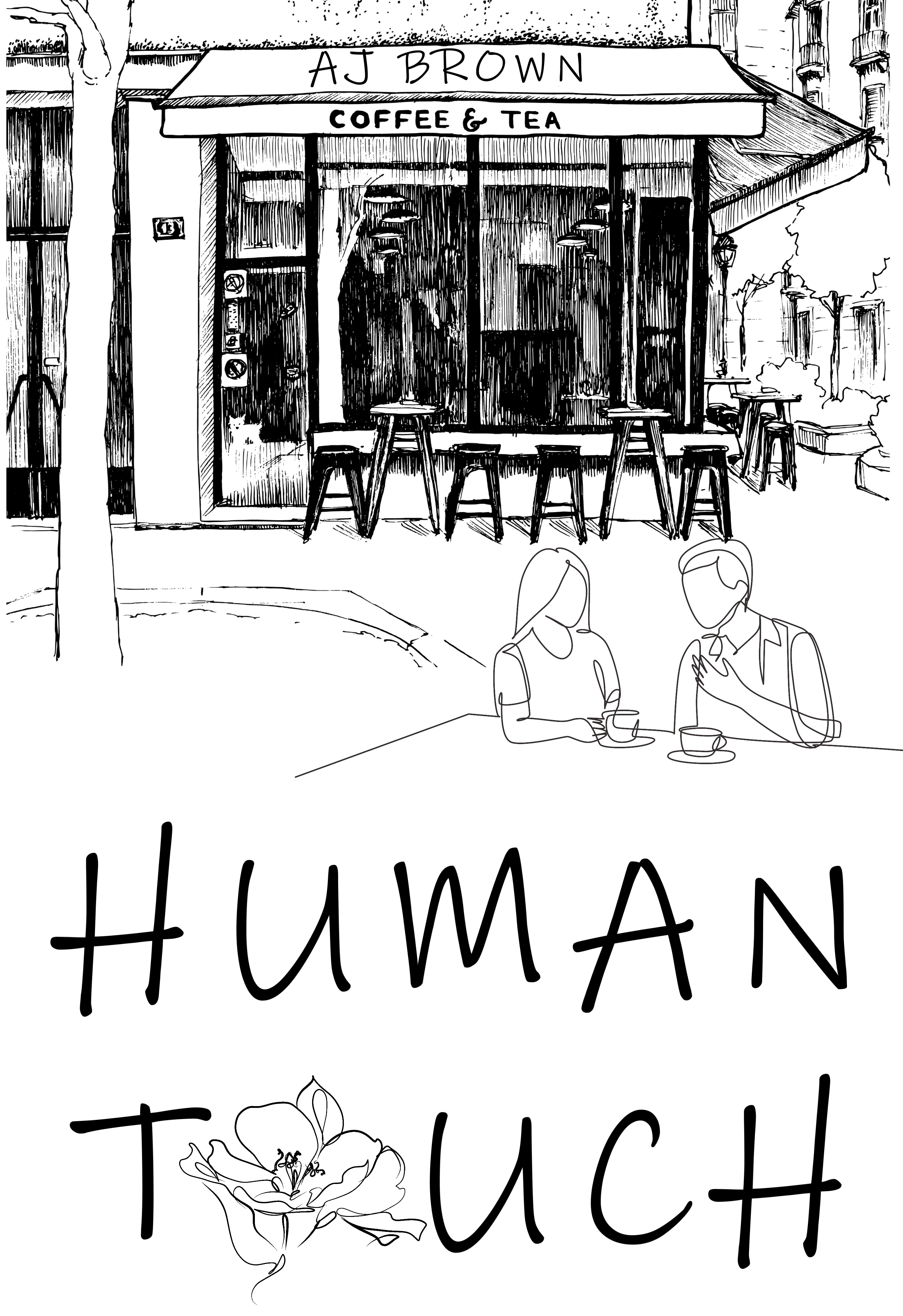
Human Touch (Cover Reveal)

A couple years ago I was in a rut with writing. A couple? Seriously, A.J.? It’s been five years. Back in 2019, I was in a rut with writing. My editor, Larissa Bennett, challenged me, literally, to write a story I didn’t want to write. I told her about an idea I had but was hesitant to write because it was a ~GASP~ love story. 

“You should write it,” she said. 

I said, “I don’t want to,” like a petulant child about to pitch a fit.

After a bit of back and forth, I finally said, “Okay,” but it was more like one of those moments where your parents told you to apologize for saying something rude to your sibling. You apologize begrudgingly but really don’t mean it.

At some point I sat down and wrote the first couple lines to the story: 

The coffee shop was quiet. The few people talking did so in whispers as if they were in a library and the librarian was an ancient old biddy with blue hair, triangle lensed glasses and a mallet behind her back. Talk too loudly and get a smack to the head you might not wake up from. Charlie liked it that way. 

It wasn’t like the Starbucks a few blocks over that garnered most of the public who were willing to spend their money on their favorite caffeinated drinks. There weren’t a bunch of college students with their laptops and schoolbooks, and there were no groups of more than four people who liked to talk and laugh loud enough to disturb those reading books (or possibly doing schoolwork on one of those laptops). No, this was a little mom and pop place not owned by a mom or a pop, but a woman in her mid-thirties who married, divorced, and had no children that he was aware of. She spent her mornings and most afternoons behind the counter of the Coffee Dee-Light serving the regulars, like Charlie, with a smile and a bottom-line price that should have competed with Starbucks, but somehow didn’t. 

I liked the first few paragraphs and decided to write more. Though I would walk away from the story and come back to it later, the story of Charlie Massingale and Dani Overton never left my mind. I finished the story close to the end of 2020 after a few starts and stops. 

I had no intentions of releasing this book. It was going to be my dirty little secret. I, author of dark, emotional stories, wrote a love story. No, no one could find out about this. But I really like the characters, even Dee, who owns the little coffee shop they meet in.

So, here we are, you and I and this book, this story, Human Touch. It’s a love story. It’s Clean Romance. It’s completely different from anything I’ve written, simply because I intended for the two main characters to fall in love. 

Why post about this now? Well, because I’m releasing it soon and I need to talk about it. I want you to read it. If you don’t know about it, well, you can’t read it.

With that said, below are both the cover, which has a Take On Me by A-Ha vibe and the synopsis.

Charlie Massingale has mastered the art of fading into the background. Haunted by the tragic loss of his wife, he seeks solace in a quiet South Carolina town, hoping to escape his past and bury his pain. For years, he succeeds in his quest for anonymity.

Everything changes when a young woman recognizes him at a coffee shop and strikes up a conversation. Plagued by his own guilt and desires to stay missing from the world he once thrived in, he denies their connection, leaving Dani yearning for more.

Determined to unravel the enigma that is Charlie Massingale, Dani reaches out to her beloved author, hoping to connect with a man no one has heard from in nine years. To her surprise, Charlie responds, sparking a fragile bond that neither can ignore. As their correspondence deepens, Charlie finds himself captivated by Dani, awakening emotions long dormant within him.

Caught between the past and the present, Charlie faces a crossroads. Will he allow himself to embrace the possibility of love once again? Can he overcome the weight of his past and accept the warmth of the Human Touch? With their lives intertwined, Charlie and Dani must navigate the complexities of age, and the lingering shadows of the past that threaten to tear them apart.

So, what do you think? Interested? Let me know in the comments below.

Until we meet again, be kind to one another.

A.J.

The Concepts: Chuckie

On June 29, 1993, I wrote my first short story. If you were a member of my Patreon page, One Step Forward, then you know that story is called, Chuckie, and was based on a nightmare I had multiple times. You also know how the story came about. But here, at Type AJ Negative and this thing I call The Concepts, you probably don’t know anything about that. Today, I give you the story—the full story that has never appeared anywhere outside of Patreon.

I was twenty-two in June of 1993. On the day—early morning, really—I wrote Chuckie, it was eight days from my birthday. Before I get into that particular day (which is really short, to be honest), I want to tell you about what led to it.

A few weeks earlier, maybe longer, I can’t really remember, I began having nightmares. Time has a way of running together. Seconds, minutes, hours, days, weeks, months, years … decades … they all run together at some point. Things you remember completely when they first happened become dull around the edges over time. Details get lost or exaggerated upon, and as a writer, my job is to exaggerate the truths while telling all sorts of lies. But those nightmares. I remember them quite well.

I was in a house, but I wasn’t me. I was a kid named Chuckie Benson. He had blond hair and blue eyes and was bigger than my lanky 150 pounds at the time—oh and I had dark black hair. These days, it’s more on the gray side than black. The doorbell rings, which was definitely not a reality in the house I grew up in. No, there was no doorbell, only knuckles on wood. In the dream Chuckie—me—opens the door and there stands Alex, who looked like a burned up weenie with a sinister grin that was mostly teeth, and well, not really a grin. Alex didn’t have a last name in the dream or even in the original version of the story I wrote. When I rewrote the story, I gave him the last name of Morrison, since I was a Doors fan. 

I always ran through the house trying to get away from Alex only to run back into him. He would grab me by the throat in his still smoldering hands and choke me. At that point, I woke, not screaming or shooting up in my bed the way you see in movies. My eyes just snapped open, and I was awake, my heart crashing hard in my chest and staring at the darkness of my room. 

I had this dream quite a few times, almost nightly for a while there. This was bad for a couple of reasons, the biggest of these being sleep. I already struggle with sleep—had since I was about fourteen—and with this recurring nightmare, sleep became nonexistent. 

Then one day someone asked me, “Hey, are you okay? You look tired?”

“I haven’t been sleeping,” was my answer.

From there a conversation was had based on my lack of sleep. I mentioned the nightmares and how terrifying they were for me.

“Why don’t you write your nightmare down the next time you have it?”

“Why?”

“That might make it go away.”

That’s hoodoo magic nonsense I believed. I think the individual who told me that caught my thoughts on my face before I could even say anything.

For the next few paragraphs, I will relay to you what was relayed to me, in as much detail as I can remember. These are the words I was told:

There was once a writer—a very good writer—who suffered from having nightmares, specifically, one nightmare over and over and over. He got to where he couldn’t sleep, couldn’t function, and couldn’t write. He went to his doctor and told him what was going on.

The doctor said, “The next time you have the dream, get up and write it down. Writing it down will make the nightmare go away.

The writer, desperate for some relief and sleep thought it couldn’t hurt.

That night he had the nightmare. When he woke, he got up and spent the next three hours writing the nightmare down. When he went back to bed, he didn’t have the nightmare, but the next night, lo and behold, the nightmare was back.

The writer went back to his doctor and took what he wrote with him. He explained to the doctor that he had done what he was told to do.

“Let me see what you wrote,” the doctor said.

The author handed him the papers. The doctor spent the next little while reading it, then shook his head. “I see what the problem is,” he said.

“What?” the writer asked.

“What you wrote is the nightmare.”

“That’s what you said to write.”

“Yes, but you’re a writer. All you did was write the basic details of the nightmare. You didn’t write the story the nightmare is trying to tell you. Next time you have the nightmare, write the story it is telling you.”

A couple nights later, he had the nightmare again. He got out of bed and spent the next three days writing the story of the nightmare. He never had the nightmare again.

That was the story told to me. Of course, with a story like that, I, like anyone who heard it would do, asked, “Who was the writer?”

“Robert Louis Stevenson.”

“Really?”

“And the story was The Strange Case of Dr. Jekyll and Mr. Hyde.”

Now, as with any story told like this, I was skeptical. Still, I was desperate for sleep. The next time I had the nightmare, which was the very next night, I got out of bed, pulled out a note pad—what people refer to as scratch pads now—and a pen. I spent the next couple of hours writing the bare bones story of Chuckie Benson and Alex Morrison. 

After I was done, I laid back down. I didn’t fall back asleep that night. However, I never had the nightmare again.

Here’s my caveat for this Concept: I’ve never been able to substantiate the story told to me about the writer or the story. I mean, the story does exist, and the author was a real person. But I’ve found no record or truth of how the story came to be. It very well may be true. Or it very well may be something made up in the mind of someone playing shrink and offering a solution. 

Either way, it did work for me, and that’s what matters here. Oh, and the fact that writing that story springboarded me into writing, something I loathed up until then. Other than jokes and parody songs, I hated the very idea of constructing a story. In school, I did the bare minimum to get by with a D-. 

The story—true or false as it may be—of the supposed nightmare Robert Louis Stevenson had that led to The Strange Case of Dr. Jeckyll and Mr. Hyde, remedied my own nightmares and spurred a love for writing that has never passed, and here it is three decades later.

Until we meet again, my friends, be kind to one another.

A.J.

Just What’s Going On Here? 1/03/2023

One thing I want to do this year is promote my work more. I’ve done a poor job of it over the last few years. Sure, I post stories here, and occasionally, I post information about a book but those have been sporadic at best. That means information about new books, old books, reviews and goings on. That also means more posts, some of them that will simply read like this one with a title similar to this one. 

With that said, here is the first installment of Just What’s Going On Here.

1/03/2024-1: There are books coming. They are, in no particular order, 22, Human Touch, Unbroken Crayons, Motivational Sh*t You Didn’t Ask For, Her Cure, The One Left Behind, Susie Bantum’s Death and Simply Put. There’s also the 10th anniversary release of Cory’s Way

1/03/2024-2: I recently had a discussion with Lisa Vasquez about doing a collaboration similar to the one I did with another writer, M.F. Wahl, a few years ago, titled All We See is the End. You can find that little book here:

Lisa came up with a really cool storyline and I am currently researching for it. I’m excited. You should be, too. It’s going to be killer.

1/03/2024-3: I received a new review for The Forgetful Man’s Disease today. It’s pretty cool and I am proud of it. Here is the review:

This story is about an old man named Homer Grigsby who suffers from dementia and has flashbacks of his son’s death. He also sees ghosts of his old friends and refuses to leave his home in the Mill. The writing was exquisite, seamlessly weaving nostalgia, sadness, and a touch of horror. Homer Grigsby felt incredibly real, and portrayal of his struggles with dementia was both moving and authentic.

Wonderful Story!!

This was a real pick me up and will be appearing on the site with the other reviews. Also, if you want to pick up a copy of The Forgetful Man’s Disease, you can get the digital version here: 

If you would like a print copy, drop me a line at ajbrownstoryteller@gmail.com

1/03/2023-4: I finished my first story of 2024, a five thousand word piece called No Sin Goes Unpunished. The devil does his deed without making a deal with someone for their soul. It was a fun write.

Thanks for stopping by. That’s all for now. Feel free to drop me a comment below or reach out to me at the email above. I’d like to hear from y’all. 

Until we meet again my friends, be kind to one another.

A.J.

Why Believe?

For the last month or so I have been posting one word on social media almost every day, mostly in the mornings. That word? Believe. 

Why believe?

Before I answer that, let me give you some context. Three years ago my wife joined a fitness group. This group consisted of a few women around the world, but mostly in America. At one point, I think around December of the first year my wife was part of this group, they started talking about their word of the year, the word they would live by during the following 365 days. My wife’s word was Consistency. That’s a magnificent word. 

I decided to do the same thing. Like my wife, I went with the word Consistency. But it wasn’t my word. It was hers. Last year I chose Unstoppable. It felt like a good word, and it was inspired by the song of the same name by Sia. Great lyrics that should be exceptionally inspiring. But I think that was a cop out word. Sure, I used it at certain points through the year, but it wasn’t even remotely … consistent. 

Fast forward to around the middle of July. I didn’t know it at the time, but I began experiencing what I fully believe was depression. Having never dealt with that in my life, I didn’t recognize it. Sure, I know people who have depression and some of it is crippling. But I—me, personally—have never experienced the feeling. 

Not knowing what it was, but knowing I was in some weird funky mood, I said nothing to anyone about it. ‘It will pass’ is what I told myself. Well, it didn’t, at least not right away. It lingered until mid to late-September … and I didn’t say anything about it. This caused some issues. I was easily angered. For the first time in my life, I felt real jealousy, and that being toward the person I love the most. At points, I withdrew from people—I wanted to be alone all the time. I already don’t sleep well, but during that time, I slept even less, which led to exhaustion and more crankiness. I would go out to the studio and hit the punching bag without gloves on—I split or bruised my knuckles a few times during this process.

At separate points, I was approached by two people, one young man, and one woman. They both asked the same question: ‘Are you okay?’ To the young man, I tried to play it off as just going through some stuff. ‘You want to talk about it?’ he asked. ‘Not really. I’ll be okay.’ To the woman, one who knows me so well because she is pretty much the female version of me, I said, ‘I don’t know.’ We were in New York at the time and she said, ‘Let’s go to the store.’ 

It was a brief trip there and back. During that twenty minutes or so, I finally said, ‘I think I’m depressed.’ It’s the only thing that makes sense. 

Saying that out loud gave me a starting point. It gave me something to think about, to act on. It gave me a way to move forward. Outside of that brief conversation, I texted with another friend about it. I didn’t talk to anyone else about it until one day after Thanksgiving when my daughter and I were sitting at the kitchen table discussing her and her boyfriend’s plans for the future. I brought it up because I feel like she was one of the ones I took it out on. That conversation helped me understand I had lost something during the entire process. 

I still don’t know what caused it, but I think it had been coming for a LONG time. What I do know, is at some point at the beginning of it, I stopped believing in myself. I’ve always been one to say, ‘I don’t need you to believe in me, because I believe in me.’ But at some point, I lost that. I had to find that. I had to get that back.

I started saying the word Believe to myself. That was it. No other words. No Believe in yourself, man. Believe in your abilities. Nothing like that. Just BELIEVE. BELIEVE. BELIEVE. 

BELIEVE.

That word means different things to different people. It might mean believe in God. It might mean believe that something will work out. It might mean believe that what happens is meant to happen. It might mean that you believe in someone else. It might mean you believe in yourself. 

The definition of believe is simple in this context: to have faith. And Faith in this context is complete trust or confidence in someone or something. Believing in yourself or having faith in yourself means you have complete trust or confidence in you and your abilities. That’s a powerful mindset. 

Two things before I go.

First, Believe. 

It’s my word going into 2024. I think it has been my word my entire life. When nobody else believed in me, I always did. Every morning now, even the bad ones, I say to myself, Believe. I leave it at that, and I take on the day. Some days are good. Some, not so good. But Believe. It’s what I have always told myself and something I am trying really hard to regain.

Second, depression doesn’t always appear as a frown or slouched shoulders or sadness. It’s often a smile, a joke, a positive appearance around people. It’s not always outwardly visible, but I can promise you it is always inwardly gray and cloudy. It’s a muddled mass of tar-like quicksand and you’re always sinking … and sometimes, you don’t realize it. 

If you need a word to live by, you don’t have to wait for a new year, choose Believe. Believe in yourself. Believe in what you bring to the table. Believe in your abilities. Just … Believe.

Until we meet again my friends, be kind to one another.

A.J.

In the Beginning There Was a Nightmare

On June 29, 1993, I wrote my first short story. If you were  a member of my Patreon page, One Step Forward, then you know that story is called, Chuckie and was based on a nightmare I had multiple times. You also know how the story came about. But here, at Type AJ Negative and this thing I call The Concepts, you probably don’t know anything about that.  Today, I give you the story—the full story that has never appeared anywhere outside of Patreon.

I was twenty-two in June of 1993. On the day—early morning, really—I wrote Chuckie, it was eight days from my birthday. Before I get into that particular day (which is really short, to be honest), I want to tell you about what led to it.

A few weeks earlier, maybe longer, I can’t really remember, I began having nightmares. Time has a way of running together. Seconds, minutes, hours, days, weeks, months, years … decades … they all run together at some point. Things you remember completely when they first happened become dull around the edges over time. Details get lost or exaggerated upon, and as a writer, my job is to exaggerate the truths while telling all sorts of lies. But those nightmares. I remember them quite well.

I was in a house, but I wasn’t me. I was a kid named Chuckie Benson. He had blond hair and blue eyes and was bigger than my lanky 150 pounds—oh and I had dark black hair. These days, it’s more on the gray side than black. The doorbell rang, which was definitely not a reality in the house I grew up in. No, there was no doorbell, only knuckles on wood. In the dream Chuckie—me—opened the door and there stood Alex, who looked like a burned up weenie with a sinister grin that was mostly teeth, and well, not really a grin. Alex didn’t have a last name in the dream or even in the original version of the story I wrote. When I rewrote the story, I gave him the last name of Morrison, since I was a Doors fan. 

I always ran  through the house trying to get away from Alex only to run into him somewhere else in the house over and over again. He would grab me by the throat in his still smoldering hands and choke me. At that point, I woke, not screaming or shooting up in my bed the way you see in movies. My eyes just snapped open and I was awake, my heart crashing hard in my chest and staring at the darkness of my room. 

I had this dream quite a few times, almost nightly for a while. This was bad for a couple of reasons, the biggest of these being sleep. I already struggled with sleep—had since I was about fourteen—and with this recurring nightmare, sleep became nonexistent. 

Then one day someone asked me, “Hey, are you okay? You look tired?”

“I haven’t been sleeping,” was my answer.

From there a conversation was had based on my lack of sleep. I mentioned the nightmares and how terrifying they were for me.

“Why don’t you write your nightmare down the next time you have it?”

“Why?”

“That might make it go away.”

That’s hoodoo magic nonsense I believed. I think the individual who told me that caught my thoughts on my face before I could even say anything.

For the next few paragraphs I will relay to you what was relayed to me, in as much detail as I can remember. These are the words I was told:

There was once a writer—a very good writer—who suffered from nightmares, specifically, one nightmare over and over and over. He got to where he couldn’t sleep, couldn’t function and couldn’t write. He went to his doctor and told him what was going on.

The doctor said, “The next time you have the dream, get up and write it down. Writing it down will make the nightmare go away.”

The writer, desperate for some relief and sleep thought it couldn’t hurt.

That night he had the nightmare. When he woke, he got up and spent the next three hours writing the nightmare down. When he went back to bed, he didn’t have the nightmare, but the next night, lo and behold, the nightmare was back.

The writer went back to his doctor and took what he wrote with him. He explained to the doctor he had done what he was told to do.

“Let me see what you wrote,” the doctor said.

The author handed him the papers. The doctor spent the next little while reading it, then shook his head. “I see what the problem is,” he said.

“What?” the writer asked.

“What you wrote is the nightmare.”

“That’s what you said to write.”

“Yes, but you’re a writer. All you did was write the basic details of the nightmare. You didn’t write the story the nightmare is telling you. Next time you have the nightmare, write the story it is telling you.”

A couple nights later, he had the nightmare again. He got out of bed and spent the next three days writing the story of the nightmare. He never had the nightmare again.

That was the story told to me. Of course, with a story like that, I did, like anyone who heard it I think would do, asked, “Who was the writer?”

“Robert Louis Stevenson.”

“Really?” In actuality, I was thinking all sorts of B.S. had been told to me.

“And the story was The Strange Case of Dr. Jekyll and Mr. Hyde.”

Now, as with any story told like this, I was skeptical. Still, I was desperate for sleep. The next time I had the nightmare, which was the very next night, I got out of bed, pulled out a note pad—what people refer to as scratch pads now—and a pen. I spent the next couple of hours writing the bare bones story of Chuckie Benson and Alex Morrison. 

After I was done, I laid back down. I didn’t fall back asleep that night. However, I never had the nightmare again.

Here’s my caveat for this Concept: I’ve never been able to substantiate the story told to me about the writer or the story. I mean, the story does exist and the author was a real person. But I’ve found no record or truth of how the story came to be. It very well may be true. Or it very well may be something made up in the mind of someone playing shrink and offering a solution. 

Either way, it did work for me, and that’s what matters here. That  story springboarded me into writing hundreds more, something I loathed up until then. Other than jokes and parody songs, I hated the very idea of constructing a story. In school, I did the bare minimum to get by with a D-. 

The story—true or false as it may be—of the supposed nightmare Robert Louis Stevenson had that led to The Strange Case of Dr. Jeckyll and Mr. Hyde, remedied my own nightmares and spurred a love for writing that has never passed, and here it is thirty-one years later.

Ally’s Story

Ally sat on the floor in the bathroom between the bathtub and the toilet. She had moved the trash can before sitting down, knocking it over in her hurry. Tissues lay scattered on the floor around it, along with a used tube of toothpaste and a couple of toilet paper rolls. Her mascara made black streaks down her cheeks from the tears that fell from her eyes. Her knees were pulled to her chest. She gripped the gun her father gave her before he died in both hands. It was heavy in her tired hands. 

If she would have stayed calm when Barry showed up, she would have grabbed her cell phone. She didn’t and it sat on the kitchen table where she had been sitting when the first knock came. The knock didn’t scare her, even though it was heavy handed and sounded like thunder. It was the voice that came with it, the voice that told her Barry was there and things were about to get ugly fast. 

“Open up, Ally,” he said. Though he tried to sound cordial, maybe even nice, she knew better. “We need to talk about this.”

The second mistake she made was not grabbing her phone. In hindsight, it was probably her first mistake. She could have—should have—called the police as soon as he showed up. Instead, she stood from where she sat at her kitchen table and went into the living room. She didn’t quite get to the couch, which was new, as was the television and the nice chair that sat a few feet from the couch. A coffee table sat between the couch and the television (with a fashion magazine and local music paper sitting on it along with a blue and white coaster that stated the name of a local band one of her friends were in, Government Poptarts). The light in the living room was off, but a lamp that sat on a small end table near the door was on and lit up the front door and the window beside it well enough she could see Barry’s shadow beyond the curtain.

Her real mistake—first, second or third didn’t matter—was replying to Barry’s “Open up, Ally. We need to talk about this,” comment.

“There’s nothing to talk about, Barry. Go away.” She tried to sound tough, but deep down inside she was scared. In truth, she was terrified of him and had a hard time thinking right then. It’s not that Barry had been a bad husband—until a year ago they were great together, spent two years dating, nine years married and had a little girl, Amber. 

That was then.

So much can change in a year, and everything had, starting with Amber’s death and the initial legal issues Barry faced because of it. If he had just held her hand when crossing the street instead of texting a friend of his, then Amber wouldn’t have run out into the road and been hit by a car. At first it was a tragedy, one Barry argued was the driver’s fault. He even told Ally that. 

“The man was speeding, Amber,” he said from his side of the plexiglass booth, a blue phone receiver to his ear. And she believed him. Why wouldn’t she? “I barely kept from getting hit. I tried to grab Amber, but …”

Ally shook her head as she stared at the door. She had opened her mouth. She had spoken to him and now he knew she was home. At some point, she crossed the room and now only stood ten or so feet from the door.

“Ally, open the door.”

“No. Go away or I’ll call the police.” Her heart beat hard and her mouth felt dry. 

“I wouldn’t do that if I were you.” His tone changed. The cordial sound was gone. His voice was no longer begging, but calm and angry at the same time.

“Barry, please leave.”

“I’m not leaving until we talk.”

She yelled next. “We’re done, Barry. Go away. I’m calling the cops.”

“Okay. Okay. I’ll go away.”

She thought it was over. She thought he would leave. She waited a minute, then another. When there were no more knocks on the door, no more Barry talking on the other side, she went to the window, moved the curtain just enough to see if he were gone. 

A rock struck the window. It, along with broken glass, struck her in the face. She stumbled backward, fell over the armrest of the couch, and landed between it and the coffee table. The pain above her right eye was sudden and intense and accompanied by blood spilling from several spots on her face. 

“Open the door, Ally,” Barry yelled, this time it wasn’t muffled through the door. It was clear and through the broken window.

Ally got to her knees and looked back. Barry had an arm in the window and was trying to unlock the deadbolt, something she had a friend install when she filed for divorce and a restraining order. His hand found it but couldn’t quite unlock it.

Get up! her mind screamed. She stood. Her world spun for several seconds before she staggered away from the door, the couch and the chair. She didn’t think about her phone on the kitchen table or calling the police. All she thought about was running and hiding.

By the time she reached the hall, she heard the door open. She was almost to the bedroom when Barry kicked the door in and the chain at the top snapped. The door slammed against the wall and Barry yelled her name. She looked back in time to see him enter the house. 

Though her world spun, and she bumped into the wall, she managed to get the bedroom door closed and locked. 

That’s not going to hold, she thought. Then, her brain thought of her father, of the gun he gave her, and the fact she had put it in the dresser on the other side of the bed shortly after Barry was escorted out of the house by the police after refusing to leave. 

She rounded the bed and opened the drawer. By the time she had the gun in hand, Barry was at the bedroom door. He didn’t knock gently, but pounded on the door, demanding she open up and “talk about this like grown adults.” 

Ally didn’t respond. Instead, she ran to the bathroom, thinking she could crawl through the window. She slammed the door shut and locked it. Her stomach sank right along with her hopes—the window was above the toilet and entirely too small for someone other than a little child to fit through. She thought of Amber—she could have fit through it if needed. She had only been five at the time of her death and Barry’s negligence and …

Amber’s death was the beginning of the end, but wasn’t the sole reason for Ally filing for divorce. The police told a different story than Barry did, but that could have been his word versus the driver of the vehicle. The three witnesses who vouched for the driver didn’t help his cause, but even then, they were married, and Amber’s death was an accident, and she was going to stand by her man like a loyal wife and …

It was the text that ended their marriage. Barry wasn’t arrested right away. That happened the day after Amber’s death. Neither of them thought to get his phone from off the bedside table. The driver and the three witnesses told the truth, but there was so much more to it than just a friend texting a friend. It wasn’t until she checked his phone a few days after the accident—just a day after her daughter was buried—that she found out who the friend was. 

It was four in the morning when his text notification went off. Ally was tired but sleep was the furthest thing from happening. She picked up his phone, typed in his password and checked the message. Ally didn’t know who Kristin was, but a scroll through the text messages told her Barry had been talking with her for a while and having an affair for almost as long. The text with this Kristin the day before wasn’t just a distraction that led to his daughter’s death, but was him setting up their next hook up.    

Everything’s a lie, she thought.

Ally sat on the floor in the bathroom, the bathtub to her right, the toilet to her left. He could smell the soap she had used to take a shower not two hours earlier. She could smell the Clorox cleaner that hung on the inside lip of the toilet. She could smell sweat on her body. They were all scents that didn’t seem to go together. 

Her heart crashed hard in her chest; tears fell from her eyes, smearing mascara. Her stomach was in knots and her arms and hands shook. She didn’t think too much about what led to her current situation, to Barry’s breaking into the house they once shared during happier times, at least for her. All she thought about was Barry being outside the bathroom door, beating on it with his fist, yelling at her to come out as if he were the big bad wolf about to blow down her house of straw. And when he did, she had no doubts he would hurt her or worse. Though he never had before, Barry had become increasingly aggressive and angry and had left a message once on her cell stating, “if I can’t have you, no one can.” Until then, she never thought him capable of hurting her. Then again, she never thought he would have an affair either and he had. If she had to bet money on it, she thought he might have had more than one, that this Kristin chick was just his latest fling. The message led to the restraining order, one that didn’t seem to matter to him.

“Ally, I’m only going to ask you one more time to open the door.”

She swallowed hard. Her hands were sweaty. Her elbows were on her knees and her arms extended toward the door. She tried to keep her hands from shaking, but they still did. Her right pointer finger was on the trigger and the safety was off. She didn’t have to check to know it was loaded—she made sure of that right after the threatening message. 

“Please, go away,” she said, her voice shaky. 

“Not until we talk this over.”

She shook her head. There was nothing to talk about. She thought about her phone, how she should have grabbed it when he knocked on the door. She thought about her opening her big mouth and telling him to go home, there was nothing to talk about. She should have just called the police the moment he called out to her. There was a restraining order for crying out loud. She thought about the message he left her, how menacing and threatening it sounded.

“Please …” 

Barry hit the door hard. It shook in its frame. She thought he kicked it.

“Open the door!”

She didn’t get a chance to respond. He kicked the door again. She screamed. A third kick and the door jamb started to give way. On the fourth kick, the door slammed open and struck the wall by the sink. She barely saw the redness of his face, the anger in his eyes, the scowl on his face. 

Ally pulled the trigger. The sound of the gun going off was deafening in the small bathroom. She pulled it again and again and again until there were no more bullets and the gun only clicked when she squeezed the trigger. 

It was over in less than three seconds.

Barry didn’t fall forward into the bathroom. He fell backward. At that moment, her brain didn’t register the blood that soaked the front of his shirt before he hit the floor or the fact that three bullets struck him in the chest, one in the arm and one in the hip. The other one hit the wall to his left. 

Ally sat there between the bathtub and the toilet, her elbows on her knees, arms extended, the gun in both hands. She stared at Barry’s body, not really seeing it, her mind in a thick fog that prevented her from thinking. Eventually, she would have to stand and leave the bathroom. She would have to step over his body and try not to step in his blood. She would have to call the police if someone else hadn’t by the time she mustered the strength to move. She didn’t do any of those things right then. Instead, she dropped the gun on the floor between her legs and put her face in her hands.

AJB

Concepts

With every book I’ve put out, I have always added notes at the back of the book or at the end of each story. I’ve always loved when authors do this, but so few do. To me, this is like getting an inside look at the process of coming up with a story. It’s a sneak peek into the mind of the author. 

Sometimes there’s not much to the process at all. It can be as simple as overhearing something someone said (as is the case for Digger’s Lament, written in 1999). Or it can be as complicated as seeing something, not knowing exactly what your mind is thinking, but absolutely knowing there is a story there (as is the case for a picture of a woman playing the piano near a railroad track as it appeared on the front page of the New York Times one day in the summer of 2023 which led to the story, Face the Music). Sometimes the idea can come from a picture a child drew (as is the case for On the Rails, based on a picture of a colorful train my daughter drew with people beneath it). It could be something disturbing or funny or maybe even worrisome that you witnessed (as is the case with Cassidy and Owen’s Cemetery For Almost Dead Things). The inspiration could have come from a song (which are the many cases for most of the stories I wrote in and around 2007). The inspiration could come from a real life tragedy (as every story I have written on September 11th has been since that day in 2001).

Amy Winehouse once said in an interview these words: “Music is the only thing that will give and give and give and not take.”

That’s powerful. I agree with her that music gives and gives and gives and never takes. I don’t agree it is the only thing that does that. I believe stories give and give and give and don’t take. Both of them are art. Both of them are created from nothing and become something. Both of them involve words and if a story is done right, it is like a song without music. Every song is rooted in something the creator saw or felt or heard or something that touched him or her. It’s personal. Every story is exactly the same. The creator saw or heard or felt something that moved him or her to create a fictional world from it. It’s a beautiful thing.

When I read about where a story comes from it’s as if the author is telling me these things—me, not you or anyone else. Me. It’s like he’s saying, ‘Hey, buddy, let me tell you how this story came to be.’ I get excited. No one else may care about this thing. But I do. 

Every story, no matter how short or how long, has a background, it has roots in something. It has its own life. And I like to share that life with you.

So, here we are, on this website, me getting personal with you about how my stories come to be. I hope you’ll stick around. I hope you’ll read these pieces. I hope you will comment and have a discussion with me about them. I hope I don’t bore you with them. That would be tragic. 

Thank you.

A.J.