AMA #1

I’m trying to start a new series here on Type AJ Negative based on the Ask Me Anything premise. You ask a question and I answer it, either honestly or sarcastically or both. I will shoot for honesty every time, but sarcastic questions deserve sarcastic replies. To do that, I need questions from you, the readers of Type AJ Negative. If you have a question, feel free to drop it in the comments below.

For the first Ask Me Anything (AMA going forward), I received a great question from Darque Pixie Designs over on Facebook. The question is:

Do you find your inspiration more at certain times of the year?

I love that question. It takes a question writers hear often and becomes specific.

To answer honestly, yes, I do. Let me explain.

I write throughout the year on whatever pops in my head at the time. But every year since 2001, usually starting around July, I start researching the events of 9/11. I write a story every year around the anniversary of the events of that day. It’s somewhat of an obsession. I start planning the story out in July, sometimes earlier.

As of the writing of this post, it’s been 23 years since the attacks on America killed nearly three thousand people—and many more have died since from sicknesses developed from being at ground zero. In those 23 years, I have written 24 stories, one on the night of the events of that day. The other 23 have been written throughout the years, each one titled the number of the anniversary.

These are some of the hardest stories I have ever written. Almost all of them have moments of heart wrenching sadness and to put my mind in the place to be able to write them is exhausting. The longest of these stories is 22 at just over fourteen thousand words. It’s the only piece I’ve written that takes place in one of the towers. The shortest of these is 23, at not even six hundred words. Probably the most emotional is 19, because of the subject matter of that particular story—a message left on an answering machine by someone write before she died that day.

Usually, when I finish one of these stories, I don’t write anything else for over a week, sometimes two or three. It’s almost like a mourning phase for me, and it takes a little time to move along from the emotions of the research and the writing.

Darque Pixie Designs, I hope that answers your question and thank you for sending it my way.

To everyone else, please give this post a like and follow if you don’t already. Also, if you have a question you would like to ask, drop it in the comments below.

Until we meet again, my friends, be kind to one another.

A.J.

Deep Dive: The Scarring

I leave notes at the end of all my books (except for Beautiful Minds, because the notes are at the end of each story). They are generalized notes about each story, just a little something for you, the readers, giving you some insights on them. I’ve been wanting to go more in depth on some of those stories for several years. This is the first of those deep dives, and it’s about a story that was written in one sitting and has recently been republished at the website Exquisite Death.

This deep dive is for the story, The Scarring. It first appeared in my collection, Voices, released by Stitched Smile Publications in 2018. It’s one of the darker pieces, and maybe one of the more violent pieces I have written. It’s also one of the more misunderstood pieces and that is probably my fault. I’ll explain, but you’re going to have to stick with me for a few minutes. 

This is the note for The Scarring I left at the end of Voices:

You met the main character of this story as Nothing, the guy with all the scars and pent up hate and anger. I knew him by a different name when I started writing this piece. But a funny thing happened as I wrote this story: the main character didn’t want to use the name I had given him. He kept whispering to me, ‘My name is Nothing.’ Of course, I didn’t listen to him. Then he decided to stop the car and tell me to get out, just get out if I’m not going to listen to him.  

I was stubborn, as I’m apt to be. Just ask my wife, or really anyone who knows me. I was determined to use the name I had given him. He was determined to not cooperate until I called him Nothing. In the end, I lost the battle of wills. Here’s the funny thing: for the life of me, I can’t remember the name I had originally picked out for him. The use of his name wasn’t meant to be–he was meant to be Nothing. And so, he is.

This is a decidedly different story, one that is more telling than anything else. At least until the end. It also came about because of a scar on the palm of my left hand, put there by a nail over twenty years ago. Nothing like a hammer, a nail, and a rotten piece of wood.  

Before you go any further, if you have not already done so, let me encourage you to read the story at the Exquisite Death website HERE. Don’t, worry, you can click on the link and it will open the page in another window. Also, The Scarring is short, so it won’t take that long to read. 

Okay, did you read it? I hope so. That will make the rest of this make sense.

Seeing how I only really mentioned the name of he main character in my notes, it’s easy to see how some would think this story is solely about revenge. However, it isn’t. This story is really more symbolism than revenge. It’s about how we let the traumas of our past dictate our lives. Those traumas are like scars left behind either physically, mentally, or emotionally. Or all three. We can do one of two things with these events, learn from them or dwell on them. If we learn from them, we can move beyond them. If we dwell on them, as Nothing does in the story, then there is no moving on, we can’t be better, so to speak. 

To further illustrate my point:

I’ve been cheated on twice, both before I got married. The first time, I actually caught my girlfriend in the act. I didn’t explode or get mad like I thought I might if that ever happened. I just said, “Oh, hey, wait. Don’t stop. Y’all keep doing what you’re doing. I know my way out.” Literally, that’s what I said. I got over it pretty quickly. I mean, if she didn’t want me, then I didn’t want her. This was a case of not letting the trauma control me or dictate my actions.

The second time was a little more difficult. My then girlfriend broke up with me in April of that year. She never told me why, just “It’s over.” I had the hardest time dealing with that. Give me something. Did I do something wrong? I wracked my brain for months trying to figure it out. 

Turns out, I was wrong. I did nothing wrong. I found out in July that she had been having an affair and had … wait for it … gotten pregnant. That one … that one made me angry. You see, not only was she cheating, her roommate knew about it and covered for her. At that point, I was like, “F—k it. I can’t trust women.” For about three years after that, I wouldn’t give women the time of day. For those three years, I let the two women who cheated on me and the one who hid the truth from me, dictate my actions. I dwelled on it. I let the scars left behind by those women determine what I did when it came to other women. That was the wrong way to handle it. I bottled it up, didn’t talk about it, and it absolutely ate me up. That is, until my wife became the stars in my eyes, mind, and heart. 

Let’s look at The Scarring, now, and yes there are spoilers here, so it’s your last chance to scroll up, hit that link and read the story before continuing on. 

Nothing is asked if he loves. No. He hates. He does so because of how he was raised, how he was hurt, how he was scarred. The circumstances of his childhood were horrific, and that’s putting it lightly. So, Nothing hates until Lena becomes the stars of his eyes, mind, and eventually, heart. Unfortunately, for Nothing to get beyond hate, he had to address the root of that hate, and that was his father. He does so violently and with Lena’s somewhat unwilling involvement. At the end he asked do you love one final time. He says Yes. Everything that had ever hurt him was no longer a part of his life and he no longer hid his scars. 

Before anyone yells at me saying I’m encouraging violence to solve problems. No. No, I’m not. Again, the story is very much symbolic of moving forward after trauma or letting trauma dictate what you do with your life. In Nothing’s case, the root of his trauma and his hate was his father and his scars—mental, physical, and emotional—had never been dealt with, which is why he was the way he was. It was never about revenge. It was always about letting go. The first instance of letting go is letting Lena see the scars. That was the beginning of dealing with it. Unfortunately, once he began Nothing could only let go in one way, a violent rage. The reason it ended the way it ended was Nothing suppressed every pain he ever had until he had to address it. By then, he saw only one way to do that. In reality, that was the wrong way. 

The moral of the story is simple: don’t let trauma in your life get to the point of where the only thing you can do about it is do something drastic, either to yourself or someone else. Address trauma head on. Seek help. See a therapist. But don’t suppress it to the point of boiling over and exploding. That never ends well.

Thank you for coming along for this deep dive. I hope you enjoyed it. If you don’t mind, please drop a like and leave a comment. I would love to hear your thoughts.

Until we meet again my friends, be kind to one another.

A.J.

Climbing the Wall

10/06/2024

A couple years ago, I hit a wall. Not literally, but definitely figuratively. The wall was tall and thick and made of all sorts of things, the biggest of those being heavy bricks called DOUBT. The mortar between those bricks was called DISCOURAGEMENT. I tried climbing the wall, but fell several times. Man, bruised ego, bruised confidence and just bruises happen when you fall from a wall you thought you could climb. Me and Humpty Dumpty were scrambled at the same time. 

For a while, I quit climbing the wall. It wasn’t worth it. Then one day I found myself standing at the wall again. I looked at it. Man, it was so high up. I couldn’t see the top. Looking at it was even more discouraging. I thought about climbing it again, but the effort really wasn’t there. I ended up slinking away, leaving all my climbing gear at the base of that wall.

At the beginning of the year, I stood back at the wall. I looked at it hard. Again, it looked so tall and so daunting and I thought ‘this just isn’t going to work.’ I walked away from it again. But this time I found myself not getting far enough from the wall so I couldn’t see it. Every day, I saw that wall of DOUBT and DISCOURAGEMENT. 

Instead of shutting my window and pulling the curtains, I did something I hadn’t done in years. I submitted a story somewhere. Granted, it was a submission that was by invitation, but it was still a submission. It got accepted. Hmm … Then I sent something to a contest and it didn’t get accepted. Still, the rejection letter was nice enough. Then I signed on with Memento Mori Ink to write a piece for them. 

The wall suddenly had a few cracks in it. I picked up my climbing gear from the base of he wall. 

In July, I decided to send out 31 stories in 31 days. I’ll talk about those stats in another post, but a few acceptance letters (along with quite a few rejections) made me think I could climb the wall and maybe tear it down one day.

With that said, part of climbing the wall is understanding some things about me, my writing and my desires. Do I really want to climb that wall? Yes, I do. Part of that is getting back to regular posts with Type AJ Negative. I used to posts pieces every Tuesday, then that got sporadic, at best, when I fell off the wall. Bruises will do that to you. 

This post is not to tell you what’s coming, about publications or any of those things. It’s just to tell you that Tuesday post on Type AJ Negative is a thing again. Some of those posts are going to be interviews with folks. Others will be about progress in climbing the wall. Others will be my stats for a given month (and overall). Other posts will be about the journey, some of those things I posted on my now shut down Patreon (damn, that wall).

If you’ve stuck with me all these years since I opened Type AJ Negative (twelve as of July), thank you. Come see me on Tuesdays. If you’re new, I hope it’s worth your time to be here.

Until we meet again, my friends, be kind to one another.

A.J. 

Book Spotlight: Along the Splintered Path

Along the Splintered Path was released in 2012 by Dark Continents Publishing. It was my first experience, as a writer, having a publisher take a chance with my stories to the extent of releasing a short collection of them. For me, it was a massive learning experience. Sure, I had worked with editors and publishers before but on a single story basis, not a book focused solely on me. It was, to be honest, a little intimidating. I don’t know why—David Youngquist and his team were outstanding to work with. With Tracy McBride doing the editing, and being patient with me, especially given I had pneumonia during the editing phase.  

I will be completely honest here, the hardest part of the entire process was coming up with the title for the collection. I had no clue what to call it. Several weeks passed before my friend, Paula, came up with the title in a chat room.  

Why not call it Along the Splintered Path? 

It made complete sense to me. Each of the main characters had a prickly past of sorts. From Phillip, who lost his job, home and family and was living on the streets when his story started, to James, who was trying to save his marriage only to learn there was no saving it and ending up in a broken situation—in more ways than one—to Kyle and Kenneth, whose splintered childhoods were dominated by an angry father with a quick temper and a woodshed. 

Below is the synopsis for Along the Splintered Path

Life is a winding road. It turns and twists and forks and sometimes it comes to a dead end. It can narrow. It can widen. Sometimes, the road is short, while other times it goes on for miles. Sometimes the road is full of potholes. Other times it is smooth, and the ride is joyful. The road might be paved, or maybe it is a dirt road or a barely visible footpath.   

Each road—each path—we take leads us further on our journey. One road can lead to fortune and fame and another one can lead to ruins. Which road you take doesn’t guarantee you reach the destination the way you intended.  

What happens when you take a wrong turn? What happens when you follow the wrong path?  

Along the Splintered Path takes you on a journey of right and wrong, of paths chosen and lives altered. Come along as A.J. Brown tells us three stories of souls splintered by the events of life. How do they overcome those events, or do they overcome them at all? The answers could be the difference between sanity and madness. 

From Starburst Magazine: 

A.J. Brown’s debut novella presents three short stories of moralistic caution, human failings, and dark, unrelenting horror. He has a fresh, unique voice that brings the characters to life with a skill and experience that makes this a real page turner all the way to its deliciously macabre ending. 

So, this guy knows how to write. 

In Phillip’s Story, a tramp discovers a bag of money that changes his life, but in a series of flashbacks we learn that the money has a violent history littered with carnage and death. But in a wonderful twist we see seeds of hope spring from its bloodied past. Phillip’s Story is worth the cover price alone, which by the way is a modest £1.98. 

Round these Bones is a grim survival story of a man who after a bitter split with his partner takes a plunge off a cliff in his car. He lives, although injured, and realises that he won’t be able to make it back to the road without help. Which is a problem, because it’s the grip of winter and it’s cold – oh, so cold. Then he notices the hut: his once slim chance to make it through the night. But the hut isn’t what it seems, and the horror is only just beginning… 

The Woodshed. There’s something to be said about saving the best for last. This is the craft at its absolute best. An evil has infested the heart of a family, and can Karl break the cycle of violence. 

There are more reviews, and you can read them at Amazon or just go to Type AJ Negative and read them.  

To David Youngquist and his staff at Dark Continents Publishing, thank you for that opportunity. It gave me the belief in myself I needed to eventually put out books of my own. 

To you, the readers, if you have never read this collection (or any of my works outside of this site, hop over to Amazon and pick up a copy. If you have read it, and haven’t already done so, can you leave a review on Amazon or even here on the Along the Splintered Path Page

Thank you for popping by and reading my words. I hope they don’t bore you and are, at least, entertaining. 

Until we meet again, my friends, be kind to one anothere. 

A.J. 

Duality and Napalm Psalms

Last week I posted about the magazine Memento Mori Ink coming in August. You can read about that here: It’s Coming. My article The Hook of Relatability will be in it. 

But that’s not all …

My story, Duality, will appear in the collection, Napalm Psalms (by Lisa Vasquez). I am honored to be one of the guest writers for Lisa. This collection comes out sometime in the fall. 

Duality is based off the song Murder in This Town by my friend, Donald Merckle. He sent me a copy of the song last year while I was in the hospital with the belief I could probably write a story based off of it. After listening to it several times, I knew he was right. Duality is about a guy who deals with hallucinations … and something far more sinister. It’s a killer story, pun intended. 

One other thing, I have started submitting stories again, something I stopped doing for a long while. We’ll see how that goes and I will update y’all with the progress.

Until we meet again, my friends, be kind to one another.

A.J.

It’s Coming

Good morning. I’m really excited to announce the coming of Memento Mori Ink Magazine, presented by the duo of Crystal Lake Entertainment and Lisa Vasquez of Stitched Smile Publications.

What’s even more exciting is I get to participate in this with a new series about writing and what I know so far.

The first issue is slated for the end of August. Check out the cover art below.

I hope you will check it out in August.

Until we meet again my friends, be kind to one another.

A.J.

Back In The Saddle

A couple years ago, I quit the business of publishing for a while. I even wrote a letter and posted it here and on social media. I was frustrated with the way the publishing world treated people, the way many authors treated other authors, with the amount of plagiarism I saw in this business, with the amount of … I don’t know … hate I saw in the writing community. 

When I left everything behind, I went through a period of mourning. You see, I loved writing. I loved the act of telling a story. I loved sharing those stories with the world. That period of time was slightly depressing, almost like a lesser version of Runner’s Depression. In case you don’t know what that is, let me try and explain it in as few words as I can. This happens to people who run, who love to run and all of a sudden, they can’t. They were born to run. They lived for that alive feeling they had when they were finished running. It’s an exhilaration that is similar to an adrenaline rush. Not being able to run can sometimes send a runner into a depression that could last a long time or just a little while. It’s as if part of them has died. It’s a mourning period.

After a few weeks, I started writing again without the pressures of wanting to put out a story, without feeling like the story needed to be amazing or I was wasting my time. I wrote a lot of bad stories during that time period. They were pieces that had been inside of me but I refused to write because I knew they would be crap and ain’t nobody got time for that. 

I also wrote some really good pieces, some I think will end up getting published at some point. 

Though I was writing, I can honestly say, I wasn’t really happy or content with what I was doing. I had been part of the writing community for over twenty years and by leaving it, I also left part of me behind. Hence, the mourning.

A few months after leaving publishing, I was convinced by two friends to give it another go. So, I did. I put together a collection of stories, titled A Color of Sorrows and began querying publishers. Not long after submitting to this one particular publisher, they responded saying they loved the collection. Yes. Awesome. I was excited. A contract was worked out. They did an analysis of my writing and deemed my style was similar to this exceptional author of horror whose initials just happen to be S.K., who also just happened to be my favorite author. 

Things were going well. Discussions were had and I did a lot of work on my end. About six months before the book was to be released, I was sent a formatted copy of the book to look over. It looked great, but there was one problem. I still hadn’t been assigned an editor. I had received edits, but those had been done by software, not a person. I had rejected half of them because they made no sense within the context of the stories. A month of so later, I enquired about an editor, more specifically, when was I going to work with one. 

I was told they don’t provide editors unless the writer pays for it. Umm … no. Up until right then, I had been excited. The discussions after that were not as cordial as they had been. I told them I expected an editor and that editing the stories was part of the process and the publisher should be the one paying for the editor. They didn’t see it that way and my excitement went from on fire to ice, ice cold. 

My enthusiasm for getting back into the publishing world tanked. You see, this was one of the things that made me want to get out of the business, poor treatment by publishers. 

Still, I was under contract and I didn’t want an unedited book to be released to the world. I asked my editor to go over it, even though she had done so before I submitted the collection. I wanted one more pass. She found two things that needed correcting, one of which was a change I had made because of the software suggestions. 

They released the book in May of 2023. I promoted it … Just. Once.

You see, the very first publisher I worked with after getting up and dusting myself off, didn’t do things the right way. 

And just like that, the experience was soured for me. To say I was frustrated and aggravated was an understatement. 

I’ve released two books since then, but I have to be honest, my heart wasn’t into promoting them and I did a bad job of letting people know about them. I’ll talk about those later. There are other things to get to for now. 

Not only did I lose enthusiasm for publishing, I neglected my website. I mean, seriously neglected it. Don’t believe me? Go look at the last post. It was in February, it’s June now. I also shut down my Patreon page. I mean, really, I just kinda said screw it.

Now for some hard truths I had to tell myself. I wrote a book called Motivational Shit You Didn’t Ask For. Great title, right? I think the title will sell the book all by itself. The book isn’t huge and most of the chapters are under two thousand words. Yeah, it’s short. Something I mention in the book multiple times is making excuses. We humans make excuses to not do things. We might say we want to do them, but if we don’t then do we really want to? Nah, I didn’t think so. 

I sat back recently and thought about why I didn’t promote my work. Sure, maybe I had some valid points with the publisher issue, since it felt like I did all the work except formatting (which I could have done) and cover layout (which I could have done, also). However, it was MY book, those were MY stories. Okay, let’s just say I had valid reasons instead of excuses for not promoting The Color of Sorrows. What about Six Strands To Lost Sanity? What about Human Touch? What about two books I believe are really good? I mean, seriously, what is the reason behind not promoting them? I have no valid reason. Only excuses. 

I have neglected a lot since first walking away, then coming back, then making excuses. That passion and drive I had when I first started out have been gone for almost three full years now. I’m trying really hard to find it again. So what have I done about it? I started mentoring again, which is going well. I’ve written a bunch of stories. I’ve joined the staff over at Memento Mori Ink, where you can read the first article at the end of August. More on that later. I’ve started submitting stories to publications again. 

And … I’m posting here. I recently realized I don’t have to post long pieces like this one. I can simply post something like: It’s coming, and post the cover of a book. And I can post as many times as I want. Once a day, once a week, 18 times a day. It doesn’t matter. You’re either going to stick around or not. If you do, thank you. Also, thank you for sticking around while I’ve been gone.

Until we meet again, my friends, be kind to one another.

A.J.

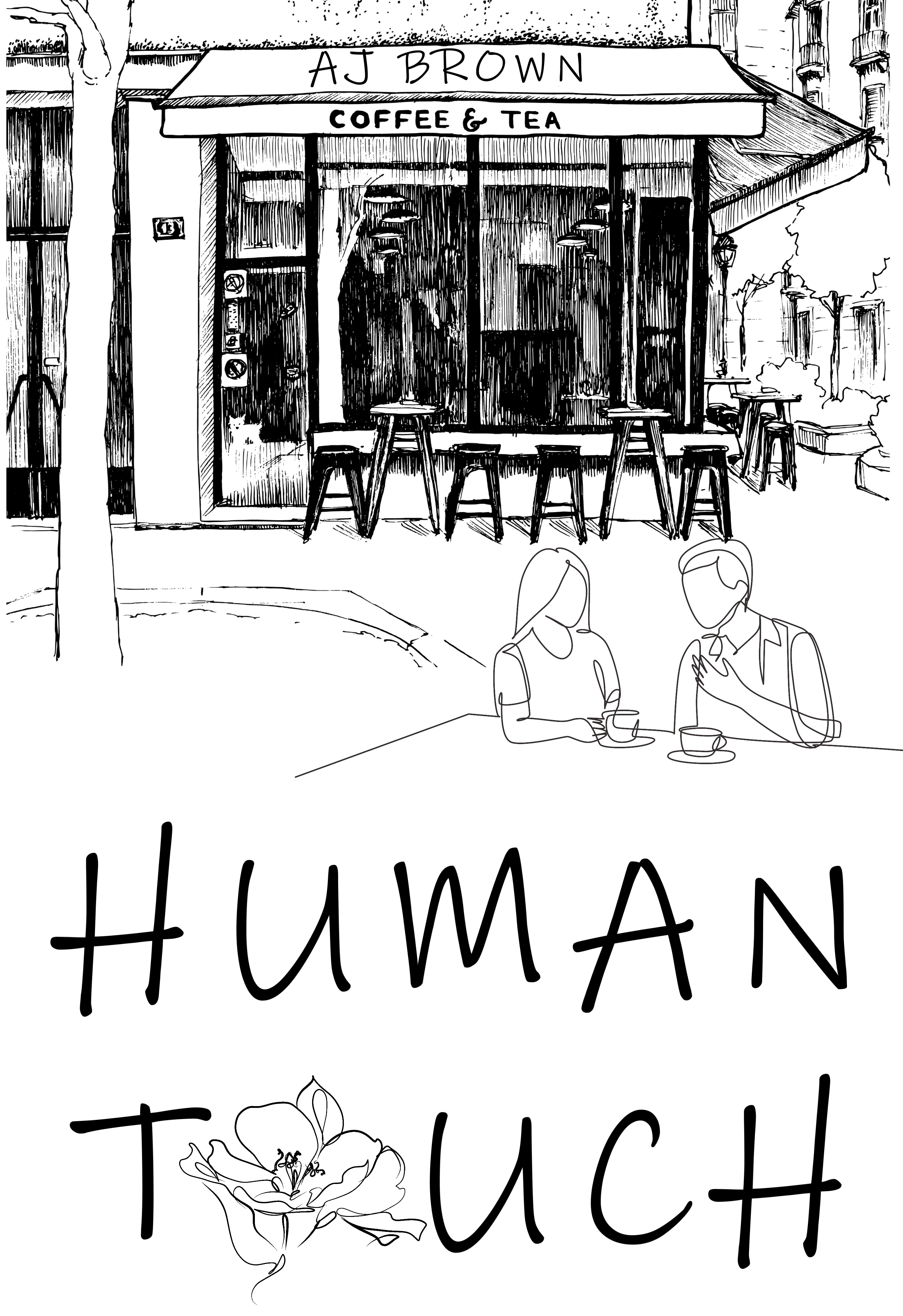
Human Touch (Cover Reveal)

A couple years ago I was in a rut with writing. A couple? Seriously, A.J.? It’s been five years. Back in 2019, I was in a rut with writing. My editor, Larissa Bennett, challenged me, literally, to write a story I didn’t want to write. I told her about an idea I had but was hesitant to write because it was a ~GASP~ love story. 

“You should write it,” she said. 

I said, “I don’t want to,” like a petulant child about to pitch a fit.

After a bit of back and forth, I finally said, “Okay,” but it was more like one of those moments where your parents told you to apologize for saying something rude to your sibling. You apologize begrudgingly but really don’t mean it.

At some point I sat down and wrote the first couple lines to the story: 

The coffee shop was quiet. The few people talking did so in whispers as if they were in a library and the librarian was an ancient old biddy with blue hair, triangle lensed glasses and a mallet behind her back. Talk too loudly and get a smack to the head you might not wake up from. Charlie liked it that way. 

It wasn’t like the Starbucks a few blocks over that garnered most of the public who were willing to spend their money on their favorite caffeinated drinks. There weren’t a bunch of college students with their laptops and schoolbooks, and there were no groups of more than four people who liked to talk and laugh loud enough to disturb those reading books (or possibly doing schoolwork on one of those laptops). No, this was a little mom and pop place not owned by a mom or a pop, but a woman in her mid-thirties who married, divorced, and had no children that he was aware of. She spent her mornings and most afternoons behind the counter of the Coffee Dee-Light serving the regulars, like Charlie, with a smile and a bottom-line price that should have competed with Starbucks, but somehow didn’t. 

I liked the first few paragraphs and decided to write more. Though I would walk away from the story and come back to it later, the story of Charlie Massingale and Dani Overton never left my mind. I finished the story close to the end of 2020 after a few starts and stops. 

I had no intentions of releasing this book. It was going to be my dirty little secret. I, author of dark, emotional stories, wrote a love story. No, no one could find out about this. But I really like the characters, even Dee, who owns the little coffee shop they meet in.

So, here we are, you and I and this book, this story, Human Touch. It’s a love story. It’s Clean Romance. It’s completely different from anything I’ve written, simply because I intended for the two main characters to fall in love. 

Why post about this now? Well, because I’m releasing it soon and I need to talk about it. I want you to read it. If you don’t know about it, well, you can’t read it.

With that said, below are both the cover, which has a Take On Me by A-Ha vibe and the synopsis.

Charlie Massingale has mastered the art of fading into the background. Haunted by the tragic loss of his wife, he seeks solace in a quiet South Carolina town, hoping to escape his past and bury his pain. For years, he succeeds in his quest for anonymity.

Everything changes when a young woman recognizes him at a coffee shop and strikes up a conversation. Plagued by his own guilt and desires to stay missing from the world he once thrived in, he denies their connection, leaving Dani yearning for more.

Determined to unravel the enigma that is Charlie Massingale, Dani reaches out to her beloved author, hoping to connect with a man no one has heard from in nine years. To her surprise, Charlie responds, sparking a fragile bond that neither can ignore. As their correspondence deepens, Charlie finds himself captivated by Dani, awakening emotions long dormant within him.

Caught between the past and the present, Charlie faces a crossroads. Will he allow himself to embrace the possibility of love once again? Can he overcome the weight of his past and accept the warmth of the Human Touch? With their lives intertwined, Charlie and Dani must navigate the complexities of age, and the lingering shadows of the past that threaten to tear them apart.

So, what do you think? Interested? Let me know in the comments below.

Until we meet again, be kind to one another.

A.J.

Ally’s Story

Ally sat on the floor in the bathroom between the bathtub and the toilet. She had moved the trash can before sitting down, knocking it over in her hurry. Tissues lay scattered on the floor around it, along with a used tube of toothpaste and a couple of toilet paper rolls. Her mascara made black streaks down her cheeks from the tears that fell from her eyes. Her knees were pulled to her chest. She gripped the gun her father gave her before he died in both hands. It was heavy in her tired hands. 

If she would have stayed calm when Barry showed up, she would have grabbed her cell phone. She didn’t and it sat on the kitchen table where she had been sitting when the first knock came. The knock didn’t scare her, even though it was heavy handed and sounded like thunder. It was the voice that came with it, the voice that told her Barry was there and things were about to get ugly fast. 

“Open up, Ally,” he said. Though he tried to sound cordial, maybe even nice, she knew better. “We need to talk about this.”

The second mistake she made was not grabbing her phone. In hindsight, it was probably her first mistake. She could have—should have—called the police as soon as he showed up. Instead, she stood from where she sat at her kitchen table and went into the living room. She didn’t quite get to the couch, which was new, as was the television and the nice chair that sat a few feet from the couch. A coffee table sat between the couch and the television (with a fashion magazine and local music paper sitting on it along with a blue and white coaster that stated the name of a local band one of her friends were in, Government Poptarts). The light in the living room was off, but a lamp that sat on a small end table near the door was on and lit up the front door and the window beside it well enough she could see Barry’s shadow beyond the curtain.

Her real mistake—first, second or third didn’t matter—was replying to Barry’s “Open up, Ally. We need to talk about this,” comment.

“There’s nothing to talk about, Barry. Go away.” She tried to sound tough, but deep down inside she was scared. In truth, she was terrified of him and had a hard time thinking right then. It’s not that Barry had been a bad husband—until a year ago they were great together, spent two years dating, nine years married and had a little girl, Amber. 

That was then.

So much can change in a year, and everything had, starting with Amber’s death and the initial legal issues Barry faced because of it. If he had just held her hand when crossing the street instead of texting a friend of his, then Amber wouldn’t have run out into the road and been hit by a car. At first it was a tragedy, one Barry argued was the driver’s fault. He even told Ally that. 

“The man was speeding, Amber,” he said from his side of the plexiglass booth, a blue phone receiver to his ear. And she believed him. Why wouldn’t she? “I barely kept from getting hit. I tried to grab Amber, but …”

Ally shook her head as she stared at the door. She had opened her mouth. She had spoken to him and now he knew she was home. At some point, she crossed the room and now only stood ten or so feet from the door.

“Ally, open the door.”

“No. Go away or I’ll call the police.” Her heart beat hard and her mouth felt dry. 

“I wouldn’t do that if I were you.” His tone changed. The cordial sound was gone. His voice was no longer begging, but calm and angry at the same time.

“Barry, please leave.”

“I’m not leaving until we talk.”

She yelled next. “We’re done, Barry. Go away. I’m calling the cops.”

“Okay. Okay. I’ll go away.”

She thought it was over. She thought he would leave. She waited a minute, then another. When there were no more knocks on the door, no more Barry talking on the other side, she went to the window, moved the curtain just enough to see if he were gone. 

A rock struck the window. It, along with broken glass, struck her in the face. She stumbled backward, fell over the armrest of the couch, and landed between it and the coffee table. The pain above her right eye was sudden and intense and accompanied by blood spilling from several spots on her face. 

“Open the door, Ally,” Barry yelled, this time it wasn’t muffled through the door. It was clear and through the broken window.

Ally got to her knees and looked back. Barry had an arm in the window and was trying to unlock the deadbolt, something she had a friend install when she filed for divorce and a restraining order. His hand found it but couldn’t quite unlock it.

Get up! her mind screamed. She stood. Her world spun for several seconds before she staggered away from the door, the couch and the chair. She didn’t think about her phone on the kitchen table or calling the police. All she thought about was running and hiding.

By the time she reached the hall, she heard the door open. She was almost to the bedroom when Barry kicked the door in and the chain at the top snapped. The door slammed against the wall and Barry yelled her name. She looked back in time to see him enter the house. 

Though her world spun, and she bumped into the wall, she managed to get the bedroom door closed and locked. 

That’s not going to hold, she thought. Then, her brain thought of her father, of the gun he gave her, and the fact she had put it in the dresser on the other side of the bed shortly after Barry was escorted out of the house by the police after refusing to leave. 

She rounded the bed and opened the drawer. By the time she had the gun in hand, Barry was at the bedroom door. He didn’t knock gently, but pounded on the door, demanding she open up and “talk about this like grown adults.” 

Ally didn’t respond. Instead, she ran to the bathroom, thinking she could crawl through the window. She slammed the door shut and locked it. Her stomach sank right along with her hopes—the window was above the toilet and entirely too small for someone other than a little child to fit through. She thought of Amber—she could have fit through it if needed. She had only been five at the time of her death and Barry’s negligence and …

Amber’s death was the beginning of the end, but wasn’t the sole reason for Ally filing for divorce. The police told a different story than Barry did, but that could have been his word versus the driver of the vehicle. The three witnesses who vouched for the driver didn’t help his cause, but even then, they were married, and Amber’s death was an accident, and she was going to stand by her man like a loyal wife and …

It was the text that ended their marriage. Barry wasn’t arrested right away. That happened the day after Amber’s death. Neither of them thought to get his phone from off the bedside table. The driver and the three witnesses told the truth, but there was so much more to it than just a friend texting a friend. It wasn’t until she checked his phone a few days after the accident—just a day after her daughter was buried—that she found out who the friend was. 

It was four in the morning when his text notification went off. Ally was tired but sleep was the furthest thing from happening. She picked up his phone, typed in his password and checked the message. Ally didn’t know who Kristin was, but a scroll through the text messages told her Barry had been talking with her for a while and having an affair for almost as long. The text with this Kristin the day before wasn’t just a distraction that led to his daughter’s death, but was him setting up their next hook up.    

Everything’s a lie, she thought.

Ally sat on the floor in the bathroom, the bathtub to her right, the toilet to her left. He could smell the soap she had used to take a shower not two hours earlier. She could smell the Clorox cleaner that hung on the inside lip of the toilet. She could smell sweat on her body. They were all scents that didn’t seem to go together. 

Her heart crashed hard in her chest; tears fell from her eyes, smearing mascara. Her stomach was in knots and her arms and hands shook. She didn’t think too much about what led to her current situation, to Barry’s breaking into the house they once shared during happier times, at least for her. All she thought about was Barry being outside the bathroom door, beating on it with his fist, yelling at her to come out as if he were the big bad wolf about to blow down her house of straw. And when he did, she had no doubts he would hurt her or worse. Though he never had before, Barry had become increasingly aggressive and angry and had left a message once on her cell stating, “if I can’t have you, no one can.” Until then, she never thought him capable of hurting her. Then again, she never thought he would have an affair either and he had. If she had to bet money on it, she thought he might have had more than one, that this Kristin chick was just his latest fling. The message led to the restraining order, one that didn’t seem to matter to him.

“Ally, I’m only going to ask you one more time to open the door.”

She swallowed hard. Her hands were sweaty. Her elbows were on her knees and her arms extended toward the door. She tried to keep her hands from shaking, but they still did. Her right pointer finger was on the trigger and the safety was off. She didn’t have to check to know it was loaded—she made sure of that right after the threatening message. 

“Please, go away,” she said, her voice shaky. 

“Not until we talk this over.”

She shook her head. There was nothing to talk about. She thought about her phone, how she should have grabbed it when he knocked on the door. She thought about her opening her big mouth and telling him to go home, there was nothing to talk about. She should have just called the police the moment he called out to her. There was a restraining order for crying out loud. She thought about the message he left her, how menacing and threatening it sounded.

“Please …” 

Barry hit the door hard. It shook in its frame. She thought he kicked it.

“Open the door!”

She didn’t get a chance to respond. He kicked the door again. She screamed. A third kick and the door jamb started to give way. On the fourth kick, the door slammed open and struck the wall by the sink. She barely saw the redness of his face, the anger in his eyes, the scowl on his face. 

Ally pulled the trigger. The sound of the gun going off was deafening in the small bathroom. She pulled it again and again and again until there were no more bullets and the gun only clicked when she squeezed the trigger. 

It was over in less than three seconds.

Barry didn’t fall forward into the bathroom. He fell backward. At that moment, her brain didn’t register the blood that soaked the front of his shirt before he hit the floor or the fact that three bullets struck him in the chest, one in the arm and one in the hip. The other one hit the wall to his left. 

Ally sat there between the bathtub and the toilet, her elbows on her knees, arms extended, the gun in both hands. She stared at Barry’s body, not really seeing it, her mind in a thick fog that prevented her from thinking. Eventually, she would have to stand and leave the bathroom. She would have to step over his body and try not to step in his blood. She would have to call the police if someone else hadn’t by the time she mustered the strength to move. She didn’t do any of those things right then. Instead, she dropped the gun on the floor between her legs and put her face in her hands.

AJB

Don’t Snoop

The following is a memory that was triggered when I made a sandwich to take to work with me. 

*

“Don’t snoop,” Grandmomma always said when I was being nosey or poking around in places I had no business poking around in. “Don’t snoop.”

My grandparents lived in an old two-story house in what some call the mill hill and others call the mill village. I called it home. I spent a large chunk of my childhood there, running the streets with my brother, for the most part. Occasionally, other kids would show up, them, like us, visiting their grandparents for the weekend or the summer or Christmas or Easter break or whenever Mom and Dad needed a break. There were only a handful. Tony. Wayne. David. Bryce. David B. Bryce was the only mainstay for a while, his family living in the corner house of the same street my grandparents lived on. He moved away when I was nine or ten. I can’t remember. David B. was the next to leave, though not by his own will. Getting hit by a car and dragged a short distance before getting untangled beneath it isn’t exactly your own will. Wayne and David—it seemed I knew three sets of brothers with that combo of names—showed up the least of the bunch. Then their grandparents moved away and so did they. Leaving Tony, myself and my brother … and the Barnett brothers, but we steered clear of them and when we saw them coming, we all ran the other way. 

I spent a lot of time with my granddad, playing marbles, watching the Braves on television, walking down to the McDonald’s from time to time for an egg mcmuffin, or heading to Brown’s Grocery for whatever he needed and the occasional bag of candy and coke in a small glass bottle. Those same bottles we collected and took back to Brown’s for money. I cut the grass and cleaned the yard from time to time, all things outside. 

When it came to the inside, that was all Grandmomma, and even trying to help clean from time to time was considered snooping. 

Still, we snooped when we could. I don’t know why, but I think it is something all children do, and many adults as well. We’re curious, people are. We go to a house we’ve never been to and suddenly have to use the bathroom, which may be true. A lot of people peek into the medicine cabinet just to see what’s there. It’s a medicine cabinet, what do we think we will find besides, I don’t know, medicine?

Grandmomma’s house was laid out fairly simple. A living room when you walked in the front door, a bedroom directly off to the left, the door always closed. There wasn’t really a hallway, but small area directly beyond the living room that opened into what could be considered a large dining room. To the right of the dining room was a walk-in closet or a pantry. To the left was a small kitchen with a stove and sink to the right, a table and chairs to the left, and like every other kitchen in America, cabinets for plates, bowls, glasses, canned goods, perishables and whatever else went in kitchens. A small black and white television sat on the counter. Off the dining room was another door. When you opened it, the door to the left was the bathroom. Stairs led up to the second floor where two large bedrooms sat, separated by a small walkthrough closet. There were lots of places to snoop. There was also the back porch with Granddaddy’s various tools and what nots and the metal shed that I thought had been built rusty but somehow remained upright. 

Snooping at Grandmomma’s house wasn’t easy. You had to be almost ninja-like. Well, not really, but we were kids and kids aren’t exactly known for their stealth. Grandmomma had to either be outside, in the bathroom or asleep for us to snoop successfully. Even then we had to be quick. 

There was a piece of furniture in the living room that had a drawer in it and two doors at the bottom. I only ever opened those doors once—there were only boring things like books and papers down there. The drawer was wide and long but not very deep. Still, it held things like jewelry and coins and other trinkets little boys wouldn’t be interested in. The only time I ever stole money from my grandparents came from that drawer. Two case quarters, as Granddaddy would put it. They never said they knew I stole the quarters, but I think they did. I mean, I explained it away when I came back from Brown’s with a little more than what a quarter would buy back then by saying I returned a couple of bottles. Still, I think they knew otherwise. I never looked in that drawer again while they were both alive. It was only after they had passed, when we were cleaning out their house, that I looked in the drawer and recalled stealing two case quarters. 

The bedroom off the living room was rarely a good idea. Though there was a bed and dresser and two small end tables in the very small room, it was mostly used for storage. Getting in and out of there quietly and quickly was next to impossible. Snooping in the pantry was easy. That was the one place Grandmomma or Granddaddy would send us to get some canned or boxed good. The only thing remotely tempting was the rack of clothes to the right of the door when you walked in. There were always boxes hidden by the clothes. Still, if they didn’t send us in there, we had best not be in there. And they always knew we had snooped. I didn’t understand how they knew, but over time it dawned on me. There was a pull string for the light. We would pull it when we entered the pantry, but not always when we left. If that light was on, we gave ourselves away. 

The bathroom was a bathroom, and yes, the medicine cabinet contained various medicines, none of which interested me, though I can’t say the same about my uncle, but that’s a different story. 

The upstairs was tricky. Several things had to happen for us to snoop up there. First, my uncle had to be away. That was his domain and if he caught us up there, he was a bear—a mean one. Second, both grandparents had to be outside. Then we had to pretend we were going to the bathroom, quickly bound up the steps (which made so much noise it made bulls in China closets look quiet). I always preferred the room on the right—my uncle didn’t sleep in that one. There always seemed to be something neat in there, from his guitars to his girly magazines. He also hid his drugs in various places in both rooms and the small walkthrough closet that never seemed to have a light that worked. I didn’t like the walkthrough closet and I spent as little time in the upstairs as possible, always afraid our uncle would come home and be a mean bear. Whenever we got caught up there by Grandmomma we told her we were just going up the steps so we could slide down on our bottoms. It was a good lie. It really was. Not that it worked, but it was the one we used the most.

That brings me to the kitchen drawer—yes a specific one. It was to the left when you walked into the kitchen and the last one along that counter. In it were various things a little boy could find interesting. Red and green rubber bands that kept the newspapers rolled up when the paper man came by and tossed them out his window and into the yard; many colorful twist ties that held bread wrappers shut. Yellow and green seemed to be the color that was most popular, with an occasional red, white, or black thrown in there. Bobby pins that were used to hold Grandmomma’s hair back. They were also useful for putting on the front part of a paper airplane to give it weight and steady the plane so it would fly longer and farther. There were measuring cups I never saw Grandmomma use. There were pennies and bottle caps and glasses so old the lenses were tinted brown. Sewing thread, needles I poked myself with more than a handful of times, and wooden pencils sharpened with a knife, not a wall or electric sharpener. Grease pencils with a piece of thread near the tip you pulled so the paper would peel, and the tip of the pencil would get bigger. I loved those grease pencils. 

The drawer was a wonderland of junk that always fascinated me. It’s also the drawer that was never off limits. It wasn’t snooping if I went in that drawer to get a rubber band or a bobby pin for an airplane. It was a safe drawer. And it was the one I loved the most. 

Like everything in life, good and bad things alike, everything comes to an end.

After both my grandparents passed away, I went “home” for the last time and helped clean some of the house out. I went back to that drawer and opened it with the reverent awe of a six-year-old. As I looked in the drawer, tears filled my eyes. It had already been emptied. I looked at the bare drawer and recalled the rubber bands and twist ties and bobby pins and thread and needles … and grease pencils. My heart cried. I did, too.

I took a deep breath, wiped my eyes, and composed myself. My brother and I made our way up the stairs for the last time. He pointed out and even showed my mom where her brother—our uncle—hid his drugs in places in the wall, by the heater, in the crawl space in the ceiling of the walkthrough closet. At the top of the steps, I sat down. I thought bout sliding down those steps on my bottom. I didn’t. 

The other day I was making a sandwich to take to work with me. I pulled the yellow twist tie from the almost empty package of bread and set it on the table. I always give the dogs the last three pieces of bread, the two end pieces and one other piece (three dogs, three pieces of bread). We call it bread butt day for the dogs. They love bread butt day. 

I tossed the empty package in the trash and picked up the twist tie. It was mangled, as twist ties tend to become once they are used. I looked at it and thought about the drawer in my grandparents’ kitchen for the first time since the last time I saw it empty. I walked over to the drawer next to the sink, opened it and dropped the twist tie in there. I smiled, heard my grandmomma whisper, “Don’t snoop,” in my mind’s ear and closed the drawer.

5/19/2023

AJB