Why Believe?

For the last month or so I have been posting one word on social media almost every day, mostly in the mornings. That word? Believe. 

Why believe?

Before I answer that, let me give you some context. Three years ago my wife joined a fitness group. This group consisted of a few women around the world, but mostly in America. At one point, I think around December of the first year my wife was part of this group, they started talking about their word of the year, the word they would live by during the following 365 days. My wife’s word was Consistency. That’s a magnificent word. 

I decided to do the same thing. Like my wife, I went with the word Consistency. But it wasn’t my word. It was hers. Last year I chose Unstoppable. It felt like a good word, and it was inspired by the song of the same name by Sia. Great lyrics that should be exceptionally inspiring. But I think that was a cop out word. Sure, I used it at certain points through the year, but it wasn’t even remotely … consistent. 

Fast forward to around the middle of July. I didn’t know it at the time, but I began experiencing what I fully believe was depression. Having never dealt with that in my life, I didn’t recognize it. Sure, I know people who have depression and some of it is crippling. But I—me, personally—have never experienced the feeling. 

Not knowing what it was, but knowing I was in some weird funky mood, I said nothing to anyone about it. ‘It will pass’ is what I told myself. Well, it didn’t, at least not right away. It lingered until mid to late-September … and I didn’t say anything about it. This caused some issues. I was easily angered. For the first time in my life, I felt real jealousy, and that being toward the person I love the most. At points, I withdrew from people—I wanted to be alone all the time. I already don’t sleep well, but during that time, I slept even less, which led to exhaustion and more crankiness. I would go out to the studio and hit the punching bag without gloves on—I split or bruised my knuckles a few times during this process.

At separate points, I was approached by two people, one young man, and one woman. They both asked the same question: ‘Are you okay?’ To the young man, I tried to play it off as just going through some stuff. ‘You want to talk about it?’ he asked. ‘Not really. I’ll be okay.’ To the woman, one who knows me so well because she is pretty much the female version of me, I said, ‘I don’t know.’ We were in New York at the time and she said, ‘Let’s go to the store.’ 

It was a brief trip there and back. During that twenty minutes or so, I finally said, ‘I think I’m depressed.’ It’s the only thing that makes sense. 

Saying that out loud gave me a starting point. It gave me something to think about, to act on. It gave me a way to move forward. Outside of that brief conversation, I texted with another friend about it. I didn’t talk to anyone else about it until one day after Thanksgiving when my daughter and I were sitting at the kitchen table discussing her and her boyfriend’s plans for the future. I brought it up because I feel like she was one of the ones I took it out on. That conversation helped me understand I had lost something during the entire process. 

I still don’t know what caused it, but I think it had been coming for a LONG time. What I do know, is at some point at the beginning of it, I stopped believing in myself. I’ve always been one to say, ‘I don’t need you to believe in me, because I believe in me.’ But at some point, I lost that. I had to find that. I had to get that back.

I started saying the word Believe to myself. That was it. No other words. No Believe in yourself, man. Believe in your abilities. Nothing like that. Just BELIEVE. BELIEVE. BELIEVE. 

BELIEVE.

That word means different things to different people. It might mean believe in God. It might mean believe that something will work out. It might mean believe that what happens is meant to happen. It might mean that you believe in someone else. It might mean you believe in yourself. 

The definition of believe is simple in this context: to have faith. And Faith in this context is complete trust or confidence in someone or something. Believing in yourself or having faith in yourself means you have complete trust or confidence in you and your abilities. That’s a powerful mindset. 

Two things before I go.

First, Believe. 

It’s my word going into 2024. I think it has been my word my entire life. When nobody else believed in me, I always did. Every morning now, even the bad ones, I say to myself, Believe. I leave it at that, and I take on the day. Some days are good. Some, not so good. But Believe. It’s what I have always told myself and something I am trying really hard to regain.

Second, depression doesn’t always appear as a frown or slouched shoulders or sadness. It’s often a smile, a joke, a positive appearance around people. It’s not always outwardly visible, but I can promise you it is always inwardly gray and cloudy. It’s a muddled mass of tar-like quicksand and you’re always sinking … and sometimes, you don’t realize it. 

If you need a word to live by, you don’t have to wait for a new year, choose Believe. Believe in yourself. Believe in what you bring to the table. Believe in your abilities. Just … Believe.

Until we meet again my friends, be kind to one another.

A.J.

Raven’s Brew (Free Fiction)

Raven’s Brew

A.J. Brown

R is for Richie Consuella Rodriguez. He was the first to see the shadow loom large overhead. The man-child with the I.Q. of a five-year-old sat in the sand box his pa had made for him years earlier. Long after Pa’s death, Richie still played in the old box, the sand replaced year after year by locals who felt sorry for him. He played cowboys and Indians with little plastic figures bought from a Five and Dime by his mother, she who now lay in her bed unable to do anything more than piss herself and spit grits down the front of her night dress. Sixteen years of dying and somehow, she held on. 

The fort sat on one end of the sand box, nothing more than sticks poked into the dirt; the Indian Reservation on the other end, with leaves stabbed through by twigs to form teepees. The many plastic men battled in the center of the box, the Indians woo-wooing and the cowboys cursing the red men with the hatchets, bows and spears. 

Richie stopped playing when the shadow passed overhead. For the briefest of moments, the sun had been blocked from the play area and a cool breeze tickled his bare arms. He craned his neck up, saw nothing and went back to destroying the pale men in the fort. 

A breeze began and the sound of something flapping with it caught his attention. He glanced up. A scream froze in Richie Consuella Rodriguez’s throat as he was lifted from the ground. His feet struck the fort and cowboys scattered throughout the sandbox. The only figures left standing were two Native Americans: a warrior with a spear, and the medicine man with his arms held up. On one shoulder sat a black bird.

A is for Alexia Garcia. She was not a man-child. Not even a man. With the kids in school and a couple of hours to herself, the cleaning and keeping of the house was at hand. With the wash done, she tended to hanging clothes. Her hum was a lullaby, her voice smooth. She snapped the clothes out, a crisp POP each time, then one by one placed them on the line; two pins per garment. When she was done there would be three lines filled with pants, shirts, socks, undergarments, linens, rags and towels. 

With two lines full, she worked on the final one. A shadow, like a cloud in front of the sun, passed over her. She paid it little thought and continued her work, a hum on her lips. The clothes fluttered with an up tick in the wind and Alexia fought against the towel in her hands. She placed the first of two pins on one creased corner. Before she could attach the other one, her feet left the ground and her world became a haze of black and purple.

One end of the clothesline tore from the post and cut into her palm. Blood spilled from her hand as four fingers fell to the earth. 

V is for Valena Montoya. She sat in the grass outside the cottage that was her parents’ home. Her three years of life had seen nothing considered out of the ordinary. Her soggy bottom soaked the grass beneath her, but she paid no attention to it. Later it would chafe her behind a deep shade of red, but at that time, she was content to stare at the ants making their way through the jungle of grass. 

sunset-2247726_1920.pngThose ants, bright red and large, formed two lines, one to and one from the food not too far from where Valena sat. They bit off portions of it and went along their way, oblivious to the giant in their midst. 

Valena picked up the brown piece of food the ants had been taking from. She shook them off the best she could and placed it in her mouth. A moment later she screamed, as the food hung from her mouth and an ant slipped from between her small lips. 

E is for Elizabeth Montoya. She set the last of the dishes in the drainer and peered out the kitchen window. Her heart skipped a beat, then a second one at the sound that came from outside. She couldn’t make out what Valena had in her mouth, but she could hear the garbled scream. 

She pushed the door open and ran across the yard to her daughter. Elizabeth stopped just short of Valena and one hand went to her own mouth. She lunged forward and knocked the finger from Valena’s gaping mouth. Her stomach knotted and gave way to vomiting. 

N is for Natalia Perez. It was Natalia who discovered the broken clothesline and blood on the ground near where Alexia disappeared. She found two of Alexia’s remaining three severed fingers. Her hysterics echoed in the twilight and the villagers ran to see what was wrong.

They clamored about; their calls for Alexia rang out but they would not find her. 

Natalia sat on her bed, her face tear stained. Her youngest sister gone, she cried her laments and spoke her prayers. In anguish she left from the small hut and set out into the night. Her curses rose to the sky and blackness like none other covered the moon. With sadness still in her heart and on her lips, she was lifted in claws like steel. One talon ripped through her midsection and organs spilled from her eviscerated body. 

With her blood sprinkling the village below, she was carried through the night, her body limp and growing cold. Somewhere in the darkness, she was dropped.

S is for Santavia Alvarez. He, like many others, combed the village well into the night in search of Alexia. Though he would not find her, he felt rain sprinkle from the heavens. He wiped his face and stared at the red staining his fingers. 

Santavia fled beneath a tree and knelt in prayer. The words that came from him were coherent to only him and the one he prayed to. Others around him fell to their knees and prayed as well.

Two more would be taken as they held their heads and hands to the grounds. 

Santavia stood next to the tall tree and watched the sky as Ramon Luiz-Guiterrez was carried off. Santavia fell to the earth again, his body prostrate, and begged for mercy for he and his people.

B is for Benita Alvarez. Santavia told her of the giant bird that swooped down from the sky and took Ramon Luiz-Guiterrez from the ground and how Ramon never screamed as he was carried off.

Benita left her rundown shack and made her way to the chief of the village. 

“We are frowned upon and the great birds have come to take us away.”

“We must make sacrifices,” the chief said.

“We must kill the bird,” Benita countered. 

She left the chief in his bed robes, his head shaking, arms uplifted toward the sky, his words lifted to the gods.

R is for Ramon Luiz-Guiterrez. They found his head near the base of Raven’s Mountain. It was as they feared. It was in that area that the men camped and watched as the giant bird flew to and from, each time carrying another of their number in its giant claws or its monstrous beak. Arrows did nothing to stop it and their spears were too slow.

They bowed and cried out to the gods of their ancestors and begged for mercy and guidance. Morning came, and the four men made their way up the hillside. 

E is for Eduardo Ruiz. He was plucked from the group of four along the mountainside. The bird dove in, its wings silent. It caught Eduardo with its beak and lifted him high in the air before it bit him in half. Eduardo’s body plummeted from the sky. The lower half of his body crumpled into a mass of pulp and splintered bones. The upper half crushed Leo DeLacruz.

The remaining two carried on, their hearts high in their throats and silent prayers whispered from frightened lips. They dashed from tree to tree to stay out of open spaces. Near the top of the mountain, the giant bird swooped down. A loud caw echoed through the hillside and Jose Beltran disappeared in a mass of claws and dark feathers. 

Carlos Guiterrez scrambled along the path. The raven dipped and dove down on him. Carlos ran through the trees for safety as he made his way up the mountain. Refuge was a hillside cave where Carlos ran as far in as he could. The bird flew away.

Night came, and Carlos continued up. With the quarter moon high in the sky, he found himself near the top of the mountain. He peeked out of the woods and toward the open mountain cap. He listened for the bird—the giant raven—but heard nothing. Carlos ran across the opening. 

A hard gust picked up and Carlos heard flapping wings. His screams reverberated all around him and he looked to the sky for the beast that had stalked his people. He saw nothing and then fell headlong. 

Carlos’s eyes snapped open at the sound of wings. He tried to roll over but could get no further than onto his side. He let out a moan as pain ripped through his leg. He felt the heat of something wet seep along his back. 

Carlos looked to the sky. The moon still hung high, its brothers and sisters, the stars, there with him. 

Another sharp pain, this one in his hip, caused Carlos to let out a yelp of pain. He looked toward his legs and a scream that never came stuck in his throat. A baby bird pecked down on his hip and tore a piece of wounded flesh away from his body. All around the bird were bones and torn flesh of the people from his village.

He tried to scramble away.

The bird leaned in, its beak near Carlos’ face. Its head snapped forward and one eye exploded in a burst of pain. Carlos screamed the scream of the dying.

W is for Wilfredo Cruz, the chief of the once quiet village. He spoke again of offering sacrifices, but none would hear him out. The villagers waited for the men who would never come back down the mountain. Their courage and hope waned with each passing minute. Until Santavia Alvarez spoke up. 

Knife in hand, he approached the chief, the leader of their village, his body frail, his mind slipping. And they followed him as he dragged the chief to the edge of the mountain, strapped him to a tree void of limbs. 

Wilfredo begged them to rethink things, but Santavia reminded him, “A sacrifice is needed.”  The knife slid through the chiefs skin, pared the muscle of one arm. They hid back among the trees, spears and arrows in hand. They would wait, and they would have the raven when he came.

Up above, in a nest of branches and mud and leaves and filled with the bones and flesh of the dead, the baby bird ate its meal, and the raven watched and waited.

_________

There’s really not much to tell about this story, except it was based on a prompt, and one I don’t remember. I had also been on bird kick at the time, thanks to another writer, Michael Louis Dixon. At the time, Dixon was part of +The Horror Library+ and he occasionally wrote for the THL Blogorama. He did a handful of posts about fear, but birds had been part of the theme. 

After reading through them, many of us who knew Michael grew concerned about his mental state. The way he wrote them was fascinating, because many of us believed something was wrong with him. We checked up on him, fearing he may have been suicidal. It turned out, they were all fiction posts he wrote. 

We took a collective sigh.

I guess there was more to this than I originally believed. Anyway, I hope you enjoyed Raven’s Brew, and please, like, comment and share. Thank you.

A.J. 


Donate

If you’d like to donate a couple of bucks to a working author, it would be greatly appreciated.

$2.00

Summer Jumpers (Free Fiction)

Summer Jumpers

A.J. Brown

Down below us children play.
Old men go about their days.
—Todd Mathis
American Gun
Nature Vs Man (From the album The Means and the Machine)

__________

It’s hot out.

~###~

It’s always hot. There are no winters to temper the summer heat—it’s summer year round. Some months are hotter. Rain only makes it worse—steam spills off concrete in white vapors that make it hard to breathe as the heat evaporates the water when it hits the ground—if it hits at all. Scientists say the hole in the ozone caused all this. I don’t know about that. What I do know is one day we’ll all be gone. We’ll all be jumpers before it’s over with. 

The first jumper plummeted to his end when I was a child. Six years old with a head full of dreams. That was the summer things came undone for the world. The sun had inched closer, notching up the heat—108 degrees on the last day of May in Michigan. The stock market had crashed and a new flu had surfaced, taking with it only a handful of people, but the media painted a picture of pandemic proportions. Many people took it as gospel. The jumpers soon followed. It’s like the entire planet lost its mind. 

Some say it is the heat that finally gets to them, drives them insane. Others say it is hopelessness and despair. I think it’s a little of both.

Harry Taylor started the exodus. Good looks, rich, trophy wife, lots of women to keep him company on those ‘business’ trips. He lost it all, money, home, cars, business and wife. It was 114 degrees outside when he climbed to the top of the Fordham building—a 27 floor high rise—spread his arms and tried to fly. He didn’t scream as he fell. He landed on top of a passing car. The impact shattered the windows and crumpled the roof of the vehicle. One tire blew out. Taylor and three passengers in the car died.

A child lived, a young boy.

~###~

The whispers call to me. 

I sit on the dusty ground. Bodies lay all about. Shattered. People walk by as if they aren’t there, or if they are just part of the everyday scenery. Children play among the bones, using them as drumsticks or anything else they can think of. Some of the kids stick the bones in their mouths.

The rats and snakes have long since cleared out. Either the stench or the glutton of food finally ceased their scavenging ways. Flies and bugs still buzz about, nestled in corpses to raise families by the thousands. 

My eyes are to the sky, focusing on the person on the ledge of the once great Fordham building. No one is going to try and coax him down—they gave that up a long time ago.

He jumps.

And I hear the whispers.

~###~

Many people followed Taylor. At first only one or two a week, then upwards to three or four a day. A handful of people jumped together, their arms intertwined. Even with the blood, broken bones and split bodies, their arms remained hooked together after they hit the concrete, like a flesh pretzel. From there it got worse.

The police tried to stop them, but what could they do? Dying is dying and whether it’s by a bullet or from landing on baking hot concrete doesn’t matter to those who want to end it all. Bodies began to pile up. The cops bowed out. Not even the military could stop the jumpers. How could they? They were jumping, too.

The high rises closed off exit doors to their roofs, but that didn’t stop the truly desperate; those who had lost everything, including hopes and dreams; those whose brains had fried with the increasing heat, whose skin had become as red as a Maine lobster. Windows break easily enough when a bullet strikes it. Or a person crashes through. Not only did bodies fall from the sky, but large shards of glass rained down as well. Some onlookers were cut up. Others died right along with the jumpers.

Some cities resorted to digging pits just outside town limits and burying the corpses by the masses. Others piled them like kindling and set them afire. That didn’t last long—the smell of cooking flesh drove folks even crazier and the extra heat didn’t help things. Eventually, they stopped removing the bodies.

It was almost as if the world spoke and its words were, “Everyone else is doing it, why not us?” The stupid rationale that was carried from the beginning of time to now, the end of it.

~###~

The body crashes down less than six feet from where I sit. Blood splatters from its ruptured skull. I flinch away, a little too late to keep some of it from getting on me. It drips down the side of my face. 

I sit and stare, not bothering to wipe the blood from my skin as it mixes with dirt and sweat. 

One of the man’s eyes lies on the ground, its socket crushed from impact and its optic nerves holding it to the pulp that was once his head. It is blue. It stares at me … and I hear the whispers.

I turn from him and look toward the entrance of the long abandoned Fordham building. There is a line of hundreds making their way inside.

Another body explodes on the sidewalk just past the man. The woman wears a dress. It has bunched up around her waist, exposing her creamy white legs and red panties. A wet spot soaks her crotch.

I stand, the whispers urging me on, and step my way through the corpses. I walk by the man. His eyeball pops under my boot.

I need to get in from the heat. My brain hurts and the whispers keep telling me the summer, the heat, the whole mess will never go away.

Maybe they’re right.

~###~

There was this one guy. He haunts me to this day. Black clothes and a chain for a belt; earrings and piercings and odd tattoos donned his body. His brown, unkempt hair and pale skin didn’t seem to fit his clothing, his image. He had taken a running start and jumped out as far as he could. He screamed all the way to the ground and landed feet first. 
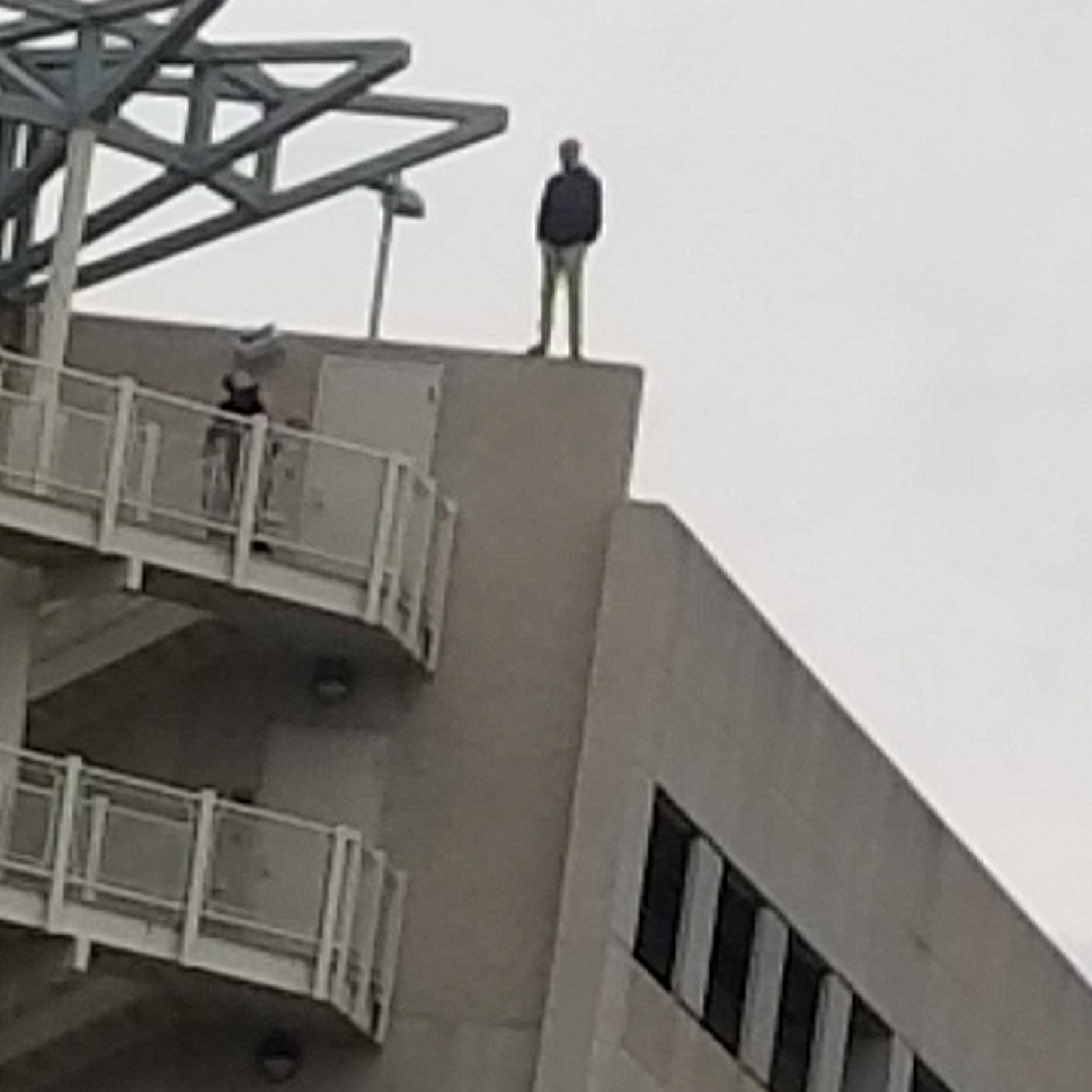
JUMPER 2
Bones shattered and blood exploded from torn skin. From the hips down was a ruptured mass of flesh. He survived the jump. His eyes met mine and held my gaze while he lay broken on the concrete. The odd angles of his legs and arms jitterbugged as exposed nerves screamed right along with him. He begged me to kill him; to end his self-inflicted pain. But I couldn’t move. For nearly seven hours he screamed and I watched as his life faded, his eyes became dim and body parts ceased their twitching. 

I heard the whisper for the first time just before his right thumb stopped moving. It came from him—I’m almost certain. 

Join us. Join us. Join us.

I walked away, found a seat in the doorway of an old department store that closed down when the jumpers began their leaps of death. For the last few years it has been where I sit during the days and well into the evenings. It has been my watching perch, my haven in the insanity that has become our world.

By then they had been leaving the bodies in the streets to rot, maybe even hoping to deter other people from jumping. Yeah, that really worked, didn’t it?

Each day chain boy’s body decayed a little more. Rats dined on him. They gave way to bugs. Time and the elements wore away what flesh remained; leaving only bones among shredded clothes and a chain around a waist that was no more. And every day after that I heard the whispers.

Join us. Join us. Join us.

~###~

My head hurts. It always has. I run a finger along the scar on the right side of my skull. It throbs with my heartbeat. I’ve noticed over the last couple of years, as it gets hotter my head hurts worse. My right cheekbone hums as if there is a bee tucked underneath the skin. It’s maddening. I wish it would go away. 

I follow the procession inside the Fordham building where the heat is so much worse than outside. My lungs constrict and the dry air burns my mouth and throat. Sweat soaks my body, and the stench of the living mixes with the decay all around us. 

I make my way up the stairs, each step tearing at the muscles in my legs. By the eleventh floor I slow down and take several deep breaths, trying to suck in enough air to continue. I struggle upward, the whispers pushing me on. A skeletal hand crushes under foot, its bones turning to dust. 

Weary and weak I continue upward, the throngs of people pushing me further. 

The whispers grow louder as we ascend. Thousands of voices sing a chorus line over and over: Join us. Join us. Join us.

I don’t want to join them. I don’t want to jump. Fear overtakes me and I struggle to turn back, to run down the stairs and go to my seat outside. But I can’t. The people push me upward. I stumble as I fight against the flow of the crowd, but I can only go up. I fear I’m going to fall and get trampled under thousands of feet. I swing a fist; connect with someone’s head. There is no sound of pain, no cry of anger. Only the continuous surge pushing me forward.

They prod me up the steps. Their eyes are vacant; their mouths slack; their skin pale, as if they were already dead and drained of blood. 

I am not like them. I am not cold to the touch or wasting away with time. I am not like them at all. But I am. I know the truth. I have never been any different from any of those before me or those who will come after me. 

Join us. Join us. Join us.

As I reach the door to the roof I see it is propped open by a cinder block. The line of people continues forward, shortening as people drop from the building’s ledge. More and more join us at the top. As one person drops off, another takes his or her place. A never-ending cycle.

My head thumps and vomit fills my mouth.

~###~

At the edge I look down. I see the bodies scattered about the street. The once small hills are now masses of arms, legs, torsos and heads. Thousands of bones lay about, broken and shattered; blood runs through the streets. The stench of decay is worse up here. I wonder if enough people jump will the mounds of flesh rise as tall as the Fordham Building itself. 

Children play within the death below. Men and women—gaunt figures of living tissue—go about their day as if nothing is wrong. Across from me people are jumping from the Seth Building. A child is crushed underneath a hurdling body.

Join us.

My father calls to me. I can almost see him on the street, his body crumpled, glass from a shattered windshield still in his eyes. 

Join us.

Mother’s arm dangles from the window of the car, nearly cut in half from the steel roof’s collapse with the impact of the jumper’s fall. 

Join us.

My older brother, James. His head ended up in my lap; his eyes staring up at me. Not much different from his face and that of the teenage punk star with the chain for a belt. They both looked as if they wanted help; release from a pain far too great to bear. 

They whisper to me, calling me every day, every night. 

Join us. Join us.

It’s so hot out. My head thumps with each heartbeat, the fractured skull forever indented by a metal bar that once held the roof of a car up. The sun creeps closer each day, melting my spirit away with its intense heat. There are many people behind me. Their eyes and souls as vacant as mine feel. I raise my hands to my sides and close my eyes. I’m tired of the heat, tired of this world. 

I’m ready to fly …

__________

Music. It is the universal language. It doesn’t matter if you understand it, simply because it makes you feel it. And if you feel it, you can enjoy it. Music is also a vast source of inspiration. A countless number of my stories have been inspired by a base beat or a guitar riff or a couple of lyrics here or there. Sometimes an entire song can be so powerful it makes the mind explode with images.

For me, one such song is Nature Vs Man, written by Todd Mathis for the local band, American Gun. After hearing it the first time I went back and played it again, and again, and again. You get the picture. The song is great, but one lyric stood out among the rest. One lyric kicked my imagination into overdrive and sparked a story. 

‘Down below us children play.’ 

From it came the image of a young man looking down from the ledge of a tall building. He can see children playing in the street. Before jumping, he wonders if he would land on one of those kids. Summer Jumpers was born from that image, inspired by one simple lyric of a song. 

You might recognize the Seth Building. It appears in another post-apocalyptic story, Lost Art. That story takes place in the same world as Summer Jumpers, only years later, and with similar results.

I received permission to use the lyrics at the beginning of this story by Todd Mathis before I ever wrote Summer Jumpers. For that, I say thank you, Mr. Mathis.

A.J.


Donate

If you’d like to donate a couple of bucks to a working author, it would be greatly appreciated.

$2.00

On A Small House (Free … Poetry?)

On A Small House

A.J. Brown

The storm rages outside.
Lightning flashes,
Thunder rolls,
Rain pelts down on the small house.

Trees bend with the wind.
With candles in each room
Their flames flickering high
Casting shadows of dancing people along the walls,
The child lies in bed.
He stares at the window
With blanket tucked beneath his chin.
He holds the stuffed doggie tight to his chest
And the lightning flashes,
The thunder rolls,
Rain pelts down on the small house.

Shadows flicker in the room,
The tree outlined by the streaks in the sky,
He shivers as a cold finger tickles his spine.
A fan on the dresser
Blows the curtains about
They sway away from the window and lay back into place.
He clutches the doggie and whispers,
“It will go away.”
The lightning flashes,
And the thunder rolls,
The rain pelts down on the small house.

His eyes catch blinding streaks in the night sky
Through the light blue curtains.
Tree branches stretch like fingers
Reaching for him,
Grasping for him.
And the doggie is held tighter.
His eyes grow wide as the curtain lifts upward.
And the lightning flashes,
The thunder rolls,
Rain pelts down on the small house.

He stares at the window
Two eyes stare back.
The child stifles a scream,
Or it catches in his throat.
He pulls the blanket over his nose
Hiding all but his eyes.
The fan flips off as the power dies
And the curtain lays flat against the window.
The lightning flashes,
The thunder rolls,
Rain pelts down on the small house.

A head appears behind the curtain,
On the other side of the window.
A shadow, that’s all,
Is what he tells himself.
Then comes the scratching.
Scritch, scritch,
Scratch, scratch,

The boy’s heart skips a beat,
Then another.
And he watches the window
Waiting for
The lighting to crash
And the thunder to roll,
As the rain pelts down on the small house.
A sound, like glass tinkling on the floor
Fills the room.
The curtain billows inward
In front of the broken window.
Cool air enters the room
And the rain becomes loud.
He hears the steady
Clink, clink, clink
Of raindrops on a piece of broken glass.
The lightning flashes,
The thunder rolls,
Rain pelts down on the small house.

A hand reaches in
Boney and pale,
Fingers like knifes with sharp pointy tips.
He pulls his legs to his chest
And he screams.
“Go away!”
The hand retracts
As the lightning flashes
The thunder rolls,
And rain pelts down on the small house.

Daddy comes into the room.
His savior arrives.
He picks the little boy up
Holds him in his arms,
“All is okay, little one.”
The boy looks at the window
As the light flashes across the sky
The head slinks into the darkness
And the lightning quells,
The thunder quiets,
And the rain slowly ceases

The boy lies back in bed,
Grabs the doggie and holds it tight.
Daddy leaves and the boy smiles
“I told you he would go away.”
And somewhere in the distance
The lightning flashes
The thunder rolls
And rain pelts down on a small house.

__________

Poems are a fun way to make you think of your word usage. Each poem has its own meter, whether it rhymes or not. Your choice of words is crucial to a smooth, lyrical poem. So often when I wrote poetry, I had the most difficult time actually making it smooth, making it sing. So, when I succeed, I am usually ecstatic.

This poem is about every child’s fear, both of storms and of the dark. I wanted to capture the raw emotion of a young boy on a dark and stormy night after his imagination has gotten the best of him. Was there a shadow lurking outside his window? Was there a hand reaching through broken glass to get him? Was there even a broken window, or was it all the boy’s imagination. I’ll never tell because, at the end of the day, the ending will always be left to interpretation.

I hope this poem didn’t bore you and that you enjoyed it. If you did, will you, please, like this post, comment on it and share it to your social media. I greatly appreciate it.

A.J.


Donate

If you’d like to donate a couple of bucks to a working author, it would be greatly appreciated.
$2.00

Eating Dirt (Free Fiction)

Eating Dirt

A.J. Brown

The ground ate Ronald today.  He jumped from the tree we had climbed, landed on both feet and kept from tumbling to the ground by putting a hand on it to steady himself. 

“Your turn, Gordie,” he yelled up at me. 

I shook my head, not so certain jumping was a good idea. If I landed wrong, I could blow out my knee, break an ankle, or worse, smash my skull. 

“I … I can’t, Ronald. It’s too high, man.”

He laughed. “You’re kidding right, Gordie?”

I shook my head again. “No. It’s really high. I don’t think I can …

He gave me a boo-hoo and pretended to rub his eyes with his hands, “Quit your crying and jump, man.”

“I can’t.” I hated the whine in my voice. I hated feeling like a wimp. But that didn’t stop me from staying put where I was at in the tree, my butt perched against a thick limb, one hand hugging to the trunk.

“Don’t be a chicken, Gordie,” he yelled, as he craned his neck to look up at me. He clucked and strutted in a circle, fingers tucked in his armpits, elbows out and flapping. “Gordie is a chicken. Gordie is a chicken.”

Heat filled my face, shame filled my heart. “Am not.”

“Are too.”

autumn-351489_1920I started down, one foot on the branch beneath me, both arms holding the one I had been sitting on.

“Chickens don’t jump,” he yelled.

I tried not to listen, but he was right. It took all my courage to climb that high in the first place—heights and I never got along, but I had been afraid Ronald would pick on me, or maybe even beat me up if I didn’t climb the tree. He was mean like that. 

Looking down, my head swooned. I thought I would fall, strike a few limbs on the way down and break my head open. My heart fluttered and my stomach rolled. I grabbed a branch with one hand and wrapped my other arm around it.

“I’m not a chicken,” I yelled back, my voice shaky. “I’m just scared.”

“You’re a big, fat chicken,” Ronald yelled back as I lowered myself to the bottom limb. I was about to lower myself further so I could sit on it and drop to the ground from there. Still, breaking an ankle was possible even from only about six feet up. 

Then the ground shifted beneath him. It was like the earth moved under his feet. His eyes grew wide and he looked down. The grass parted and the ground opened up, sucking Ronald in to just below the knees. The ground closed just as quickly, like a teeth biting down on a piece of meat.

Ronald screamed.  

I screamed. 

From where I was in the tree it looked like Ronald had been pulled into the ground by some invisible mouth. I scampered back up the tree, one branch, a second one, third and fourth, until I was back up as high as I had ever been, gawking down as the ground ate Ronald.  By then, he was thigh deep in the shifting dirt and trying to grab a hold of anything to pull himself up.

“Gordie, help me!”

Too terrified to move, I could only watch. Blood appeared in the sand around his thighs and spread outward.

“Gordie, help me, please!”

Waist deep, Ronald reached out as far as he could, clawed at the ground. His hand sunk into the earth, followed by his arm up to his elbow. I climbed higher into the tree, height and I no longer bitter enemies. I closed my eyes and clutched tight to the tree with both arms as I stood on a branch I hoped would hold me.

Ronald’s screams echoed in my ears for several seconds. Then he went silent. I glanced down. Ronald was gone. A moment later, the ground burped. It’s the only thing that makes sense—an earthly burp. One of Ronald’s shoes popped up from the dirt and grass, the shoelace still knotted, a bloody sock lying limp inside it.

Now I sit high in this tree, the ground beneath me; Ronald’s shoe and sock taunting me. I know if I jump down and try to run, the earth will get me too, maybe not as quickly as it ate Ronald—it’s had a dog and two squirrels since then. Occasionally, it burps, the ground shakes and a bone or some fur pop out of the dirt. Then it settles down and waits.

I think I’ll stay here a while. Maybe the ground will go to sleep. Maybe I really am a chicken.

__________

Back in 2010 there was an anthology titled, The Elements of Horror. As the title suggest, all the stories had to be based on an element: Earth, air, fire, water and space. When I saw the call for submissions, I wanted to write a story based on each element. I thought it was plausible seeing how the word count was under 750 words per story. I ended up writing four pieces with the only element missing being space. Two of those pieces were published in the anthology, Eating Dirt being one of them.

I’ve since rewritten a couple of the stories, including the one you read here today. It’s short and simple and I hope you enjoyed Eating Dirt. Also, please comment on the post, like and share it to social media for me. I thank you from the top of my heart.

AJB

Flecks of Dead Skin on a Landscape of Red (Free Fiction)

The day was warm and we walked, hand in hand, Kyra on my right, marveling at the window displays as we passed them; her mom, Kate, on my left. The park was down the road from us and Kyra carried a bag of breadcrumbs for the pigeons and squirrels. Still young and excitable, my daughter pointed out various clothes and articles in the window displays and asked to go in some of the stores as we passed them. Her mom smiled and pulled her into a boutique. I stayed outside.  

I crossed the street to where an ice cream vendor jingled a small bell on his cart and yelled about his fresh, hand churned frosted delights.  

“What’ll yah have, mister?” he asked in as charming a tone as his rustic voice allowed him. He was short and squat and had a head full of scraggly brown hair. His face was chubby and he was clean shaven. I thought the smooth face didn’t fit the rest of his rough exterior.

An old, worn poster board beside the cart held a wide variety of ice creams. As I tried to narrow down my selection, he rang his bell and yelled for folks to give his treats a try. 

“Can I get three single scoops of chocolate in cups?” I asked.

“Yah want three scoops in one cup?”

“No, sir. I want three cups with one scoop in each of them.”

He said nothing but gave a quick nod. As he leaned into his cart with a metal ice cream scoop the day took on a dusk feel, though it was barely eleven in the morning. I looked up. An odd sky hung above us, its blues traded for grays; its white clouds shifted into a hue of yellow. If the clouds would have been green I might have reacted quicker believing a tornado would be on us soon. But they were yellow, and an odd shade, almost deep enough to be a mustard color. 

The ice cream man mumbled something. He held the scooper in one hand and a bowl in the other. On the ground by his foot lay a scoop of chocolate ice cream.  

“That’s not right,” he said. But he wasn’t looking at the ice cream on the ground at his feet. He looked up at the sky. His mouth hung open and scooping out ice cream seemed to be the last thing on his mind.

“It’s the end of the world,” one man yelled. I didn’t know if he meant the dropped ice cream or the yellowed clouds above me. When I looked at him, it became obvious. He was older than me by a good fifteen years. His hair gray on the sides and still somewhat dark on top. He had a spotty beard that was full at the sideburns and chin, but sparse along his jawline. His red shirt looked too tight and his shorts seemed too loose. He pointed to the sky with one shaking hand. 

I guess that’s when people panicked. They hurried inside stores, fearful of a storm that was certainly brewing, leaving many of us still outside; still craning our necks to the unusual heavens. It didn’t look like a coming storm at all.  

I looked to the boutique, but didn’t see Kate or Kyra. I didn’t think they knew what was going on outside. I started to go inside and find them; hurry them along. As I walked toward the boutique I looked up again.

Soft purple rays of sunlight filtered through tiny breaks in the clouds. They sparkled like glitter as they cut through the thickening air. The beams shot through as if spotlights were switched on one at a time. Still, I looked on.

city apocalypseI’m not sure when the screams began, but I knew why they had.  People began floating upwards within the rays of the sun. They struggled and screamed and begged for help but what could we do? In seconds they were gone, so many of them all at once, disappearing into the clouds, their cries muffled, then falling silent.  
Murmurs ran through those of us still watching, even as others ran for shelter. It was an eerie moment. I looked from the sky to the buildings then back to the sky. More folks were sucked into the purple rays only to vanish seconds later. The thought of running into a building didn’t strike me as the safest thing. Standing outside also didn’t appeal to me, but at least I could run if I stayed outside. I looked to the boutique. My ladies stood at the glass. Like everyone else they looked to the sky.

The temperature dropped a few degrees, growing cool as I watched on. The flesh on my arms swam with chill bumps. A slight wind picked up and the clouds moved closer to us. The hair on my head blew with the breeze.  Other people headed inside, their whispers of fear carried away on the wind, never to touch my ears.  

My breath came out in a fine mist of white.  

Electricity filled the air and the hairs on my head and arms stood on end. My teeth vibrated. Others seemed to have the same issue. Brilliant shoots of green lightning streaked through the clouds. A low rumble followed and within seconds, the world shook with each bolt, with each thunderclap. It may not have looked like a storm was brewing, but one had arrived. 

I ducked, my hands went over my head, and I ran for the boutique. I reached the door and stopped. It looked too crowded in there. I motioned for Kate to come outside using two fingers as if they were walking. I pointed away from the storm. Kate shook her head and pointed to the sky. Her eyes were big and worried.

Others took to the indoors, leaving only a handful of us to continue without the safety of the modern world’s structures.  

From the yellowed clouds fell what looked like red snow. I put a hand out as it dropped all around me, getting on my clothes and skin and hair; sticking to the ground and soon to cover the world in red. The flakes splatter on my palm. It was rain, not snow. I looked around. Others were doing the same thing, holding their hands out and looking at the red drops of rain. As I stared on, the rain grew harder, soaking us. Red ran down the faces of those of us unlucky enough to still be outside. 

Mixed with the red are other colors, mostly tans and brown. These looked more like snowflakes and I pluck one of the larger pieces off my shirt. I held it in my open palm and stared at it until the wind picked it up and carried it off. Seconds later another one landed on me, then flitted away, fluttering in the increasing breeze.  

“This is—” I started.

“Skin!” Someone else finished. The woman held a piece a few inches wide. She dropped it to the ground as if a bug had crawled up her arm. She shook and jittered, then ran for one of the many stores nearby. But she couldn’t get inside—they were all too crowded, much like the boutique Kate and Kyra were in.

The few remaining sky watchers did the same, bolting toward buildings, their screams of the sky raining blood and snowing skin barely audible over the rumble of thunder and the howl of the wind.  

My hair whipped about my face and I stumbled forward, barely able to hold my ground against the onslaught of the growing windstorm. I peeled a piece of skin off my face, stared at it, then let it go. The growing blizzard of blood and skin picked up. The ground was covered in red. The skin dust blanketed the tops of cars and buildings and benches that lined the street.  

I wondered if this was some type of celestial joke, the world being washed in blood and skin. Then I realized the one man was right. It was the end of the world and we were all going to face it.

Fear seized my heart and my soul screamed for me to run. Panic welled up in me and my muscles twitched with adrenaline. As the world fell before me I knew there was no chance to escape the wrath of Mother Nature or Father Time or a Deity in the heavens we have angered by standing pat and not fleeing the situation. I headed for the boutique, my heart thumping, my skin freezing and the remains of those lifted to the sky earlier falling down around me, on me. 

I tapped on the glass. Kate s stared at me, her eyes full of fear. She mouthed something and motioned for me to get inside. I shook my head and point up the road. I yelled that the store is too packed for me and for us to run.  

The buildings in the distance began to crumble as the clouds turned from yellow to purple and beyond that, black. They shook on their foundations. One after another, they fell to the ground, taking with them those who sought shelter, who thought sanctity was within the walls that we had built. People, many of which appeared to be dead, rose into the sky, pulled along by the beams still poking through the clouds.  

The storm grew heavier. People ran from the coming rage and collapsing buildings. Beyond them the world was dying as electricity danced along the wires. Water and sewage shot from hydrants and manholes and into the air and soaking the world with sludge that mixed with the blood and skin of the dead.  

Those who saw buildings collapse ran from the structures they had hid in. Some of them were sucked into the light, their screams echoed in the beams, their eyes wide, and their hands and legs flailing weightlessly, until they disappeared into the clouds and the blizzard became increasingly violent. I stumbled backward with a strong gust of wind. The blood was at my ankles and rising. The frigid air enveloped me and my once white plumes of breath were tinted pink.

Flakes of thick skin pelted down like ice from the sky. Bits of bone splash in the blood and on the hard surfaces of cars.

“Kate! Kyra, come on!” They were trapped in the mass of terrified people. I grabbed the door and yanked on it. Someone yelled for me to close it, but it wouldn’t shut. The wind pulled it from its hinges and it smashed against the wall of the next store. Glass shattered and the aluminum frame bent and snapped off. They became like spears and the wind tossed them about and cut through several people as they ran, splitting them in half.

Not far from me were the beams of light from a sun I will never see again. Somehow the rays penetrated the clouds. A luminous shaft of light struck down in front of me. To my left the buildings shuttered before collapsing and the people who managed to escape were rising into the air.  

To my right people pushed their way out of the boutique. The window cracked, then shattered. Several people fell through the hole and lay dead or dying on the ground as others trampled them. I saw my girls running. Kyra dropped her bag of crumbled bread.

“Run!” It’s all I could say as the beams of light raced for them. I tried to catch up to them, but they were lifted in the air. I heard Kyra’s screams. Kate looked down, her hands outstretched and her eyes begging me to help them.  

“Kate!” I yell as they rose higher and higher into the sky. “Kyra!”  

Then …

They were gone. 

I dropped to my knees and the sting of icy tears burned my eyes. I cried out and yelled at the top of my lungs. My heart cracked, then broke in half. I shivered as I sat there in a puddle made of dead people. More flecks of skin and hail made of bone pelted down on me. I caught a piece of light-colored skin stared at it, wondering if it belonged to my little Kyra.  

Moments earlier, I wanted to run, to escape the catastrophe before me though I knew it was probably futile. But without my girls I can’t bring myself to flee. Instead, I stand and face the ray moving toward me.  

The light is brilliant. It will engulf me with its soft purple aura and I will leave the ground. Weightlessness will probably fill me. The world cracks and crumbles around me. There is darkness behind the storm and there is nothing from where it came. A cosmic void awaits what’s left of the world.  

I look to the intense clouds. The lightning streaks and thunder shakes the world. The ray is on top of me. I close my eyes and hope for a quick death.

__________

This is one of those stories where I had a title pop into my head and the story followed after. The original version was significantly shorter and poorly written and not thought out that well. This version, though quick with a horrific ending, I wanted to leave open ended. In my head (and yours too after reading this, if you got to this point) I could see the narrator surviving with the end of the world fizzling out before it actually sucked him up and spat him out in the form of blood, skin and fragmented bone particles. The torment in such a scenario would be horrific in and of itself.

I hope you enjoyed Flecks of Dead Skin on a Landscape of Red. If you did, do you mind sharing this post on your social media or telling your friends to come on over to Type AJ Negative and read a few of my stories? I appreciate it more than you will know.

A.J.


The Suckage Called Excuses

Recently, I had to ask myself a few questions. Before I get to those questions (and the subsequent answers), let me state a couple of things.

First, I suck at promoting myself. Second, I suck at promoting my books. Third, I suck.

Now that we have that out of the way, let’s get to the question and the why behind it. So, let’s start again:

Recently, I had to ask myself a few questions. The first question is: Have I done everything in my power to get my work into the hands of readers? The answer is NO. Question number two: Have I done everything I can to promote my books? The answer, again, is NO. Question number three: Why the heck not? I’ll answer this one later.

CiPvrIyWEAAv-gJGoing into 2018, these are questions I had to ask myself. Up until recently, I chose not to answer them. It’s like that thing you ignore in hopes that it will go away. Instead of going away, it gets bigger or worse or it learns how to talk and you can’t ignore it anymore. It is at that point where you have to face your fears (and the thing you have been ignoring). You brace yourself, hoping you can handle the situation. Then you find out there was no reason to worry and the issue is easily resolved. If you would have just faced the thing you were hoping would go away, you wouldn’t have had sleepless nights, and you wouldn’t have worried yourself into a corner with your thumb stuck in your mouth.

Being stuck in a corner, I decided to answer the questions and face the music. I hoped it was punk music I would hear in return. So, I asked myself the first question and sat back and thought about it. Have I done everything in my power to get my work in the hands of readers? I scratched my head and rubbed my chin. I even had a few false starts, telling myself excuses as reasons to why I can’t do everything in my power to get my work in the hands of readers. Not all readers will want to read your work. You don’t have enough books (or money to purchase those books) to put them in everyone’s hands.

“Fair enough,” I said and moved onto the second question: Have I done everything I can to promote my books? Again, I responded, Come on, A.J., you don’t have the money to market your books. You don’t have the network to market your books. You don’t know how to market your books. You don’t know how to use social media to promote your books as well as you would like. You don’t have the time to market your books the way they need to be marketed in order to do it right.

“Fair enough,” I repeated. The two questions I needed to answer had been answered and I was satisfied with them.

Here is TRUTH #1: All of that is bogus. They are excuses I told myself so I could sleep at night. They are excuses I told myself so I would be satisfied with where I’m at. They are excuses I told myself so I could say, hey, you’ve done everything you can. The problem is I wasn’t sleeping at night and I wasn’t satisfied with where I am as an author, and I certainly haven’t done everything I can.

Here is TRUTH #2: If I truly (and I mean truly) want to get my books in front of people, then I will do it. If I truly want my books to sell and do well, then I will do it. I’ve said similar things to other folks in the past: if you want it, you will do everything you can to achieve it.

This led to three more questions: Have I worked for it? Well, yes, I have. But have I worked hard for it? Umm … yes. Have I worked as hard as I can for it? Umm … not really?

This leads me back to my original third question; WHY THE HECK NOT? There are two answers to this question. The first being confidence. The second is quite simply, fear. Both of those things lead to self-doubt, and self-doubt can be crippling.

Let’s break down the excuses I told myself. Have I done everything in my power to get my work in the hands of readers? Excuse #1: Not all readers will want to read your work. To this I say, “So what?” Does it really matter if everyone wants to read my work? Of course not. Different strokes for different folks and all that jazz. Excuse #2: You don’t have enough books (or money to purchase those books) to put them in everyone’s hands. This is really not an excuse. I don’t have enough money to purchase enough books to put them in everyone’s hands. But should that stop me from getting as many Brown Bag Stories into the readers hands? No. The more of those I can get in readers hands, the better. They are like business cards, with all the proper information in them, and a story to boot.

[[Side Note: In case you don’t know what The Brown Bag Stories are, they are booklets I put together each month. Each booklet contains a story, author’s notes on what inspired the story, and information about some of my books you can purchase. This year there is a little something extra in them. Do you want to know what that is? Well, I guess you’ll just have to subscribe to the newsletter to find out. You can do that by going here: http://eepurl.com/cDEh9v. End Side Note.]]

On to the next question and its excuses: Have I done everything I can to promote my books? Excuse #1: You don’t have the money to market your books. So? You don’t always need a lot of money to market. You just have to have a cost effective plan. Excuse #2: You don’t have the network to market your books. Maybe not, but you will never have the network if you don’t try to build it. Excuse #3: You don’t know how to market your books. That is somewhat true, but still, you have to learn. Research is your friend. Excuse #4: You don’t know how to use social media to promote your books as well as you would like. Hey, Self, see the answer to Excuse #3 above. Excuse #5 (and this one is a doozie): You don’t have the time to market your books the way they need to be marketed in order to do it right. Really? You have time to watch a basketball game, right? How about do some marketing during commercials and at half time? What about Facecrack? You have time to be on it, right? If you’re not using it to market yourself, then hop off and, I don’t know, market yourself.

Lack of confidence and fear often lead to excuses. I’ll be honest here and say it isn’t so much a lack of confidence—I have plenty of that when it involves my ability to tell a story. That is one area I do not lack in.

Fear, on the other hand … I think we all have a touch of fear in us. I was once told the definition of fear is: False Evidence Appearing Real. Our minds conjure up false evidence and then tells us it is real. Kind of like our media outlets and their news reports.

Fact: if I stick a knife into a live electrical socket, it will shock me. There is no fear of doing it. There is only knowledge and that knowledge is enough to keep me from being an idiot and sticking a knife into a live electrical socket. So, I need not to fear doing it. I just need to be smart.

Fear: I’m not going to be any good at this. I can’t do this. I don’t know where to start, so why try?

Again, let’s pick this apart. Fear #1: I’m not going to be any good at this. Really? You never know until you actually try. Fear #2: I can’t do this. See Fear #1, and with that mentality, of course you can’t do it. Fear #3: I don’t know where to start, so why try? Why not try? There is always some place to start.

Here is the point to all of this: In order to do anything you have to believe you can, you have to be willing to have a dream and then chase it. In order to chase the dream, you have to put a LOT of effort into it (and not some half-hearted try, either). In order to catch that dream, you have to work harder than you ever have before. In order to live that dream, you have to want it. And anything worth wanting is worth working hard for.

I’ve been bad about keeping up my blog (a form of marketing) and my website (another form of marketing) and posting on social media (yet, another form of marketing). I know, I suck. I make no excuses—I think I’ve made enough of those already. What I do want to say is stick around. There is news on the horizon and there is effort …. lots and lots of effort.

Until we meet again my friends, be kind to one another.

A.J.

The Fear of Failure

Failure: an act or instance of failing or proving unsuccessful; lack of success.

Failure, a word we all hate. Many of us not only hate the word, but we fear it as well. It can either drive us or paralyze us. Many choose to let it paralyze them.

I once heard a conversation that went something like this:

“You’ll never succeed if you don’t try.”

“But I might fail.”

“So? What if you fail?”

“Then I’m a failure. A loser.”

“No. Then you try again.”

“But…”

“No buts. If you give it your best effort and you still fail, at least you tried, and trying and failing is better than never knowing if you could have succeeded.”

Failure.

Be afraid. Be very afraid.

Why?

Why are we so afraid to fail? Is it the way we’re raised? Is it thinking we will let others down? Or maybe we feel we will let ourselves down? Maybe we think people will laugh at us. Sure, that could be it. I’m sure we’ve all been laughed at before. Sometimes it’s quite uncomfortable, especially when you can’t escape the laughter.

Does it really matter? Does it really matter what others think about us? Should it?

Listen to me for a second.

I’m terrified of failure. I hate it.

I wasn’t a particularly popular kid. Nor was I the guy the girls all went googly eyes over. I didn’t come from money. And, to be completely honest, I’m not all that smart. What comes naturally for most, I struggle with. In order for me to ‘get it’ I have to do it over and over again until it is a habit.

Not being popular isn’t such a bad thing. I learned to rely on myself to get things done (for the most part, I still do that today). Since the girls didn’t particularly find me as appealing as others, when the right one came along I knew it and I hadn’t been in a ton of relationships that could taint the ‘right one’ (though I had been engaged once before and that ended badly when I found out she was the cheating sort). Not coming from money helps me to value my money more so, to not spend it willy nilly, to cherish the things I have. And not being all that smart makes me appreciate the things I can do even more and it also gives me the right to say, ‘if I can do this, so can you.’ It also makes me try harder in hopes of succeeding at what I put my mind to.

But that doesn’t keep me from being afraid to fail.

Let’s look at this another way: What causes us to fail? What is behind our failures?

Is it a lack of real efforts? Sometimes.

Is it a lack of know how? Sometimes.

Is it rushing through things and not doing it properly, not reading the instructions all the way through? Sometimes.

Is it being afraid to succeed? Hmmm… Sometimes.

All four of those questions have a similar theme: the person who is afraid of failure is generally in the way of their success. It’s true. What keeps you from succeeding at a task? Lack of effort? Lack of know how? Rushing things? Afraid of success? Answer the questions, and if you answer yes to any of those four then you are in the way of your own success.

I have been guilty of all four at one time or other and sometimes more than one at the same time (maybe even all four at once).

Here’s a little secret that only a handful of folks know: Outwardly I come across as confident, and in many things I am. But inwardly… inwardly, many times I am worried about how I will do, that I might screw something up or that I might do something wrong, maybe even say the wrong thing at the wrong time. Or that someone won’t like what I have done. Believe me, failure is something that is always in the back—scratch that, in the front—of my mind.

Sometimes—yes, I’ve used that word a lot in this blog—you have to stop being afraid, or at least be brave enough to step outside your comfort zone. With writing, that is what I do. I step out of my comfort zone every time I submit a story or promote someone’s book or do an interview. When Along the Splintered Path came out back in January, I was excited, but I was nervous. Admittedly, sales haven’t been that great. It’s hard to market a book that was Amazon’s Kindle only for the first nine months of its existence. Even now, with the book in print format, sales are not what a writer would hope.

Still, I’m proud of the short collection.

The daunting task came for me to look around for other publishers who may give me a shot. Guess what? I tried. I contacted several of them. When none of them considered my work an option, I could have given up and stuck with submitting stories to magazines and e-zines.

Instead, I decided to try to do this on my own. I began the tedious work of creating my own book. There were times that I started to think it wouldn’t be any good, that who would buy from an unknown. That is fear poking its ugly head out and laughing at me. I trudged on, and with the prodding of a good friend and my wife, Cate, I finally put out Southern Bones, a collection of short stories. I had some help—a lot of help, actually. But there were times that I still doubted myself.

Failure. That’s what I am afraid of.

Now to the reality of writing. This collection, like the first one, hasn’t fared too well in the sales department. But, like the other one, I’m proud of it. I’m proud of the effort I put into it. I’m proud of the fact that I didn’t know how to do it and I sought out the right help and learned how to format the book and put links in and upload it and do it right. I didn’t rush through it. I took my time and went over the book several times—so many times that Cate and Belinda were ready to kill me—or at the very least, maim me.

Still that fear of failure nagged at me, right up to, and after, I pressed that submit button. I let out that long breath that comes after holding it without realizing. My body sagged in my desk chair and I think I sat there for ten minutes without so much as moving.

Here’s the thing: I did it. I did it. Do you understand that? I did something that just a year or so ago I would have never attempted. I didn’t let the fear of failure stop me from trying. And that’s the key, people: Trying.

Not some half-hearted attempt. A full out put yourself into it effort. Do that, and regardless of where you end up, you can hold your head high and say, I did my best. Win or lose. Fail or succeed. If you don’t try, you never know.

Southern Bones may never sale another book, but I’m proud of it.

If you want to succeed, you have to do two things: 1) Try and 2) Get out the way. You’ll never succeed if you are in the way, and you certainly won’t succeed if you don’t try.

I need to go. I need to make sure I did the print format for Southern Bones right. If not, then I will try again until I do get it right. I may be afraid of failure, but I never want to say I didn’t try.

Until we meet again, my friends…

It Keeps the Monsters in the Closet

As a child I wasn’t afraid of much. There was a small list of things that bothered me to the point of fear. Snakes were at the top of that list while spiders were nowhere near it. Darkness was somewhere in the middle, but not all darkness. I wasn’t afraid of being outside at night with no lights to show what was out there with me. Being inside the house with no lights on wasn’t too bad either. But, while I lay in bed in my room, alone with no night-light and the door closed, my mind roamed. The only light in the room came from outside either from the moon or the street lamp. The moon was more consistent… The sparse glow from beyond the window would cast shadows along the walls and seemingly innocent objects became menacing monsters.

I’m sure I’m not alone here. I’m sure most people, maybe even you, were afraid of the dark as a youngster. It’s natural to be afraid of the dark. Even the Bible mentions how God separated the light from the dark, that He saw light as good and He called it day and He called the dark night. It’s no wonder that most horror stories and movies have major events unfold at night, when it is perceived as a more dangerous period of time.

Each night I would lie down and pull my blankets to my chin. Sometimes I would rap the blanket around my head so the only things showing were my eyes. Closing my eyes was the hardest thing to do. I would stare out from my blanket-made turban, focusing on the ceiling and trying not to look at anything else.

Wait! What was that? Something moved over there. I just knew it. My eyes would shift ever so slightly to the far corner where the shadows seemed to taunt me. There it sat, the monster in my room; the monster that only visited me. This I was sure of. Sometimes the beast sat quietly on his haunches. Other times he stood, his hulking frame hid only by the darkness of the corner.

My body would become rigid. Blinking petrified me. I hoped that my blanket, my salvation as it was, would protect me from the beast if it leapt from its perch to grab me. I always held onto the false notion that as long as I was in my bed and beneath the covers then he couldn’t get me. It was as if there was a force field around it so if the monster tried to grab me then it would be pushed away.

Since my bed sat next to a wall I would squeeze myself as close to the wall as I could, trying to blend in, so the monster couldn’t see me. I don’t know if it worked, but each morning when I would wake I was relieved that it didn’t eat me during the night.

The false securities of childhood can be a wonderful thing. It was the one thing that allowed me to sleep.

I only yelled for my parents once and got the “there’s nothing there” speech and decided they couldn’t see my beast in the corner.

Then one evening it occurred to me—turn on the light, you dummy. After all, it was just above my bed. All I had to do was stand on the mattress, reach up and pull the chord and the monster would be gone. Or it would be standing there and I would die from fright of actually seeing the creature for what it was. For several nights more the creature remained in my corner, though it seemed he was in a different position each night. And each night I tried to convince myself to reach up, to pull the chord and expose the monster.

It wasn’t until I awoke suddenly one night that things changed. I thought something had touched my foot. I saw the monster in the corner, looming large in the shadows cast by the moon. Without thinking I screamed and jumped up, my hand grabbing the chord and yanking it. The light flooded the room and the monster was… gone. In its place was a coat rack—the same one that sat in that corner for as long as I could remember.

My heart thump-thumped, my brow was sweaty and my pillow was soaked with perspiration; I shivered. And felt totally stupid. It was a coat rack. All that time my monster was a coat rack and it terrified me.

The next day I removed the coat rack from the corner and put an old chair in its place. That night my monster was replaced by a smaller creature, one that was about the size of the chair I had placed in the corner. Funny, what the mind can conjure up isn’t it?

Now, I have a daughter who at age five–right around the same age I was when I discovered the monster in my room–was afraid of the dark. She’d cry out in the night and I’d run in to her room thinking something was terribly wrong with her. ‘There’s a monster in the corner,’ she would say to me most every time. Or, ‘there is a monster by the closet door.’ This was always followed by ‘I’m scared.’

I would sit on her bed and stroke her light red hair and would give her a kiss on the cheek. Then I would tell her it’s okay, but just to make sure I turned the light on and ask her where the monster is.

‘It’s gone,’ Chloe usually said.

After a glass of water and a visit to the potty she huddled back down in her blankets and felt better about the world in which she lived in—at least about the monsters in her room. Then, she would fall asleep in no time, back into dream world where she dreamed of fairies and Barbie’s and lots of candy. Most of the time she was fine the rest of the night.

One morning after a particularly rough night of visits from the monsters in her room, I went to check on her before I went to work. Chloe was sleeping peacefully, her teddy bear clutched in her arms. I smiled and went to close the door when I noticed what she had done. In front of her closet, where she said one particular monster was hiding, she had placed a row of shoes along the door. There were seven shoes total, from one end of the door to the other. I chuckled softly and left for work.

The very next morning the shoes were in front of the door again. My daughter had slept through the night for the first time in a long while. For several more days I noticed the shoes blocking the door to her closet. Then, one night, shortly after tucking her in, I opened the door enough to peek in. She was placing the shoes neatly along the doorway. Chloe jumped and let out a little scream when she saw me. I asked her about the shoes.

‘It keeps the monster in the closet,’ she whispered to me.

‘Okay,’ I responded and helped her place the shoes in front of the door. She slept very well that night and did so for a while.

Like I said earlier, it’s funny what the mind can conjure up. It was her belief that her shoes protected her from the monster by binding it to the closet. It was her security blanket against the fear of the dark and what may have been in it.

Chloe is soon to turn ten. She no longer puts shoes in front of the closet door. She no longer sleeps in that room either. My wife and I do.

A few nights ago, I crawled into bed, kissed my wife goodnight and closed my eyes. A soft creak of hinges caught my attention. My eyes snapped open and I listened, trying to decipher where that sound came from. For me, that’s hard to do. Being completely deaf in one ear will do that to you.

‘Did you hear that?’ I asked my wife.

‘Yes,’ she said.

‘What was it?’

‘I think it was the closet door.’

My mind went back all those years earlier, to Chloe bending down at that same door, placing her shoes across the edge of it. I stood from the bed and flipped on the lamp on my desk. The door sat slightly open. I could have sworn I had closed it.

I had put a lock on the closet door a couple of years earlier, partially to alleviate Chloe’s fears of the monsters in there. I shut the door and slid the lock in place. My wife laughed at me.

‘What?’ I asked.

‘You’re just funny.’

‘Laugh all you want, but you’ll sleep better with the door locked.’

It is kind of funny. Why? Every night since then, I’ve closed that door and locked it before going to bed, kind of like a security blanket.

Maybe Chloe was on to something back then…