13 of 52

Daddy Cursed the Wind

Caitlyn was seven the first time she heard her dad swear for what seemed like no reason. He had been digging a hole in the backyard—that’s something she didn’t get right then either. Gray clouds hung low. A storm was coming, but he was out there in his work pants and a tank top with spaghetti sauce spilled on the front. Wind had begun to pick up earlier and was starting to gust when he went out, shovel in hand.

He sank the spade into the ground near the back fence. It went in easy enough. For several minutes, he scooped dirt from an ever-expanding hole. Then a strong gust struck him, knocking him off balance and sending dirt swirling in the air around him. 

“Damn the wind,” he yelled. He got back to his feet, picked the shovel up and continued to dig.

By the time he finished, it was almost dark. The clouds gave way to black ones and lightning streaked the air. Her dad went into his tool shed and came back out with something long wrapped in a gray tarp slung over his shoulder. He reached the hole, then tossed the tarp and whatever was inside in it. He took a few deep breaths, his chest heaving with each one. He wiped hair from his eyes, then buried filled in the hole, even as the wind whipped around him and the rain began, slow at first, then becoming a downpour.

Caitlyn watched all of this from the screened in back porch. It’s not that she was fascinated with what her dad was doing. She was just happy his focus was on something besides his anger with his mother and her. As he tamped down the mound that was no longer a hole with the spade end of the shovel, Caitlyn went inside. 

“Where have you been?” her mother asked. She chopped carrots at the counter for the night’s stew.

“Watching Daddy dig holes.”

Her mother looked up.

“Daddy cursed the wind,” Caitlyn said, matter-of-factly.

“Did your daddy put something in the hole?” 

“Yes.”

Her mother nodded. “Probably just your uncle Fred. He had it coming.”

Caitlyn didn’t know what this meant and didn’t ask. Uncle Fred had come by that morning, but Daddy and him left a short while later. She never saw her uncle Fred again, so there was that. 

This happened twice more over the next three years, each time with Daddy cursing something. If not the wind, then the roots of a nearby tree. If not that, then Caitlyn’s mother for making him do it, damn it.

Caitlyn was thirteen when her dad dug another hole—the final one. By then, she had a feeling where her mother had run off to and that she would not have approved of the woman Daddy brought home not long after he dug the previous hole. If she remembered correctly, Mommy and Daddy argued the night she last saw her mother. The next day, he dug a hole and Mommy … 

Like then, Daddy’s newish woman had argued with him that night. Then there was silence.

And Daddy was digging again. This time, he cursed the cold and how it made the ground hard. 

She didn’t wait for him to finish digging to find out what she thought to be true. She made her way to the toolshed, eased through the door and stared at the blue tarp on the floor. She peeled back part of it, to see the top of the woman’s head. There was blood in her hair. Though Caitlyn didn’t care about her, she knew what had happened and she was now convinced her mother was in one of the three spots he dug at before. 

She ducked out of the toolshed and hid. She waited for Daddy to go get the woman she never liked. When he did, she ran and grabbed the shovel, then hid in the bushes not too far away. 

He left the toolshed with the body slung over his shoulder. He carried it to what Caitlyn now knew was a grave, then dumped her in like she was trash being tossed away. Anger—raw and pure—swept over her as she thought of him dumping her mother in a similar hole in the same manner. 

There was no scream of rage as she left the bushes, the shovel lifted above her head. Daddy searched the ground for the shovel, cursing the dark as he did so. She brought it down as hard as her arms allowed her to. The clang of steel on the back of his head sent slivers of pain into her palms and elbows. Daddy pitched forward and tumbled into the hole, his head split open. He landed on his side with his eyes open wide. His body shook violently, and his eyes rolled into the back of his head. Foam spilled from his mouth. Then he stilled. 

Caitlyn cursed her father as she filled the hole in.

***

Back in 2010, Paramore released a song titled, The Only Exception. The second lyric is “And curse at the wind.” Though I’ve only recently heard of the song (within the last two years), that lyric stood out. The image of a man digging a hole in the dark while a little girl looked on came to mind. Later that day, I wrote the very short piece you just read.

A.J.

10 of 52

This Place

Chet sat alone in a blue chair that might have been meant for a beach, but instead was around a metal firepit with chairs of the same type. A slight breeze blew through his hair. A car went by, a song he didn’t know blaring from it until it was off in the distance. There were too many people, mostly younger than him.

He didn’t know this place, had never been there until that day, but he knew he didn’t like it. It was too busy, with its crowded streets, loud music and people, and stores, stores, stores. Everything about that place screamed commercialism. He wanted to be home, away from the noise and the people, where trees dominated the landscape instead of concrete buildings, where animals roamed the countryside instead of cars zooming by on roads, where the sounds you heard were leaves rustling in the same breeze he felt right then, birds chirping and bees buzzing from flower to flower.

Instead, he sat, uncomfortably, as a group of young men set up instruments on a stage at the end of the building. There was a cover over the stage meant to protect anyone playing from the elements of weather; the sun, rain, the cold—the last of those he had his doubts about. Based on the long sleeves the five men wore, they had theirs, too.

After several quiet minutes to himself, his wife, Allie, came to her seat next to him. She had a beer in one hand—bottled not draft. He smiled at this. She wasn’t a country girl by any stretch of the imagination, but with her hair pulled into a ponytail and a bottled beer in hand, he thought she pulled off the look quite well. 

“When are they going on?” she asked and sat down.

Chet looked at his watch—not a digital deal, and not a phone, but an honest to goodness analogue watch with ticking hands and lines for minutes. “In about ten minutes, I reckon.”

“Are you excited to see them play?”

He shrugged. “I’ve seen ‘em play plenty of times.”

“Watching your brothers play at home or church is one thing, but they’re getting paid to play here.”

“They’ve been paid before …” he said and looked around. “… just not in a place like this.”

“You mean not in the city?”

He nodded. “Yup.”

“You don’t like it here, do you?”

“Not particularly.”

“Why?”

“It’s too …” He shook his head, looking for the words.

“Busy?” Allie interjected.

“Nope. That’s not the word I’m looking for. It’s too fast. People hurrying by like there’s no tomorrow, like, I don’t know, they don’t have the time to stop and smell the roses, or in this case, the exhaust fumes.”

Allie laughed at this, took a drink of her beer. “I guess this means you don’t want to move to the city?”

Chet frowned at this. He knew by being here that question would come up. “If you want to move back—and I know you do—I’ll do it. If that’s what’ll make you happy, then I’ll do what I need to.”

“I hear a ‘but’ coming?”

He took a deep breath. “But this place … this isn’t for a country boy like me. I feel about as out of place as vegetarian at an all meat buffet.”

For half a minute they sat in silence. Then Chet spoke the most honest words he could think to say. “I know you want to move back home. I also know you won’t ask me to do that. Just know if you want to come home … to this place …” He waved one hand in the air, motioning their surroundings. “… then I’ll move the earth and moon to make it happen. As long as we’re together …”

Allie didn’t respond, but he saw the smile on her face. She reached for his hand as The Bluegrass Brothers began their first song. At the end of the song, she released his hand. 

“It’s just a place,” she said. 

He nodded. “Yup.”

AJB

8 of 52

Passing Clouds

He sat in the hospital room alone. It was the first time since his heart attack that someone wasn’t in there. Even at night when he was asleep—or trying to sleep if the nurses would just stay out of there—someone had been sleeping on the couch. The first two nights it was Evelyn. Last night his son, John, stayed over. He was as restless as Norvell was, but probably because he was too tall for the loveseat the hospital called a couch. It didn’t look all that comfortable.

But right then, no one was there. Evelyn was at the house. John stepped out to make a phone call and the nurse—Cruella, he thought of her as with that white streak in her otherwise black hair and the stern tone to her voice—had done her morning rounds. He thought he might have ten or fifteen minutes of peace. 

The clock on the wall to the right of his bed was nothing more than a cheap dollar store battery operated thing. The second hand tick ticked away. It read seventeen minutes after three in the afternoon. Norvell stared out the window. Gray clouds rolled by. Earlier John said a storm was on the way. With the way the clouds moved, Norvell thought it might be a doozy. Black clouds began taking the place of the gray ones as he watched. He thought they moved a little faster than they should. He frowned. Yup, a doozy indeed.

“I see a face,” he said. His voice cracked and sounded tired, almost breathless. He shook his head slowly. He raised his hands.. They were thin and wrinkly and there were several liver spots on them. HIs wrists looked too thin for his liking.  “When did I get so old?”

The face in the clouds rushed by, replaced by gray and black and the occasional puff of white that looked like the only clean spot on an otherwise dirty sky. As the clouds moved along, a swirl of white clung to the underside of a dark one.

“That looks like a cinnamon roll.”

Norvell smiled at this. 

A laugh came from his right. When he looked, a kid stood there in brown pants, a tan button-down shirt and brown suspenders. His feet were bare and his face was smudged with dirt. 

“Hey, Ed,” he said. The kid smiled, showing he was missing two teeth.

“Hey, Norvell, Ed said, then added, “That does look like a cinnamon roll. Remember Grams’ cinnamon rolls?”

Norvell nodded. Grams was his grandmother and she baked the best cinnamon rolls. She put them in the open window of her kitchen to cool before scooping them out of the pan.  “They were the best.”

“Yeah, they were.”

They sat in silence for a minute, then Ed pointed with one long finger at the clouds. “Is that a cat?”

Norvell shook his head. “No. That’s a lion.”

“I guess so. Remember how we used to lay in the field out behind the house when were kids?”

“I do,”

“We watched the clouds go by with our hands behind our heads.”

“And we chased the rainbows after storms.”

Ed nodded. “Those were good times.”

“The best times.”

Another minute passed. Norvell didn’t look back at his older brother who died when he was only thirteen thanks to a clumsy fall off a wall and a busted skull. “It’s time, isn’t it?” he asked.

“We can watch the clouds a little longer,” Ed said. “Whenever you’re ready, just close your eyes and the clouds will stop moving.”

Norvell nodded. He thought of Evelyn, of how hard his health issues have been for her. He thought of John, of the many times he took off from work or left his own family to take him to the doctor or the hospital and the many nights he slept on too short and uncomfortable  couches like the one in the room he was in. 

He looked at the clock on the wall again. The hands had stopped moving and it read nineteen minutes after three. Norvell’s lips turned up slightly, then he looked back out the window. 

“What do those look like?” Ed asked and pointed to the window where white clouds tried to overtake the gray and black ones. A flash of lightning was followed by a rumble of thunder. 

“Angels,” he whispered as the clouds continued to move along briskly. “I’m ready.” Norvell closed his eyes … 

5 of 52

My brother and I were never the best of friends. He lied. A lot. He stole. A lot. He cheated. A lot. He did a lot of things I never thought good people would do. I never thought he was a good person. 

He was three years older than me and far meaner than I would ever become. He beat me up more than a few times.

I was eleven when my grandfather broke up a particularly nasty argument that had me lash out and punch Bart as hard as I could. He saw the punch, not what led to it. He sent Bart in the house for some ice and some good old-fashioned consoling from our grandmother. I imagined he would twist this into some lie, and I would get the blame for it somehow. I was right, but that’s not what this is about.

Granddad pulled me aside and said, “Do you want to play marbles?”

I was confused. Was this a calm before the storm?

He nodded. “Sure, you do.”

He went to the porch and grabbed my marbles off the swing. They were in a purple Crown Royal bag my dad gave me. He came back to where I stood, still unsure of what was happening. He knelt, wiped dirt away with his palm and drew a circle with a stick in the clearing he had made. The marbles went into the circle and we each picked out a shooter, his a plain green one, mine a shiny purple one with white speckles. 

We only played for a few minutes. At one point, I took my shot and knocked a yellow and white swirled marble from the circle. Before I could pick it up, he did. 

“That’s mine,” I said.

He looked at it. “It is.” Then he reached into the circle and picked out another yellow and white swirled marble. He held his hand out, the two marbles side by side on his palm. Then he closed his hands.

He spoke in the way only he could, calm, soothing and wise. “Brett this circle is your world, your surroundings. These marbles …” He pointed to the ones within the circle. “… are the members of your family. These two …” He held up the two yellow and white swirled marbles, one between each pointer finger and thumb. “… are you and your brother.”

Grandad dropped one marble inside the circle. “This one is you.” He dropped the other one on the outside of the circle. “This one is your brother.”

He paused, as if thinking of what to say next. “Sometimes, you will not like your family. Sometimes they will do things that make you mad and you will not want to be around them. But they will always be your family.” He picked up the marble representing my brother. “You may not like him, but Bart is your brother and one day … one day you will wish you kept him in your circle.”

Grandad set the marble back in the circle, stood and went inside the house. I stared at it for a moment or two, then scooped them all up and placed them back in the bag. At some point, I lost track of that bag of marbles.

Life went on and Bart and I never really got along again. 

Twenty years have passed since that day. I found the bag of marbles the other day as I helped clean my grandparents’ house. It had been sitting empty since Grandad’s death a year ago. The bag was at the bottom of one dresser in the room I slept in when I was a kid. I opened it up and dumped the marbles out. Among them were two white and yellow swirled ones—my brother and I. 

I stared at it for a long while …

Now, here I stand, at my brother’s grave. It’s been four years since drugs took him in the form of an overdose. When I leave, I will go visit Grandad and tell him he was right—I wish I would have kept Bart in my circle. For now, I will stand here a little longer, silent and in thought. Before I leave, I will set one of the two yellow marbles on his head stone. I will never have him back in the circle, but maybe … maybe this will wash away some of the guilt and pain I feel. I doubt it, but it’s worth a shot.

***

Before anyone asks, the only thing true in this story is the game of marbles and the conversation my grandfather and I had when I was a kid. Yes, it did come after a moment of fighting between me and my real brother, but it never escalated to the point of the two brothers in this story—thankfully.

AJB

2 of 52

Before you read this piece, let me state up front, it is an odd story, mostly told in reverse. For the most part, you can read it from the first paragraph, like a normal story, and read it to the end, or you can start from the end and work your way to the top. It’s very much an experimental piece that was difficult to write, especially in so few words. 

I hope you enjoy the story and don’t get too confused. Let me know what you think in the comments below.

Maryjo

A.J. Brown

The light was on in the lone room on the third floor. That’s where Maryjo lived before she died. She had been smoking a cigarette in the bed and fell asleep. The cigarette started a fire on her blanket and the bed went up in flames. She was 43 when she died. And there was a light on in her room.

The second floor window on the east side had a hole in it. Maryjo lived in that room for a while before moving to the third floor. A not so lovelorn guy tossed a brick through it. The brick held a love letter on a piece of paper wrapped in rubber bands to hold it in place. Marry me, Maryjo, was written in black marker on the paper. It creeped Maryjo out and she moved to the third floor. She was 38 then. The window was never fixed.

There’s another window with a hole in it on the west side of the house. A brick didn’t break this one. A rock did. Smaller and easier to throw. It struck Maryjo in her blonde curly-haired head. It left a nasty gash, lump, and painful bruise. It gave her a concussion that caused severe headaches and nausea. She moved to the East side room on the second floor after that, hoping with it not being on the open side of the house, nothing like that would happen again. She was 31 then.

On the first floor of the old Victorian house are three bedrooms. East room number two is on the backside of the house. A door next to the room opens to the outside if you are inside and to the inside if you are outside. At first, she didn’t mind being next to the door. She could come and go as she wanted with neither parent wise to her, well, coming and going. Then came the random knocking at all hours of the night. It started as soft taps and gradually grew to angered thumps then heavy kicks until the door jamb split one night. Dad didn’t hear the soft taps or even the knocks, but he heard the angered thumps and the kick that broke the door. He ran off the person—someone dressed in black who was never identified. That scared her enough to make her move to the second floor. She was 25 then.

East room one wasn’t really on the East side of the house but more towards the West side. Maryjo liked this room more than the others with its high ceilings and lone window that faced out at the field behind the house. There were trees beyond the field and on the other side of those trees is where Clint Hall and his family once lived. 

Maryjo loved Clint and dreamed of marrying him one day. He often came through those trees and across the field to see her. She watched him approach on his way there, then on his way home. 

Clint and his family died long before Maryjo did in a similar way. Unlike with Maryjo, a cigarette didn’t burn just her and her bed up, it ended up taking the entire house, Clint, and his family as well.

Heartbroken, Maryjo moved to East room number two so she could no longer look out at the field for who was never to come that way again. She was 20.

The West room sat closest to the front of the house. Maryjo lived in that room the longest, from birth until she moved to East room one. There were no pink walls or unicorn posters. It was just a room, almost like a place of waiting … waiting for another room to open for her. She hated the West room more than any room in the house. She was sixteen when she left the West room behind, choosing to leave bad memories alone and start anew in East room one. She never returned to the West room, where a monster lurked in the shadows and where sleep was often interrupted.

Once upon a time, she had a brother. He smoked cigarettes before he was twelve and liked Uncle Billy’s moonshine. He was sent away for doing things to little girls. No one has seen him since. He was nineteen when he vacated East room one and she moved in. 

Maryjo didn’t smoke. 

AJB

One Step Forward …

Good morning, y’all.

On my Patreon page, One Step Forward, three new posts are up: Part 7 of One Step Forward. Part 7 of the serialized novel, Unbroken Crayons, and Part 1 of a new short story. If you’re a Patreon member, head over, check them out. If you are not a Patreon member, head over, check out the page–there are some posts that are available to nonmembers–and maybe consider joining.

https://www.patreon.com/onestepforward

Until we meet again, my friends, be kind to one another.

A.J.

Broken Shells

A few years ago, I wrote a story titled, Broken Shells. (Brief spoiler coming) In it a teenaged boy who recounts the last night he saw the girl he loved and how he believed it was his fault she died. It’s a terribly sad piece about how things are viewed as ugly or beautiful, how people are viewed in that same manner. 

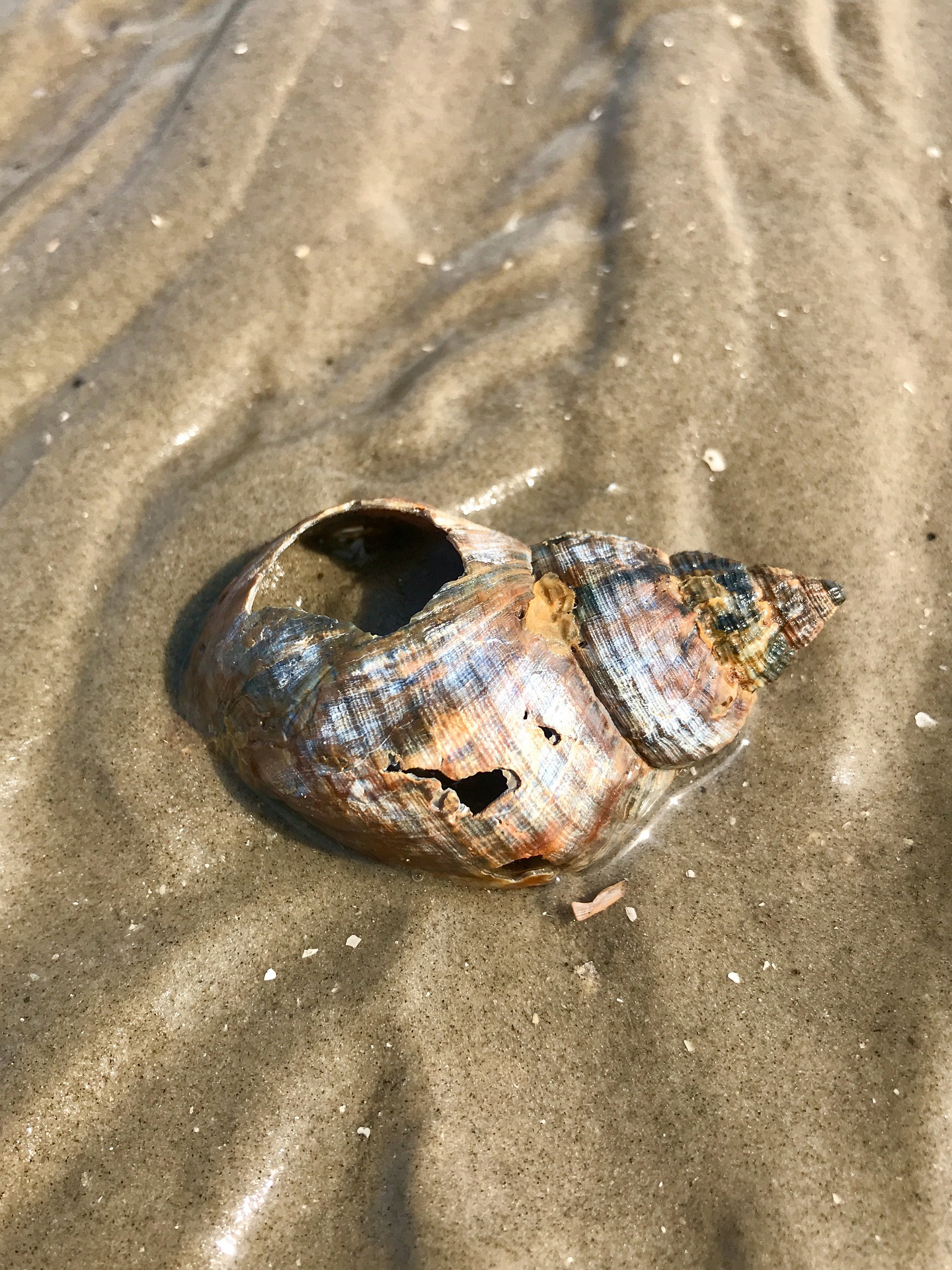
I wrote the story one night around Thanksgiving of 2013. That year we went to Folly Beach for Thanksgiving with my wife’s family. It was insanely cold during the day and even colder at night. We went out one afternoon, braving the cold and the wind that whipped around us. As we walked, I did what I always do: look for shells. I came across this shell that was nothing more than a fragment. It’s edges were purple and faded into pink. I almost threw it back, then stopped. It wasn’t a full shell, but it was beautiful, probably one the prettiest shells I’ve ever seen.

That’s when the story began to take shape. You see, beauty can be found in anything if you look for it. It’s what the main character of the story didn’t know, but what Mazzy did. I tucked the shell into my coat pocket and wrote the story shortly after.

Fast forward to the end of 2021. Cate and I return to Folly Beach on a warm day shortly after Christmas. We walk the beach for a couple of hours. At one point, we pass these driftwood trees to our right. Cate had seen them on one of her prior trips earlier in the year and she wanted to show me. She takes me to this tree, one with all these half shells attached to it with twine or string or anything that people could find. Up a little high, as if it were the star on top of a Christmas tree, was a starfish with some words written on it. She took a few pictures and we left. But a seed had been planted. Now, all I had to do was water it.

That night, I sat at my laptop and wrote the story, Forever Broken, Forever Beautiful. It takes place five years after Broken Shells. It deals with the guilt of poorly chosen words and the perceived results of those words. Below are those two stories. I hope you enjoy them.

As always, until we meet again, be kind to one another and keep taking one step forward. It’s the only way you get anywhere.

A.J.

Broken Shells (2013)

Mazzy wanted to walk on the beach. I thought she was crazy. I’ve always thought she was a little nuts, but this time, she was taking it to a new level. It was bitter cold—twenty-six degrees—and it was well after noon, so the temperature wasn’t going to rise much, if any. The sun was as high in the sky as it would go before making its descent back the other way. The wind blew off the ocean, dropping the temperature another ten or so degrees. We had tried the beach before lunch, but the gust whipped her blond hair about her head. It cut through my coat and sweater and the T beneath it. It made my face hurt and my nose run and my body like ice. We gave up then after only a few minutes.

Still, Mazzy wanted to walk on the beach.

“Why?” I asked.

“I want to look for shells.”

“Shells?”

“Yes. Seashells.”

“I know what you mean. Why do you want to look for them now?”

“We can add them to your collection.”

With that, I donned my long shirt, my sweater and jacket. She pulled on only a thin coat, not enough to keep the chill from her skin, much less the wind off her bones.

“You’ll be cold,” I said.

She regarded me with pale blue eyes that hid a truth in them I didn’t see right away.

It didn’t take long to get to the beach. It was a block from the house her parents rented. My hands shoved deep into jean pockets, I still shivered, even with the layers I wore. Mazzy gave no indication she was cold at all.

Clouds rolled in, brought by the wind. A threat of sleet or ice hung in the air. 

“We shouldn’t stay out long,” I said.

“You can go back,” she remarked, knowing I wouldn’t leave her.

For the next two hours we picked up shells to add to a collection I had started years before, when I was only a child of six. I picked up one with frozen fingers, dropped it back to the sand, and plucked it up again. By then the sun was setting behind the darkened clouds, giving the clouds a purple hue. I stared at the shell for a moment, before flipping it into the incoming tide. 

“Why do you throw back the broken ones?” Mazzy asked. In her hand she held a curved piece of a conch shell—it was just a piece, and nothing more. 

“It’s broken—it’s not worth anything.”

Again, she regarded me with those pale blue eyes. They were sadder than I had ever seen. She held up her piece, turned it over in her hand. “Is that how you see them? Just broken pieces that have no meaning. Pieces so insignificant you can’t see the beauty in them?”

“There is no beauty in broken things.”

She frowned, looked down and whispered, “A shell is like a life—fragile and easily broken. Each one should be looked at for what it is: once something beautiful before the world destroyed it, before people destroyed it.” She dropped the broken shell and turned away from me.

I wanted to chase after her, but I couldn’t. Even if it had been a hot sunny day, my legs would not have moved, and my voice couldn’t be bothered to speak up when I needed it to most. 

I looked to the sand. The piece of shell was there. I bent, picked it up and had a hard time standing upright, thanks to the cold that had seeped into my bones. With the dying sun sinking further into the horizon, I caught a glimpse of the purple edge of the shell, the way it turned red, then pink. It was a beautiful fragment of something much larger. It was like Mazzy, and right then I understood her grief.

Life had been cruel to her, but she kept going, kept putting one foot in front of the other. At least until then. 

“Mazzy,” I called, but she was gone. I looked up the beach in the direction she had gone but didn’t see her. I saw shoe prints in the sand that led to the water. You can figure it out from there, right? I don’t need to go into all the details of how I called her name until I was hoarse, or how I ran into the water up to my knees, even as the tide rolled in harder and harder, pushed along by the bellowing wind, or how her body washed up on the shore three days later, bloated and blue and nipped at by hungry fish, or how I cried until no more tears would come, and still, my heart lay shattered in millions of tiny pieces. Or do I?

All that really matters is Mazzy is dead, and I can’t help but believe part of it is my fault. The words I said echo in my skull, haunting me daily, keeping me awake until the early hours of morning. 

There is no beauty in broken things.

I was wrong. 

Mazzy was a broken shell, but she was beautiful in her own special way.

I once had a collection of seashells. They were whole and carefully cleaned and sat in boxes in my closet. They were beautiful. They still sit in their boxes, but I haven’t added any to them since Mazzy left. Now, I walk the beach in search of the beauty of broken shells …

Forever Broken, Forever Beautiful (2021)

It’s warm today, even for mid-November. The last time I was here, it was bitterly cold, in the mid-twenties and with a wind coming off the ocean that made it feel like it was below freezing. That was five years ago. Five. Years. Ago.

I can only shake my head at that. 

I left my car in the gravel parking lot. Four years ago, this part of the beach had been wiped out thanks to Hurricane Andrew. The parking lot had been just a dirt road that dead ended at a small building with two changing rooms—one for women, one for men. A sandy path led from the building to the beach; a thin slat fence kept people from going onto the dunes. Now, there’s a building with four ramps leading up, up, up to changing rooms and bathrooms. There is even a deck area with nice wooden tables you can sit at and look out at the ocean. It’s a beautiful view from there. 

Mazzy would have thought it was neat, maybe interesting, but beautiful? I’m not so sure. 

The ramps lead to a long boardwalk that takes you right onto the beach. Real guard rails keep people off the dunes. 

“Are you sure you’re ready for this?”

I look to my right. Kimberly stands there. Her light brown hair moves with the slight breeze. There is concern in her hazel eyes and written all over her face. She holds a small paper bag with both hands in front of her. She’s a good person, my friend, my heart. She’s understanding, and in so many ways, I don’t deserve her. She knows Mazzy no longer had my heart, but a big part of me still missed her … still mourned her. She knows that, too.

“Not really,” I reply. “But I need to do this. I need to put this behind me. If not now, when?”

She nods. It’s a sweet gesture of pure understanding. She also knows this is as much for her as it is for me. We can’t go on until this is done. 

We walk, not quite side by side. She’s a little ahead of me, and I’m okay with that. She can’t see the anxiousness on my face that way. We go up the ramps and to the boardwalk, where the view is absolutely breathtaking. The tide is coming in and the whitecaps roll along the shore. There are a handful of people on the beach. We stand there for a few minutes, then walk down the boardwalk to the beach. There are three steps that lead to the sand. She goes down. I stop. 

“Are you okay?” she asks after taking a few steps and realizing I’m not there with her. 

I take a deep breath, swallow the nothing in my mouth and nod. I’m not okay, but I hope … I hope, soon, I will be.

Kimberly walks back to the steps and reaches out to me. Her nails are light purple and seem to shimmer in the sunlight. “I’ll be right beside you the whole way. Just take my hand.”

I take the three steps down to the sand and grab her hand. It’s warm and soft and everything I need to go forward.

To the left are a row of houses that span about a mile, then a hotel that seems to extend forever. Just beyond that is the pier loves stand on and grumpy men fish from. To the right is just beach. No houses. No hotels. Just beach. We go right. 

There are less people in this direction than the other, mostly out of towners from up north who probably didn’t expect it to be in the upper sixties down south this late in the year. What they don’t know is this is typical South Carolina weather. Today it’s upper sixties, tomorrow it might be lower thirties. Stick around a few days and you can experience all four seasons in less than a week. 

Neither of us speak as we walk along. I try not to look at the ground, at the broken seashells that dot the sand. To the right a few small trees have grown up on this side of the dunes. They look like nothing more than driftwood that sprouted roots and grew into the ground. 

Then I see what I’m looking for. It’s still over fifty yards away. One of those driftwood trees stands by itself. It has no real branches and it looks like it could be a wooden person standing there with two arms extended out and a pointy head separating them. Part of me thought the tree would be gone, pulled into the ocean when Hurricane Andrew blew through, but there it stands. And what lies beyond it is our destination. 

I squeeze Kimberly’s hand. She squeezes mine back. 

We approach the tree. About ten yards from it, we stop. Just beyond the driftwood tree is another bank of smaller trees, these with dozens and dozens of limbs. One, in particular, calls to me.

“Is that it?” Kimberly asks.

“Yes.”

For at least a minute, maybe two, we stand there, staring at the tree.

“Are you okay?” 

I’m not. “Yes,” I lie. She knows. 

I release her hand and take a few tentative steps. I pass the driftwood tree that could be a wooden person and stop in front of one that could have been a bush at one time. Like the driftwood tree, I half hoped it had been swept away. Its branches have no leaves. It holds seashells, put there by people over the years, memories of loved ones or important moments. Most of the shells are gray or white, just boring things that, at one time, I would have thought were ugly and not all that special. I was wrong then. Each of those bland shells means something to someone.

“Here,” Kimberly says and holds out the small paper bag. 

“Thanks,” I say and take it. I open it. Inside is a piece of a shell—something I once thought was insignificant. I reach inside, pull out the shell. It’s the curved piece of a conch shell. It’s white and pink and when the light reflects off it, the pink looks purple. Once upon a time, I would have tossed it back—in fact, I had, five years before, on a frigid November night when the temperatures were anything but warm. Mazzy had picked it up and regarded it with terribly sad eyes. 

“There is no beauty in broken things,” I said that night. I’ve lived with the guilt of those seven words ever since. Mazzy considered herself broken, even at sixteen, with what should have been her entire life before her. She looked at the shell and spoke about broken things and humanity and dropped it back to the ground. Then, as I bent to pick it up, she walked into that icy ocean. Her body washed up on the shore three days later. It may have washed up sooner, but she wasn’t found until three days passed. 

And I haven’t been the same since.

Last night I drilled a hole in the thick end of the shell. I ran a zip tie through the hole and connected the two ends, creating a loop. I wrote on it in tiny print, Mazzy. Forever Broken. Forever Beautiful. Forever loved. This morning, Kimberly put it in the small bag. Now, I hold it in my hands. The sun shines off it, making the pink a beautiful purple. 

I lick my lips and swallow hard. My chest tightens and I struggle to breathe. Finally, I hand the bag to Kimberly and take the few steps to the tree. There is a shell on one branch that someone—either Rochelle or Augustus wrote the words: Rochelle and Augustus 4 Ever 11/02/2021. There’s a dried out starfish on the top someone wrote a bunch of words on that I can’t read it. I guess it represents the star on the top of a Christmas tree. Maybe.

I hold the shell up by the zip tie, turn it over and read what I wrote. Mazzy. Forever Broken. Forever Beautiful. Forever loved. 

I slip the ornament on a branch not too far below the starfish and pull the end of the zip tie, tightening the loop and securing the shell in place. 

“I’m sorry, Mazzy,” I say as tears fill my eyes. “I miss you.”

I lower my head, take a deep breath. The floodgate breaks and I can do nothing to keep from sobbing. A warm hand touches my back, then I turn. Kimberly’s arms go around me, pull me into her. One hand goes onto the back of my head when I lower it into her shoulder.

We stay like that for a while, until I have cried my tears out, until I have wet the shoulder of her shirt. Not once did she remove her arms from around me. Not once did she tell me I needed to grow up or get over it or anything else along those lines. I said I didn’t deserve her. I don’t. 

Then I hear it, a soft voice. Not Kimberly’s but Mazzy’s. Two words. That’s all.

It’s okay.

I look up. I pull away from Kimberly and turn around. The sun shines off Mazzy’s shell and I see that beautiful purple. A soft breeze blows through the branches and the sun catches the shell. The pink and purple and white glisten and seem to wink at me. I smile. It’s nothing much, but still a smile. 

“Thank you,” I whisper. 

I wipe my eyes and take a deep breath. For the first time in five years, I feel light; the weight of guilt lifted from my shoulders. I turn around. Kimberly stands in front of me, her eyes full of her own tears.

“Are you okay?” she asks.

I nod. “Yes.” It’s the truth this time. She knows it.

WHY?

I wrote a letter at the end of 2020 that I eventually sent to my publisher, editors, proofer and select friends. It is titled, Why I’m Getting Out of the Publishing Business. When I wrote this letter, my resolve to leave the publishing business was so strong I almost sent it without letting it sit, without letting my strong emotions run its course before making such a decision. Instead, I sat on the letter for nearly a month longer, watching things play out, seeing if I would have a change of heart. 

I did not.

One of the biggest reasons for my desire to leave the business of publishing is I feel the system is broken. I feel there are too many small presses with the right ideas but without the funding and/or the understanding of how to make those ideas work for both them and the authors. I feel there are small press publishers who steal the ideas of others to benefit themselves within the writing and publishing communities. I feel there are so many writers out there who don’t care about the readers and will throw anything together to make a buck. 

I feel the business model in publishing is broken. Authors submit their works to agents or directly to publishers, who, if accepted, make more money off the authors’ hard work than the actual authors make. But the business of editing, creating cover art, marketing and so on is why the publisher makes X percent of the royalties and the author makes x percent. Please, understand something important that has been lost throughout the years: without authors, there are no publishers. 

There are rights—so many rights—to published works that authors lose for either a period of time or forever when they sign certain contracts. But those authors get advances, you say. Only with certain publishing houses, but if the book doesn’t sell well enough to meet the advance amount that puts the authors in a precarious position. Sometimes part or all of that advance has to be paid back if the book doesn’t meet the publisher’s expectations. To go with that, sometimes authors have to fight to get the rights to their work back, even after a publishing company has folded. 

That’s not the worst of it. I once had a publisher tell me he would give me the rights to my book back if I paid him five hundred dollars for what he paid out on the book. I asked for receipts and he sent me a bill. I asked for proof work had been done on a book I had not seen edits for though the book was scheduled to be released in less than two weeks. I had not seen cover art, either. The publisher had not done anything he said he would in the contract, and I pointed that out. We had a bitter back and forth until I finally told him he can talk to my lawyer from that point forward. I had already been in touch with an attorney and he had found the contract was null and void and that I could sue the publishing company if I wanted. I did not want to do that. I just wanted the rights to my book back. In the end, I was lucky. The publishing company’s contract provided an out that they didn’t realize was in there. A lot of authors aren’t so fortunate.

Then there is Amazon. I loathe Amazon. There is a mindset among some readers that if your books are not on Amazon, then you must not be that good of a writer. That’s a bogus mindset. Amazon is not a publisher. It is a provider. It provides people who want to publish their books with an avenue to do so. It also provides a means for readers to get those books. It is, in no way, an actual publisher. They don’t edit, they don’t proof. Don’t try to get them to market. They just provide. 

What it boils down to is a story is an author’s intellectual property. It is also an art form—yes, even bad stories are artistic in some way. More than those things, a story is the brainchild of the author. It is a part of them, one the author cherishes. At the end of the day, publishers should respect the authors under their imprint. They should treat them like customers they long to get and keep. A writer is not a dollar sign, and yes, I know the business of publishing is about money. Or is it? Rather, should it be? Maybe it should be about entertaining the readers and giving them the best bang for their buck. I honestly feel doing that will lead to more dollars down the road.

The thing is, it’s not just the publishers doing this. It’s the authors. I work hard on crafting atmospheric and emotional stories. I work hard on putting stories out that move readers. I work hard to give the readers an experience. I work hard on the logic of the stories I tell. I don’t just write some words on a screen and call it good and publish it to make money off readers. That would be tantamount to screwing them. But many authors do. Sadly, readers eat those writers up, hang on their every misspelled word or poorly constructed sentence. 

The art of telling a story is dying and we’ve watched it happen. Sadly, authors have allowed it to happen. It makes their job easier. They don’t have to invest time and energy and heart and soul into crafting something memorable or something that moves you. Just give the readers a beginning, middle and somewhat of an ending and call it a day. Smoke your cigarette. Drink your wine and smile your yellow-stained teeth smile.

I can’t do that. For every story I’ve published, there are at least ten stories I have not. If you do that math, only nine percent of the stories I have written I feel are worthy of seeing the light of day. Nine. Percent.

I’ve always done things my own way. I question things. I question rules. One of my favorite questions is simply, Why? If I’m given an answer I feel is satisfactory, then great, if not, I ask again. Why? The biggest of those questions is why is it done this way? Because it always has been is not a good answer.

So, I left the business for about six months. I wrote more in that six-month period than I did in the previous two years. I cleared my mind. I didn’t watch the business. 

When I decided to step back in, I went with a book I had released in January, then pulled before it could get a head of steam. It’s a good book, one of my favorites. I also went about it differently. I focused on the fun side of the business, which has always been about creating. In September of 2021, nearly seven months after leaving publishing, I rereleased Five Deaths, and I was excited to do so. I was excited to talk about it. I was excited to promote it. I was excited to get it in people’s hands. What a glorious feeling.

That leads us to here, to Patreon. Why? Why Patreon? Patreon is a platform for artist, and as I stated before, writing is an art, sometimes good, sometimes bad, sometimes it can be amazing. Patreon allows the artist to offer you, the fans of such an art as writing, the opportunity to get content no one else can get through a subscription. It allows fans to help artists continue to create. It allows the artist more control over the content you receive. It allows the artist to actually make a little money off their work. 

I’ve been in this business a long time. I’ve seen how writing organizations treat those who are not members and it is shameful. I’ve witnessed biasness firsthand. I was once told by a publisher who rejected one of my stories that he would have taken the story if a more well-known author hadn’t sent him one for consideration. Someone had to get booted so the well-known author could have a spot. He went for name recognition over quality of story. Sadly, that happens a lot in this business. 

Admittedly, I see things differently. I feel this business fails its readers more than it should. I won’t kiss butts to get further in this business. I won’t lie to a reader. If I feel my work is not a good fit, I tell the reader. It might cost me a sell, but if it’s not for that person, what are the chances that person will read it to the end? And what are the chances they will ever buy from me again?

I stated earlier without writers there are no publishers. There’s one other thing that goes with that: without readers, there is no reason to write and be published. The most valuable person to a writer is not the publisher, editor, proofer, cover artist, or beta readers. It’s the book buying reader. You are the most important thing to me, as a writer. Without you, then I’m not writing this. 

So, what do you get by subscribing to my Patreon page? Depending on the tier you subscribe to, you get exclusive stories, either in a series format or as stand-alone pieces, once a month. You get first looks at new books, you’re the first to know about new releases and you are the first to see cover art. You get a quarterly print booklet, much like my original Brown Bag Stories or Southern Darkness booklets, mailed to you in February, May, August, and November. You get an exclusive first look at my novel Unbroken Crayons—once a month (over a twelve-month period) a new portion will be posted, and you get it all before it is released. There is a 25% discount on print books. You also get what I call ONE STEP FORWARD—one writer’s journey in this business of writing. You also get a birthday shoutout video from me and your name goes in the Great Big Page of Appreciation at the end of my books. Again, all that depends on what tier you subscribe to. I absolutely must stress that. It’s not free. 

So, if you are here, I thank you. You’ve taken time out of your life, from your daily activities, to come here and read my words. Thank you for your support, here on my Facebook page, and hopefully, over at Patreon.

On January 1st, I will share the link to the Patreon page. Why not now? It’s not quite ready yet, and it won’t be launched until January 1st. I hope you will consider checking it out, and subscribing to one of the four tiers. And please spread the word. Help me build this Patreon page. 

Until we meet again, my friends, be kind to one another and keep taking one step forward. It’s the only way you get anywhere.

A.J.

Crumbled Blacktop–Rough Cuts #3

I saw the woman on the bridge right before she jumped. 

A little context: I often take long drives on the weekends. I get in the car, crank the music up and drive until I want to turn around, then I usually come home. I usually go on either Saturday or Sunday. Sometimes, especially if the world has been particularly cruel, I go on both days. Still, on a handful of occasions, I drive until it gets dark, stopping only for gas and food, then park for the night on the side of the road at a rest stop or in a state park if one was near. On those occasions, I usually spend the next day driving home.

This was a Saturday, which was shaping up to be the first day of a two day bender. My head ached, as did my heart. The lady I loved—Lelani—left me a couple of days earlier, while we sat at a restaurant during my lunch break. She barely touched her food and she wouldn’t make eye contact with me. 

“What’s wrong?” I asked her. 

She stared down at the table. Her hands were in her lap. When she brought her right one up she had the ring I gave her when I proposed four months earlier (and she said yes then) in it. She set the ring on the table. 

“What’s this?” I asked. I knew what it was. I knew she was breaking up with me. 

She shook her head. “I can’t do this.” She stood and walked off, leaving me sitting at the table, staring at the engagement ring. I was stunned. I didn’t know what to do. Part of me wanted to chase after her and find out what was going on, what happened and how I could fix it. The other part told me it was over. Our turbulent on again, off again relationship was over and chasing her down would do no good. That part won out. 

I paid for our meals, stood and walked away, leaving the engagement ring on the table. 

This is what I thought about as I drove roads I don’t remember and lost hours I would never get back. And my head hurt and my heart hurt and I wanted nothing more than to stop hurting.

I got off the interstate hours before, following road signs for a town I never actually found. I did come across old houses along the road with rusted out cars in drive ways or sitting up on blocks in front yards. I didn’t see any people and I didn’t pass any other cars. The road was blacktop that was more crumbled than whole with weeds and grass growing through all the cracks and crevices. 

I drove slowly, as if on a dirt road with deep ruts that made the front end shiver and the back end shake. At some point, I turned the music off, silencing some punk rock band or other—I truly can’t recall which one it was. The world grayed at some point and the music felt off, as if where I traveled commanded a quietness that felt loud in my ears. 

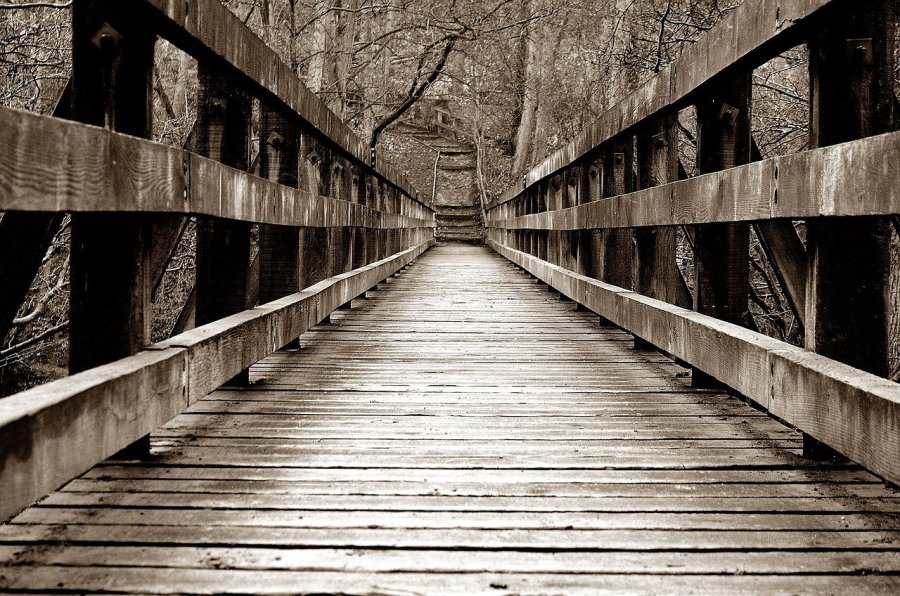
I rounded a curve. Ahead about a hundred yards or so sat the bridge. Even from that distance, I could see it was old and wooden. I won’t lie and say my curiosity didn’t suddenly pique. There I was on an old forgotten road after spending all day in my own head and that was in my sights. I drove on, but by then I was mostly on the road’s shoulder and trying to stay off the bumpy black top. 

About fifteen feet from the bridge, I pulled off the side of the road and parked next to a tall, thick tree with bare branches. It was well into mid-afternoon by then and I would need to start trying to find my way back to the interstate. But the bridge … I had to see it up close. 

That’s when I saw her. She stood in the center of the bridge, her back to me, looking out at the world to her right. She wore a light colored blouse and blue slacks, kind of like the ones my grandmother wore when she was alive. Her hair was gray and she was thin—maybe too thin, as if she were sick. 

I got out of my car and closed the door gently. I didn’t want to startle her. Thinking about that now, it sounds stalkerish. I wasn’t trying to be creepy but I thought it odd that there was an old lady out on this road that didn’t seem to have a name and with no other cars to be seen besides mine. I was afraid she might have wandered off from a home and she was lost, or maybe her car had broken down and she needed help.

For a minute or so, I stood at the front end of my car and stared at her. She didn’t move. The slight breeze that came off the water blew through her hair and ruffled her shirt. I took a step forward, suddenly very concerned for this woman I had never met. My head swooned and the pain that had been small earlier, bloomed.  I was slow about it but I made it to the edge of the bridge. The wood was mostly rotten; there were quite a few holes in the planks and some boards were missing all together. The rails to either side were mostly warped but still in place. 

“Ma’am?” I called. “Are you okay?”

She didn’t look back at me or even flinch like she had heard me. 

“Ma’am?” I called again, a little louder this time. “Are you okay?”

I took a deep breath. My head still thumped but it wasn’t swimming. I stepped onto the bridge. The wood was soft beneath my feet and I hesitated, afraid I might fall right through to the … the what? I couldn’t see water in either direction, just land on my side of the bridge and land across it. Up until that moment, I didn’t notice what was beneath the bridge or what it crossed over. I leaned to my right to peer over the rail. I saw muddy water, but it couldn’t have been much more than a wide creek; the bridge probably wasn’t needed.

When I looked back at the woman, she had turned around and now stared at me. Her jaw was slack and her eyes were blank. Beneath her eyes looked like bruises. Her hands hung down at her sides and the front of her blouse had a large brown stain on it, almost in the center of her chest. I knew immediately she had been shot, or at the very least, stabbed.

“Ma’am …” I said. Both of my hands were out in front of me, as if trying to keep her from moving. “You’re hurt.”

I looked down, then took a few unsteady steps toward her, then looked up again. She hadn’t moved. Her eyes still looked distant and her jaw was still slack. She didn’t see me. I was almost certain of that. It didn’t matter if she could see me or not. I could see her and I couldn’t leave her out there to die. Every few feet I looked down to make sure I didn’t step through a weak spot or fall through a hole that was already there. And every few feet my head spun and I had to regain my bearings.

Thirty or so feet from her, she seemed to notice me for the first time. Her eyes seemed to clear and her jaw clamped shut hard enough for her teeth to clack together. She looked out at the world beyond the bridge’s rail. 

“No,” I yelled when she moved far quicker than I believed she could. She took four quick steps, put her hands on the top wooden rail, her foot on the bottom one, then launched herself off the bridge. She didn’t scream. She didn’t yell. She just plummeted. 

I went to the rail and looked over, the pain in my head forgotten. The woman was gone. She didn’t land in the water or hit dry ground. She was just gone, as if she had never been there before. Maybe she hadn’t been. 

“No, no, no, no,” I said over and over. Then, as if someone watched me, my skin began to crawl. I was in a horror movie come to life and fear gripped my heart. I backed away from the rail and hurried back toward my car the best I could. The pain in my head intensified with each step I took. I reached the end of the bridge, stepped off and started to run for my car …

And somehow ended up back on the bridge, standing where the woman had been when I first saw her. I turned, first to my left to the side of the bridge I had no intentions of walking to, then to my right, to where I stepped onto the bridge and where my car … my car didn’t sit on the side of the road where I parked it. It was off the road, the front end smashed into the thick, tall tree. The front windshield was splintered right about the spot a head would have struck if …

I touched my forehead and pulled back red fingers.

“What’s going on?” 

I touched my head again, this tim planting my palm on my forehead. The skin there was torn. I could feel flesh bunched up near my hairline. I probed a gash that seemed like it ran the length of the top of my head, feeling something hard that could only be my skull. I pulled my hand free and looked at it again. Blood dripped from my fingers and palm. I wiped my mouth with my other hand and suddenly felt the urge to run, that something was terribly wrong and I was in danger. 

I ran for my car, not worrying about the holes or weak boards in the bridge. I couldn’t hear my feet or my breaths or feel my heart beat hard in my chest. I only felt the heavy weight of panic and fear in my chest and mind and the sharp, intense pain of the headache that seemed to split my skull. I reached the end of the bridge, stepped off and was back in the center where the woman had been. 

I almost ran for my car a third time but didn’t. Instead, I walked toward the other end. My legs grew weak as I walked and I didn’t think it would matter what happened when I reached the other end. I reached it and stepped off the bridge and back onto it in the exact same spot as before. 

Now, I stand here, in the center of the bridge. I can see both ends of the bridge, but it doesn’t matter. I can’t step off of it. But this waiting, this feeling of being trapped here with no way to get help isn’t the worst of it. That’s reserved for the creature standing at the end of the bridge where my car is. It came up in an old style horse and buggy, both of which are black. It stepped away from the buggy. It is not much taller than I am and it wears a hooded robe. In one of its hands—hands that look skeletal—is a long pole with a sharp blade on one end. It’s spoken a couple of times, but I can’t make out what it’s saying. It can’t be anything good. It’s on the bridge now and coming toward me. A darkness spills off of it, like a thick fog rising into the air and going out before it. It’s coming for me. It’s …

I can’t run away. I’ll just return to this spot and it will be waiting for me. But what if … what if I jump over the rail and off the side of the bridge? What if …

AJB

Coming Soon: Five Deaths

Andrew Colson never intended to kill anyone. The dead that haunted his childhood had other plans.

The first ghost to appear to him was Billy Jumper, a four-year-old special needs child murdered by his stepfather in a drunken fit. Billy was followed by Sarah Lockingham and Janie Whiteside, then the one person who he loved most, his father. 

After the death of a close friend, Andrew learns what the ghosts want from him and sets out to fulfill their needs. In doing so, Andrew discovers a devastating truth that may push him beyond setting things right for the dead. It might lead him to revenge.  

Coming to an e-reader in your hands or get your hard copy on September 13th.

Spread the news. It’s coming.