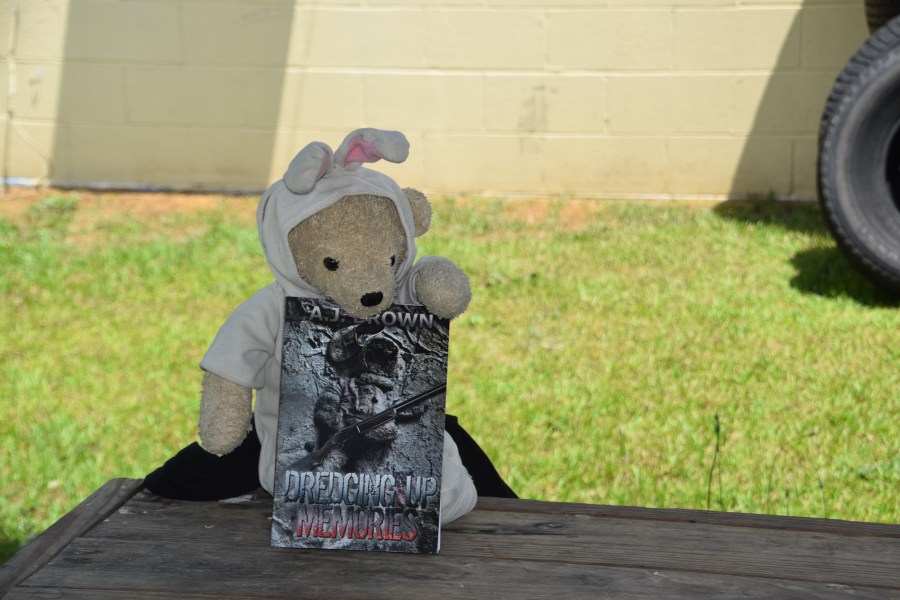

A few years ago, I started a story about a guy named Hank. He was alone in the dead world and searching for his friends and family in hopes of finding some of them alive. That story turned into a novel titled, Dredging Up Memories, and it follows Hank’s story into a downward spiral of … well, I can’t really give you all that information, now can I? Doing that would spoil the book for you.
One thing I can do is tell you about one of the main characters from Dredging Up Memories. Her name is Humphrey and she is a teddy bear. I know, right? Who names a female teddy bear a boy’s name? Anyway, she became like Wilson to Tom Hanks in the movie Cast Away. She also became one of the most beloved characters of the Hank Walker universe.
After completing the novel, getting it published by Stitched Smile Publications, and then writing a handful of shorter pieces involving Walker, I approached a friend of mine about interviewing the characters of Dredging Up Memories. This young man—his name is Frank—went home and wrote out twenty-seven pages worth of questions he came up with for those characters.
What you are about to read are the first twenty-five hundred or so words of Humphrey’s interview. I know, it’s kind of mean not giving you all thirty-nine pages of it, but as I said above, I can’t give you all the information, now can I?
I hope you enjoy the following excerpt from The Hank Walker Interviews.
HUMPHREY

There is a room in an old school in the lower state of South Carolina. The school used to be known as Century Falls High School. It is now Fort Survivor #3. Half a block away is what is left of the middle school of the same name (minus the High, adding the Middle). Directly out the front gates are the remnants of the town that used to be Century Falls. Remnants that consist of burned out cars, and buildings that are little more than husks. If one were to pay close attention he or she would see the occasional dead corpse shambling around the debris and other corpses that are truly dead. If one was listening, then he or she would hear the occasional gun shot, putting that walking corpse down, joining its brethren on the ground among that debris.
This room is on the second floor on a long hall with double doors at each end. One set of doors leads down the steps and to the outside world. For the most part, these doors stay locked from the inside. The other set of doors leads down another hall that t-bones before reaching a set of stairs on either side of that t-bone. There’s no real need to get into where those halls lead.
The room number is 209, and it used to be Mrs. Willoughby’s math class. Most kids hated having Mrs. Willoughby, due to her always angry demeanor and her penchant for giving out zeroes and detention notes. That’s not a problem here now. Mrs. Willoughby is among the permanently deceased. The room, however, has been turned into a bedroom for children who have survived the End Times. Currently there is no one staying in the room and it is as dark in here as night is these days.
A creak rings through the room and down the hall as the door opens. A switch to the left of the doorway is flipped up and the glow of lights spill across the room, forcing the dark into the corners and beneath furniture. Speaking of the furniture, the room is nice. It is painted pink and white on opposite walls. There are a row of four beds directly ahead, foot lockers at the foot of each one. End tables are to the right of the beds, each one with a lamp sitting atop it. On the opposite wall is the exact same set up: four beds, four foot lockers and four end tables with lamps on them. It is clear to anyone who enters that this is a room set up as a basic dorm for little girls who … well, who may have lost everyone except for themselves. On the wall to the right, the same wall the door is on, is a long bookcase filled with books.

Sitting in the center of this room is a table with two chairs. This is not normal. The table is round and the chairs are simple wooden dinner table seats. There is a vase sitting on it with a single daffodil in it, its yellow star-like petals and tea cup bud brighter than the overheads that light up the room. Next to the vase are two bottles of water. They are already open, though the tops are still screwed on.
There is one other thing that is out of place in this room: a video camera. It stands between two of the beds on a tripod, its lens pointing directly at the table.
Two men walk into the room, one of them in his early forties, stubble chinned and a book bag over his shoulder. He reaches into the bag and unzips the front pocket. Jutting from it is a teddy bear in bunny pajamas. The man, known to many readers as Hank, sets the bear on one of the chairs. He doesn’t like the way the bear’s head barely comes to the bottom of the table. Hank goes to the bookcase and snags several of the hardbacks. At the table he sets the books in the seat, sits the teddy bear in it, and then scoots the chair up to the table.
The second man is younger, but not by much. His hair is sandy brown. Wire rimmed glasses are perched on his nose; his hair is long and is pulled into a ponytail that runs down his back. He walks over to the camera and presses a button on its side. The camera comes on. Accompanying it is a faint hum that is barely noticeable if you aren’t standing right next to it. He fiddles with it a few seconds more, pressing the red record button. He looks in the digital view finder and sees the red REC blinking, nods and walks away.

“Morning, Frank.”
“Good morning, Mr. Walker.”
To the teddy bear Hank says “Humphrey, this is Frank. He is going to do your interview, okay.”
Humphrey says nothing.
“Come on, Humphrey. Don’t be shy.”
Still, the teddy bear says nothing. Really, why would it? How would it? It is just a teddy bear, right?
“Humphrey, Frank is a good guy. You have to trust me. Can you do that?”
The teddy bear’s head seems to move slightly.
“Please?”
“Okay.”
The bear’s voice is soft, not much more than a whisper. But it is enough to startle Frank. His eyes are wide behind the lenses of his glasses. A lump has formed in his throat. If there is one thing Frank did not expect it is that the teddy bear would actually speak. He really did believe he would sit there at the table with the teddy bear, who had been Hank Walker’s traveling companion for several months at the beginning of the End Times, and field answers from Walker, himself. Not some inanimate object.
“Did … did Humphrey just speak?”
Hank laughs, rubs Humphrey on the head. “Yes, she did.”
“She? Yes, that is right. Humphrey is a she.”
“That’s right. A lot of folks wonder about that, why anyone would name a female teddy bear Humphrey?”
“It is a fair thought. Why would someone give a stuffed toy that is clearly a female a boy’s name?”
“Why do guys give their cars girl names?” Hank responds. “Who knows?”

“Good point.”
“Okay, I’m going to leave you guys alone for a while. I’ll come back later and see how you are doing. Humphrey, Frank is not going to hurt you. I promise. He and I have already done this. You’re in good hands. Okay?”
Humphrey doesn’t look up, but she gives a small nod and whispers, “Okay.”
With that said, Walker turns and leaves, closing the door behind him.
The room is quiet for several long seconds. Frank has been in similar situations, with the silence being so loud you can hear it. He doesn’t like that feeling. It is awkward and thick. He is determined to fill the silence quickly. He picks up his notepad and flips it open. He turns the pages until he finds the first page marked in his scratchy handwriting as, Humphrey’s Interview. He looks at the first question and starts to ask it, then stops. He looks at the glassy eyes of the stuffed toy in front of him. This is a moment right out of a little girl’s childhood, where the stuffed toy is her best friend and they are having tea and crumpets with their pinkies out and slurping away at the nothing in the cups. He could almost see a girl with her favorite white and pink dress on and her hair pulled back into pig tails, her voice very much like the teddy bear’s in front of him. There is a moment of pure joy as he sees the little girl is blonde and her eyes are blue and she has dimples and freckles across her nose.
‘Is your tea good?’ the little girl asks.
‘Delicious,’ the teddy bear responds.
The little girl smiles wide, showing off her teeth, including the gap where one is missing.
Briefly Frank wonders if the Tooth Fairy visited her the night she lost that tooth. If so, how much money did he (or she) leave the little girl? A dollar? Two? Five? Maybe the Tooth Fairy was very well off and left her a ten spot or even twenty.
Frank shakes his head, smiles and then chuckles softly.
“What’s so funny?”
He is startled by this question. He’s the one who is supposed to asks the questions. The grin leaves his face and the chuckle dies off. “I … ummm … I just didn’t think you would talk to me.”
“Why is that?”
She is well-spoken for a young teddy bear who Frank imagines is around five or six.
“I just didn’t think you would, especially when Mr. Walker left.”
She seems to nod, but says nothing else.
“So, ummm … would you like to get started?”
“Okay.”
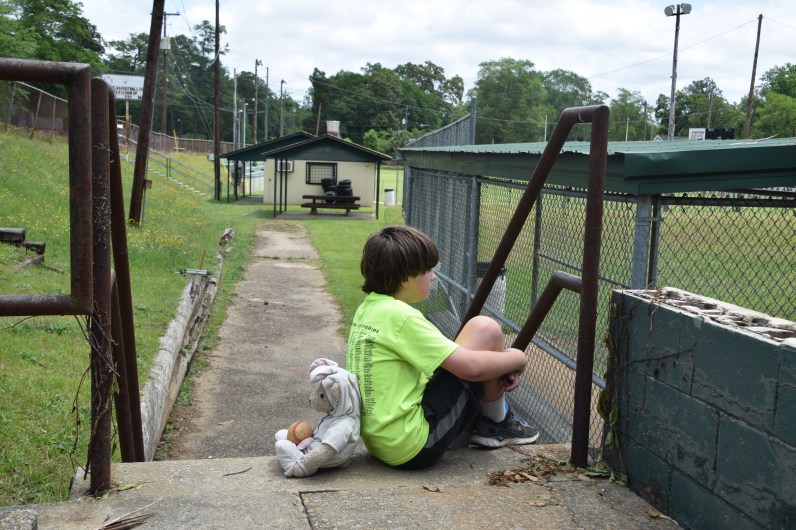
Frank glances down at his notes. The first question is short, but he imagines it is an okay question to ask. At least, he hopes
“Let’s start from the beginning. What was life like before Hank?”
The silence he so hates fills the room, but it’s not that same awkward thickness. It is more of an anticipatory silence, as if Frank is watching a game show on a television of the past, one where the show has gone on for weeks and weeks and now there were only two contestants left and the host is about to announce the winner. There should be some sort of dramatic music playing, and maybe there is in Frank’s mind. The host opens his mouth and says, ‘And the winner of who doesn’t get eaten by a biter today is …’ and the commercial break interrupts the tension, sending the audience into a series of groans and ‘you’ve gotta be kidding me’s’.
But the silence doesn’t last all that long. In fact, it doesn’t even last as long as a short commercial break.
“It was fun,” Humphrey says. Frank thinks he can see her pink string mouth turned up into a smile. And is that a shimmer in her eyes?
“It was fun?”
“Yes.”
“How so?”
Humphrey doesn’t say anything right away. When she does, several seconds have passed and it is not an answer, but a question: “How so?”
Though her face doesn’t change, Frank thinks it does all the same. Maybe it was a twinkle in the eye. Or maybe it was just a slight shift of the head, or the angle at which she is sitting, but something has changed and it is a physical thing he can’t figure out. What he does know is she looks confused, as any living, breathing person would be. Then the light bulb comes on and he realizes she doesn’t understand his question.
“Oh, umm … ’how so’ is another way of asking, how was it fun?”
“I see.”
“So that’s what I am asking: how was life fun before Hank?”
The creative mind is a place where thoughts conspire for either good or bad. It is also the center of imagination, and as Humphrey sits, stoically, in her seat, Frank’s mind begins imagining she iss moving, like a child would, maybe one of five or six years of age; maybe a little older. He can see her tapping her chin as if she is thinking. Her lips are twisted slightly, almost in a pucker. Then she smiles, her small pink thread lips turning up and her fuzzy fingerless hand pointing at him.
“Before Mr. Walker came I was alone in my girl’s room. They had left me when everything went bad.”
She is quiet, this time with her head dipped and her glassy black eyes staring down at the floor. One shoulder goes up in a shrug. Then she lets out a deep sigh.
“My girl’s dad died.”
“I’m sorry to hear that.” And Frank truly is sorry.
“Me too. They thought he was dead and they were sad and scared and my girl—her name was Casey—she held me so close as she sat on her bed. She had taken a shower and I could smell her shampoo. She always smelled so clean after her showers. Her momma made her take one every night, and sometimes I got one too, but not in the tub. They put me in the wash machine with some clothes and I spun and swam and spun and swam, and then they put me in the dry machine and I tumble up and down until I am dry.”
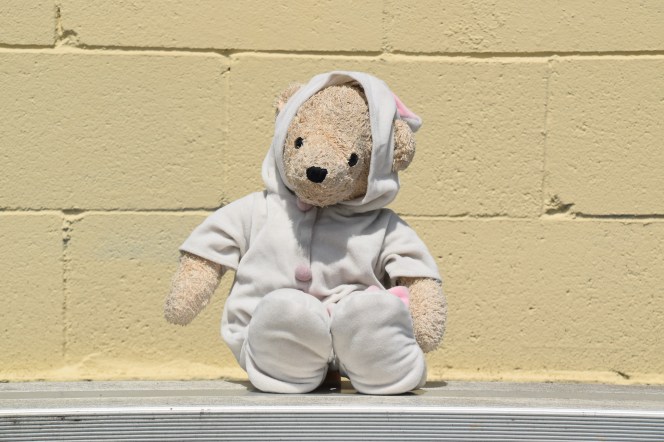
Frank smiles at this. The Humphrey in his imagination is opening up without realizing she is doing so. He remains quiet as she continues her story.
“Then they put my pajamas on and I was fresh like my girl.”
She pauses, as if thinking again. When she speaks, her voice is almost a whisper and Frank has to lean in to hear her. Though he misses the first part of what she says, he clearly gets the second part.
“… they were gone.”
Not for the first time he wonders what it would be like to have gone through the End Times, as Hank Walker calls it. Would he have lost everyone he cares about? Would he have even survived the initial outbreak, and if so, would he have lasted as long as some of the survivors in Fort Survivor #3?
In his imagination—a place he thinks he will spend a lot of time during this interview—he sees tears in Humphrey’s eyes. They are no longer glassy and black, but soft and blue, almost real eyes. His heart sinks into his stomach as he realizes Humphrey is remembering the events that took her girl, her Casey, from her and left her alone when everything went bad. She takes a deep breath, holds it for a second and then releases it. She looks up at Frank. Her smile is still there, but it is not a happy one. What he sees on her face right then is resignation.
“Her dad tried to kill them. Her mommy escaped and took my girl with her. They screamed a lot as they tried to get away from him, and then my girl screamed even more when her mommy grabbed her up and left me behind.”
…
…
“She tried to grab me, but knocked me on the floor instead. I landed on my back. She cried and screamed and then the door slammed shut. I heard the car doors and … they were gone.”
…
“I’m sorry,” Frank says.


 could not be revoked, what would it be? Any change that could be made is wrought with consequences, both good and bad, and any policy change that could never be revoked would make for bad policy. Take education, something I feel strongly about, something I feel is on the “need” list if we want a viable society. But, say we were to be invaded by aliens and required all resources for one year to go toward surviving the invasion as a country rather than education. If a policy of universal free education couldn’t be revoked temporarily we might perish at the hands of the tentacled invaders. Beyond that, every policy must be made with an idea of how to fund, implement, and sustain it at its highest ideal. I don’t think I’m qualified to make such decisions. So, I suppose I would veer away from an individual sweeping reform policy, despite the fact there are many issues I feel strongly about. Instead, perhaps I would try to install a diverse, flexible, and highly intelligent council that operated outside the influence of politics and money and that could help create policies with the public’s input for society’s good. Of course, now we’re essentially speaking about the total destruction of our current and corrupt, money motivated political system, and such an overhaul is bound also to have unforeseen consequences, although they may be preferable to the abomination we currently kowtow to. It would also likely be met with vehement opposition by those who benefit from the status quo and be susceptible to corruption in of itself. Which, I suppose would lead me to deciding that the one change made that couldn’t be revoked be that I was the ruler of my country for ever and ever, past my one day with the stipulation that I would step down from my position once I installed an new and fair system. But now, don’t I sound like a wondrous dictator?


 Type AJ Negative