Three Seconds of Life

I want to tell you a story. Well, it’s not really a story, but a moment in life, a few minutes of a day that was pretty much like any other day, except for these few minutes. But aren’t these moments what stories are made of? Aren’t these moments the times that we recall later in life, the stories we tell people? Moments like this are exactly what stories are made of.

It was a wet day. Gray outside. Rain coming in fits and starts. Just two days earlier it had been in the upper seventies. Pollen dusted most outside surfaces. People had been out and about enjoying the beautiful weather. But, like I said, that had been two days earlier. On this day it was in the mid-forties, rainy and windy. I’m not sure that really plays into the moment, but it might have. I’ll let you decide.

The events took place after a routine morning of stretching, coffee, getting ready for work, and going to that job I got ready for. 

I went to the post office, something I do from time to time when there is no one else there to do it. I had my raincoat on and I walked the two blocks there only getting rained on a little. At the post office I said good morning to Mrs. Cathy and we exchanged about thirty seconds worth of pleasantries. We gave our “Have a good days” and I left. The rain had picked up by then and I flipped my hood up.

Normally, I will make a left at the corner and walk along the sidewalk until I reached the next corner, where I cross the many lanes of traffic one way, then the many lanes of traffic the other way. I then walk the half block to the backside of the building I work in. It’s pretty simple and usually takes about ten minutes round trip. 

This day should have been no different.

I reached the corner of the block and stopped. Though I had the little white walkie man on the sign and the light was red for cars traveling in that direction, I reached the corner the same time as a car did. It was a burgundy Toyota, nothing new but certainly not something older than ten years. It had slowed a little faster than I liked and came to a stop halfway in the crosswalk. I waited for a couple of seconds to see if the person driving was going to make a right turn, even though I had the right of way. When the car did not go, I stepped into the road and started to round the front of the car. 

That is when things went south. 

I glanced at the car when i was about halfway by it. It lurched forward. Time did not stand still but it slowed down considerably like in the movies or a good book. There was no way to avoid what happened next. I didn’t jump but somehow ‘lifted’ myself a little. The car struck my left knee. I tensed up and lowered my elbow and shoulder as I fell onto the car’s hood. My elbow struck first, then my shoulder. I rolled to my right and off the car, landing on my right foot, then my left. Then I took a step backward.

The entire incident was maybe three seconds, but they could have been far more devastating than what they were. 

I was shocked.

I was stunned.

I was pissed.

I honestly believe the person in the car had struck me on purpose. I thought for a second there that the person had gotten angry that I decided to cross at the crosswalk when I had the light and drove into me on purpose. I imagined this angry guy with a scowl on his face and wearing a wife beater sitting behind the wheel and cursing me for having the balls to cross when I had the right of way. Or maybe he was just impatient and thought I was walking too slowly. I didn’t know.

I held my arms out at my side and yelled, “What the heck are you doing?” Yes, I said heck and not any of the other words that probably could have come out of my mouth. 

I stood in the road, mail rubber banded together in my left hand, and stared at the car for maybe ten seconds. When the driver didn’t open the door I thought, “They’re going to run.” I reached into my back pocket and pulled out my phone, certain I was going to have to take a picture of a fleeing vehicle’s license plate. 

During all of this, the light turned green. I stepped out of the road, my phone in hand and watched the burgundy Toyota. I flexed my left knee, rotated my shoulder and bent my elbow several times to make sure I was okay. Thankfully, there was no immediate notice of injury. 

The light turned red and the car had not moved. The hazard lights were now on and blinking their orange warnings. Then the door opened, and sitting in the car was not some crazed guy wearing a wife beater, but a woman who was possibly eighty or so (and if not, she missed a good chance to be). Her hands were shaking and she was crying—I’m talking ugly crying with tears and her face scrunched up and snot dribbling from her nose like a sniffly three-year-old. 

“Oh my God, Oh My God. I am so sorry.” She said this over and over again. 

Suddenly, I felt like crap standing there on the side of the road. I had yelled, not at the woman, but at my perception of who had to be driving that car. But that wasn’t who was there. Instead there she was, crying—sobbing—and shaking like a leaf in the wind. She was pale and constantly saying “I’m sorry.”

Right then, I had a choice. I could be a jerk and be rude to her or I could console her. Though it should have been the other way around—after all, I was the one hit by the car—I chose to console her. I squatted down in her doorway and we talked. Well, that’s not quite accurate. I talked, she cried and said she was sorry over and over again. 

As I squatted in her door trying to calm her down, I discovered there had been a witness. It turns out, a man who was maybe my age or a little younger, had seen the incident. He walks by the car where I am with this distraught woman and he said to me, “You need to call the cops.” He didn’t asks if either of us were okay. He just saw me do a slow motion Dukes of Hazzard style roll off the hood of a car and all he could say was, “You need to call the cops.” And it wasn’t just what he said, but how he said it, as if he couldn’t see the crying woman. In his eyes, I was the victim and she was the criminal. This was an opportunity for this guy to step in and be somewhat of a hero. Instead, well … you can see what I think of him two sentences from now.

Yes, I got pissed a second time. 

I turned to him and in my amazing wisdom, I said, “You don’t need to be a d*ck.”

It was his turn to have a shocked look on his face. I continued. “If you’re not going to help the situation, stay out of it.” He said something, but I don’t know what it was. He did, however, walk away. 

I turned my attention back to the woman. I learned a couple of things from her: 1) she parks in the garage not thirty yards away from where we were, 2) she works in the building we currently were in front of, and 3) she had just found out her sister was diagnosed with pancreatic cancer. The last of those three things told me her mind was elsewhere. She had said, multiple times, she had not seen me. She looked left then right and didn’t see me. Of course she didn’t. Her mind was on her sister—her terminally ill sister. 

With her still crying, I knew right then she was having a far more difficult go of things. Her hitting me was the straw that broke the floodgates open. It was my turn to ask if she was okay. She was not. I knew that. We sat and talked as cars went by, some honking because they were impatient and we were an inconvenience to them. 

Finally, after about fifteen minutes of trying to calm her down, she said she was sorry one last time. I reached over and took one of her shaking hands and said, “Ma’am, don’t say you’re sorry again. You’ve said it forty times. I forgive you. I am okay. Okay?”

I held her hand for probably thirty seconds. One thing I have learned in life is the importance of the human touch. The human touch is personal. It can have a calming effect or a damaging one. This is why hugs in hard times are so important and often lead to people letting their guards down long enough to get a good cry out. This is why physical or sexual abuse is so damaging, because it should never happen and it’s a personal attack on our bodies (and psyches). It can comfort in a time of stress. 

After getting assurance she was finally calm enough to drive the thirty yards to the parking garage, I stood, closed her door and backed out of the road. I watched her make the turn and drive away. 

As I made my way back to the office, this lady was on my mind. I had yelled at her after she hit me. I think it was a natural reaction, but I can’t help but believe that part of the reason she didn’t open her door right away is because of my dramatic display of anger and she was, possibly, scared of me. I felt terrible about that. 

When I arrived back at the office, most of my co-workers were already there. I walked in and one of them looked at me and said something, which I don’t really recall now. 

My response? “If you get hit by a car, do you get to go home?”

It was a tension joke all the way. It was at that moment that it sunk in: I had been hit by a car. Three seconds of my life could have ended much worse than it did. Three seconds either way and this story is different—or maybe not told at all. 

But there’s more to this than those three seconds. There were choices made. I had a choice: call the police and file a police report or look at this woman with compassion and console her. I chose to console her. I chose to look at someone—a complete stranger—as a human being, not as someone who struck me with their car, not as someone I could sue and get money from, not as someone who was negligent and needed to be punished. I looked at her like I would my grandmother, and I hurt for her. I can only imagine what went through her head as she sat in her car: “I could have killed him.” Yeah, that might have been one of the thoughts she had. I can only imagine.

I chose compassion over anger. I chose not to pursue a legal course of action. I chose to forgive and go on with my life. Unlike the guy who passed us and didn’t offer help or even ask if we were okay, I chose to not make this woman’s life any harder. 

There are moments in life where you can do the right thing or the thing you want to do or even the thing everyone else would do. Those are the moments that define you as a person, they show you—and the world—the type of character you have. Sometimes the right thing is easier to do than you think. It’s called having a heart and caring. 

A moment in life—three seconds—and things could have been different in a worse way. This is life. This is the way life happens and life is the very heart of every story.

Until we meet again, my friends, be kind to one another.

A.J. 

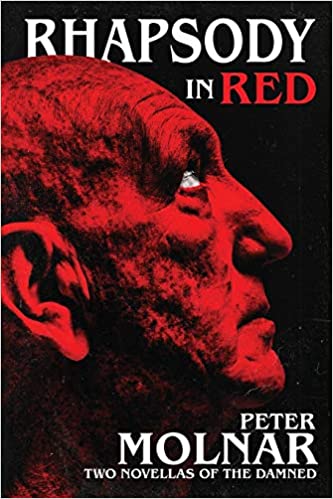
A Talk With Rhapsody In Red Author, Pete Molnar

On December 17th of this glorious year, my good friend, Pete Molnar, released his second book, Rhapsody in Red. It’s a two novella collection that is sure to keep you up at night. Having read some of Pete’s work, I’m really excited to get my hands on a copy.

Here’s the thing about Pete: he is a true lover of horror and one hell of a nice guy. I got to meet him a couple of years ago at Scares That Care and the time I spent with him and his wife was one of the highlights of the event. I couldn’t think of a better person to support than Pete.

Shortly after the release of Rhapsody in Red, Pete and I had a chat through PM’s on social media. The following is our conversation, in it’s entirety.

A.J.: So, Pete, talk to me about your new book, Rhapsody in Red.

PETE: Well, it started out with just one novella I had been working on about a second Civil War sparked by a pair of Undead Confederate vampires. Then I started a second novella and it just so happened to center around the same vampire theme, only it came from a very different place. 

I’m always listening to the news and following stories and the subject of gun rights and the school shooting epidemic just wouldn’t leave me be. Just as the first novella was sparked by the ongoing tragedy of systemic racism, the second was sparked by another social crisis. My mind married both issues to a sanguinarian plot line and the result is Rhapsody in Red

I’m deeply concerned with societal ills and this is how I process them, so as not to wallow in hopelessness when it comes to some sort of divine reckoning or soothing of the masses. Basically, I worry about the world just as much as I dread what’s underneath the bed, so to speak.

A.J.: I’m curious, what role do the vampires play in these societal ills?

PETE: They take advantage of our weaknesses as human beings as well as manipulate our vices and tragic flaws.

A.J.: That makes sense. 

You state something intriguing in your first response: Basically, I worry about the world just as much as I dread what’s underneath the bed, so to speak.

With this in mind, could the world itself be considered the boogeyman or the monster beneath the bed or in the closet?

PETE: Absolutely. I liken that to the main theme of one of my favorite books, Lord of the Flies. The boys on the island think the island is evil and there is a monster stalking them. In reality, they fail to realize the monster is within each and every one of them. That hits me hard.

A.J.: In Lord of the Flies, Piggy’s death is what I feel is a turning point for the story. Though Roger was responsible for his death, the events leading up to that point all build up to the moment where Piggy dies. In this way, the evil is kind of a creeping up type of thing. Do the events of the two stories in Rhapsody in Red have that same build up where the reader possibly starts dreading turning the next page?

PETE: I think so. Each chapter of each novella is like another couple of steps in the downward spiral.

A.J.: Do the two novellas go together or are they standalone stories?

PETE: They are conjoined by the presence of The Familiar, an ageless vampire who has taken the form of The Tumor Deer. It watches and waits, sort of like a god.

A.J.: Nice. Do you feel like you are tackling subject matters that others might shy away from?

PETE: I used to write straight horror when I started out, but I started to realize that I had other things to say that were pressing to me. I realized I was kind of walling myself into a very specific far too stringent genre of writing, and I decided if I was going to keep writing horror then I wanted to do more with it than I was before. And I had to start grounding it in the real things and people that have always scared the sh*t out of me. I mean, sorry, but Cthulhu doesn’t quicken my pulse in the slightest. But a student walking the hallways with an AR-15, picking off anyone that moves, well, that’s something I could find outside my classroom one day.

And that’s horror.

A.J.: That is, indeed, horror—a real horror.

When writing the two stories for Rhapsody in Red, did you find yourself rooting for any characters in particular or did you know where the stories were going and knew the fates of the characters already?

PETE: I always know the ending, but the journey towards that end is almost always a surprise in how it plays out. And the heroines in both novellas have been living their lives under perpetually black clouds of bad luck and hardship. To watch them both grapple with evil and rise above their own difficult circumstances made me feel really good and it kept me writing because I wanted to get them to the finish line!

A.J.: Did those characters surprise you in how they overcame their circumstances?

PETE: Yes, and they made me very proud of them.

A.J.: Is there anything else you would like to tell us about Rhapsody in Red?

PETE: I think we covered everything.

If you’re looking for your horror grounded in both myth and reality, then Pete is your guy. If you’re looking to support a small press author who won’t disappoint you, again, Pete is your guy. If you’re looking to support someone I support, for the third time, Pete is your guy. I love this guy like a brother, and y’all know me, y’all know I’m all about quality work and good people. Give my buddy a try. You can do so on his website where he has several stories posted to whet your appetite, and by purchasing his books, Broken Birds and Rhapsody in Red. 

Until we meet again my friends, be kind to one another.

A.J.
Visit Pete at his Amazon author page and his website.

Space Available

I live in South Carolina. I have worked in downtown Columbia since May of 1990. It’s nuts to see that thirty years have passed since May 29th of that year. A lot has changed. I’ve gotten older, gotten married, raised two kids, released fourteen books and had over 200 stories published in various online and print publications. I’ve blown out my knee, had pneumonia, had a heart scare and a few other things that could be considered life altering events. I’ve lost many friends and some relatives to the eternal sleep. I’ve had some good times and I’ve had some bad times. That is the way of life.

On that Tuesday in 1990, my boss at the time, a young woman named Sheri who was not much older than my twenty years, told me, and I quote: “Go across the street and tell them you want a short, sweet blonde.”

I smiled because, in truth, I really did want a short, sweet blonde. Or, really, any blonde. But that is besides the point.

I left the office, went across the street and stepped into the little mom and pop cafe known as The Lunch Box (established in 1980). When I walked in, I saw two small tables with two chairs each, one directly to the left of the door and one directly in front of me along the wall. A glass refrigerator stood behind the table in front of me. Inside were various salads, banana pudding, and boiled eggs. To the left of the refrigerator was the entrance to the cooking area. That opening wasn’t but maybe thirty inches wide. A counter spanned from there and formed an L that ran the entire left side of the area just beyond the table directly to my left. 

Behind the counter was a short, round woman. Her name was Vickie. She was pleasant and funny, but also a no-nonsense woman. Making sandwiches was another woman, Eleanor. It turned out, they were sisters and they were the owners of The Lunch Box. Next to her was a young man named, Todd. 

I walked up to the counter. There was a young woman in front of me who had just ordered her food. Two people walked in after me and stood in line behind me. 

“Can I help you?” Vicki asked.

“I hope so,” I said. “I need a short, sweet blonde.”

The girl who ordered before me smiled, almost embarrassingly, for me. Vickie also smiled in amusement. I probably should have phrased my request differently. 

“A small coffee, with cream and sugar,” Vickie said and rung up my order. She gave me the coffee shortly after, and she was still smiling when she did so.

That was the first time I had stepped foot in The Lunch Box. Over the next twenty-nine years of my life, I would go there quite often for my breakfasts and lunches. I loved their chili cheeseburgers before switching to their hotdogs with chili and cheese and mustard, no onions, please. 

I got to know Eleanor and one of her sons. I became friends with Vickie and was even treated to her one of a kind creation, The Vickie Special. 

For almost forty years, The Lunch Box had been a mainstay on Lady Street in downtown Columbia. During that time period, Vickie passed away from cancer but Eleanor remained, running the place with a welcoming smile and a conversation. 

In early April of this year, as places all across the world were closing their doors temporarily due to the coronavirus, The Lunch Box did the same. I must admit, I was concerned that the doors would remained closed. 

Today, I walked to the post office on Marion Street. On the way back, I walked down Lady Street and went right by The Lunch Box. The front door had been busted out during the race riots in May. There was a piece of board where the glass had been. On the window to the left was a sign that simply said, Space Available.

I stood there for about thirty seconds looking at the sign. I shook my head, saddened by the absolute realization that The Lunch Box would not be coming back. I last ate a couple of hotdogs from there about a week before they closed the doors. This was a sad moment for me, and I’m sure many people in the area will be as saddened.

I think back to Vickie’s amused smile when I told her I was looking for a short, sweet blonde and I can’t help but feel a piece of my life—one thirty years in size—is now gone forever. I think about Eleanor and her asking how I was doing, then how my marriage was going, then how my kids were doing, then how my writing is going. I’m going to miss that place, it’s friendly atmosphere and people.

To Eleanor, to Vickie, to Todd, to all of those who have worked there and brought us good food that wasn’t expensive, as well as smiles and real conversations, thank you for all the great years you gave us. God bless you all. I’m sure I can speak for all of downtown Columbia, you will be missed greatly.

Until we meet again my friends, be kind to one another.

A.J. 
Communion, A Short Story

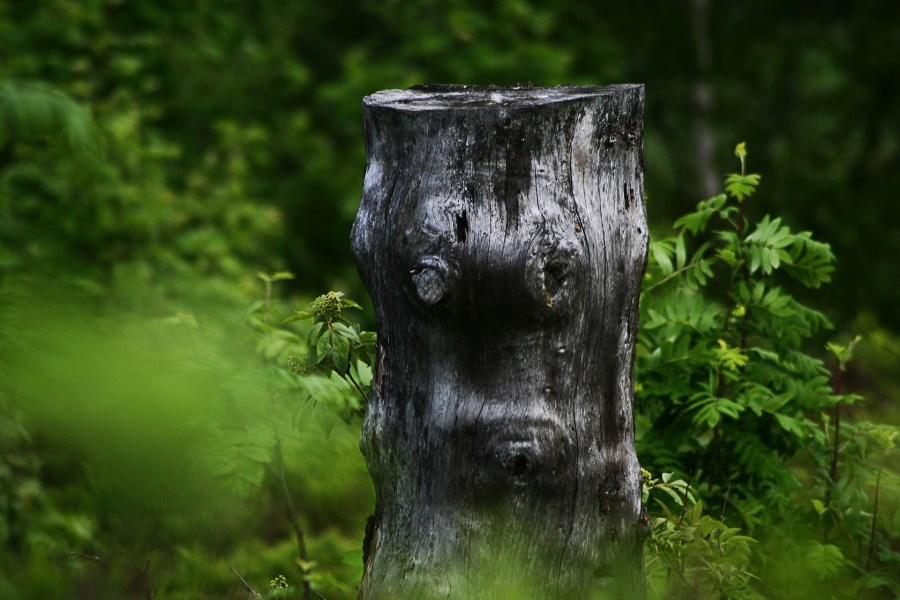
My dad sat on a tree stump every day before dinner. It was about three feet tall and stood near the back fence. Dad looked more like he was leaning when he sat on it. Usually both hands dangled between his legs and he stared off beyond our yard toward the trees that ran along the backside of the neighborhood. If you walked through the trees, you could only go about ninety or so feet before you came to a stream that split the center of the wooded area. 

It didn’t matter how hot or cold or rainy it was, he went to the tree stump, sat for a few minutes, then came inside. On some days—mostly in early fall—he would sit a little longer, sometimes with his head bowed as if he were asleep or maybe praying. Dad wasn’t the religious type, so I doubt he ever prayed.

I guess I was four or five the first time I noticed him go outside and to the stump. I went to go after him, maybe so he would play with me, but probably out of curiosity more than anything. 

“No, Heath,” Mom said from where she stood at the counter, cutting a peanut butter and jelly sandwich in half for me. 

I looked back at her. “I wanna go outside,” I said—or I think I said. Time has a funny way of playing with memories. 

“Not right now.”

“Why?”

“Your dad’s having communion.”

“What’s com-u-non?” I asked. 

“It’s what your dad is doing right now.” She set my sandwich on the table. “Now sit down and eat. Your daddy will be inside when he is done.”

I didn’t sit and eat. Not at first anyway. I went to the back door. It was open and the screen door was shut. I could see Dad from there. His shoulders were slouched like he was tired. His head was down. I thought he just might have fallen asleep. Then I saw his shoulders go up then down a couple of times. His head bobbed in sync with them.

“Sit down, Heath,” Mom said and steered me away from the door with both her hands. She closed the door gently.

I ate my sandwich and set my plate on the counter. Dad came in as I was leaving the kitchen to take a bath. He looked so tired. His eyes were rimmed red and there were angry red squiggly lines in them. The tip of his nose was pink. He wiped it as he went by me and to the bathroom where he washed up. He didn’t say anything to me as he passed, just went by without even glancing in my direction. I remember how bad it felt. He walked by me as if I were invisible. Maybe I was.

“Get ready for your bath,” Mom said when she saw me standing at the foot of the hall looking toward the bathroom where Dad went. She sounded irritated. That was her default setting.

“Dad’s in there.”

“He won’t be for long, so do what I said to do.”

I went to my room and gathered my night clothes, then took a towel from the hall closet. I waited outside the bathroom door until it opened, and Dad walked out. His eyes were no longer red, and he didn’t look as tired. 

“Hey there, Heath,” he said with a smile. He bent down and picked me up, then gave me a big hug. His hugs always made me feel safe, like everything would be okay. He set me down and all was right again. He didn’t look worn or weighted down at all. He didn’t look sad. 

Every day for the next six years, I stood at my window, watching Dad out on the tree stump. After the first time I was shooed away from the  back door, I didn’t think Mom would take too kindly to me going and watching him as he had communion. 

I still didn’t know what that meant.

***

I was eleven when Mom died. She wasn’t really the loving type. She was stern and rarely gave hugs, kisses or said ‘I love you.’ I should have felt more, but I didn’t. I think I felt more ashamed that I wasn’t as sad as I thought I should be. It didn’t help that we had argued before I left for school. I wanted to go to Jerry’s house before coming home. 

“Not with your grades, Heath. You come straight home and do your studies.”

I guess it wasn’t much of an argument after all. I left for school, angry at her for the umpteenth time in my life. 

Mom died while I was at school and Dad was at work. It wasn’t anything terribly tragic like the house caught on fire and she couldn’t get out or she was in a car accident, or even someone broke into the house and murdered her. No, it was nothing like that. Mom choked on a piece of toast. 

I found her when I got home from school. She lay on the kitchen floor, faced down. She was still in her bath robe and nightclothes and her face was a shade of purple that bordered on black. I stared down at her. And I didn’t feel anything, at least not right then.

I called Dad, then I called 9-1-1. Then I sat on the front porch and looked out on the road in front of our house. 

The ambulance made it there before Dad did, but not by much. They were inside tending to her body when Dad pulled up in his old truck. He was out of it in a hurry. He forgot to close the door before he ran across the yard to me. His face was red, as were his eyes. I had seen that look every day for the last six years of my life. 

I stood.

Dad reached me and put his arms around me. Just like when I was little and he would pick me up, I felt safe. I know it sounds crazy, but even with Mom in the house dead and the emergency people inside the house doing what they do, I felt safe in Dad’s arms. Everything would be okay.

Dad released me and went inside. I walked over to his truck and gently closed the door.

For me, everything was fine. Like I said, Mom wasn’t very loving, and we never really got along. But for Dad, nothing would ever be the same again. 

One thing didn’t change, though. Like every night since I could remember, Dad went out the back door to the tree stump. He sat, stared off into the woods, but this time I could tell he was crying. I stepped away from the window and sat on my bed. And I cried. too.

***

Dad did the best he could. He was a widower and he and Mom had been together since they were kids. They were high school sweethearts and married right after graduation. 

For the better part of my life since her death I’ve regretted not being closer, not trying, though she never really tried either. Guilt is a funny thing. You don’t realize you’ll feel it until you do.

***

I was sixteen when I finally worked up the nerve to ask my dad why he went outside every day before supper. He was already out there with his coat on and his hands between his knees. His head was down, and I could see his lips moving when I approached him.

“Dad?”

He didn’t jerk in surprise of my presence. His head didn’t swivel on his neck and he didn’t look irritated to see me standing there, my hands jammed into my coat pockets, vapor pluming from between my lips.

“Everything okay, Heath?” His voice was shaky.

I nodded. “Yeah. Yeah, everything is okay. I just …”

“You just what?”

I shrugged. “Dad, why do you come out here and sit on this stump every day?”

He looked away from me, back in the direction of the woods. By then, some of the land had been sold and some of the trees further down from our place had been removed. The frame of a house stood like a silhouette in the dying sunlight. When he looked back at me, he had tears in his eyes. He wiped at them and looked away.

“My Daddy died cutting this tree down.” He patted the side of the stump with one hand. “I was a little older than you, eighteen, I think. He had a heart attack and died where he fell. I come out here to be near him. It’s like he never left. I can feel his presence.”

Dad looked back at me again. His eyes shimmered with tears. “I know it sounds crazy but sitting here makes me feel like he’s still around and not dead and in some box in the ground in Meacham Cemetery. I come out here and talk to him. Then I listen for his voice. I reckon you can say I come to have communion with him.”

I never bothered him while he was out there again. I still looked out the window from time to time, but I never bothered him. It was sacred for him.

Now, I understand why.

***

Barely two years later, Dad passed away. I just turned eighteen, and yes, I see the foreshadowing in our lone conversation about his visits to the stump. He died before supper, and yes, he was sitting on the stump.

He had aged so much in the seven years since Mom passed. He looked older than his fifty-four years. If you do the math, you can figure out my parents had me when they were in their mid-thirties, but Dad looked like he was in his mid-seventies that last time he walked into the back yard to the stump to have communion with his father. 

I stood at the back door, something I hadn’t done since that first time when Mom shooed me away. He sat gingerly on the stump. As always, he looked out to where the woods used to be, but now they were all gone. Houses now sat where trees once stood. His head dipped, his chin touching his chest. Then he leaned to one side and fell.

“Dad,” I yelled and ran from the house. I vaguely heard the clatter of the screen door as it slammed shut. Dad was gone by the time I reached him. I reached into my pocket and pulled out my cell. Much like when Mom died, I dialed 9-1-1. This time I didn’t wait on the front porch, my elbows on my knees and my head down. No, this time I waited in the back yard, Dad’s head on my lap. 

***

It’s been two days since his funeral. The coroner said he died of a massive heart attack. He was dead before he hit the ground. I can still see him toppling off the stump. I can still hear me yelling for him. 

Tonight, just before I sat at the table by myself for the first time in my life, I walked out to the stump where my dad died, and where his dad died. I sat down on the stump with my hands between my legs. Tears spilled down my face.

“I miss you, Dad.”

Then, like so many times as a child, I felt his arms around me, and I knew I would be okay.

AJB

10/15/2020

August Blues

Happy September to everyone out there in TAJN land. For those who are wondering, yes, I took a month off from the website. Yes, it was intentional. I will briefly explain. 

Going into the year, we had a plan to release five books to the masses. We had it scheduled out and spaced so a new book would come out every eight weeks starting at the beginning of March. Each year my wife and I set up events (festivals, conventions, book clubs) where I can promote my books in person. I find I do better face to face or in a group setting than I do through online connections. Personally, I hate promoting through the various social medias. It feels like I am screaming into the void and no one hears me because everyone else is screaming, too. But face to face, I get to meet you, see your personality, hear your voice and you get to see me, learn my personality (which is humorous and sometimes intelligent) and hear my voice. Face to face is, in my opinion, a better way to connect to you, the readers. 

Back in March, we did a book club, signed books, had a fun time with about a dozen women who enjoyed Cory’s Way, my first novel. The day before the book signing, we released My Summer Vacation by Jimmy Lambert, my fourth novel. I was excited to see how people received it. The next week the world began shutting down, people started getting sick. By the beginning of April, stores and businesses began shutting down. One by one, the events for April were cancelled. I was still hopeful we would get in the two we had schedule for May. Nope. By mid-April, they had been cancelled. 

During that month of April I kept myself busy with several writing projects and I made sure to post stories daily on TAJN for the duration of the month. I updated the blog and turned it into the website you are currently visiting. (Have a look around. There are many stories you can read, book links, reviews and other stuff.)

As the months rolled by with no end in sight to this pandemic more and more events were cancelled. We pushed back the book releases, dropping them from five this year to four to three to two … to just the one. I know I could have released the books anyway and stayed on schedule, but without events to go to and only social media to promote, it didn’t strike me as cost effective. In order to purchase books to sell to y’all, I had to be able to sell the ones I already had. I don’t make money in online purchases—Amazon gets almost all of that cash. I make money face to face. The revenue wasn’t there, so the books didn’t get published. 

At the end of July, I received a phone call from one of my favorite events. It was scheduled for October. They were cancelling the event and were letting their vendors know by phone call instead of email or social media.

~Sigh~

This is where I got disheartened. I like being behind a vendor table or in front of a group of people discussing books or answering questions. With nowhere to really go and nowhere to really meet new readers and socialize with them, I sunk into a kind of mini depression. I couldn’t write. The very thought of writing frustrated me. I got angry and I couldn’t sleep. I talked to my wife and my editor, both of whom usually can help me get out of my funk. Nothing helped.

So, I decided to take a break to try and recharge the batteries. I don’t think I needed a break, but inspiration. One of the things Cate and I did a lot of before the pandemic set in were day trips, even ones that were only half an hour or an hour away just so we could get out of the house. I didn’t realize how important those little trips were for us, and especially my writing, 

In late August, we took a drive to North Carolina to try and find a waterfall that wasn’t all that popular among touristy types. We eventually found it after hiking through the woods, going down the wrong trail and almost giving up. It was fun and hot and we were tired when we finished, but it was good to be out and about and in my element—seriously, I love wooded areas and mountains. 

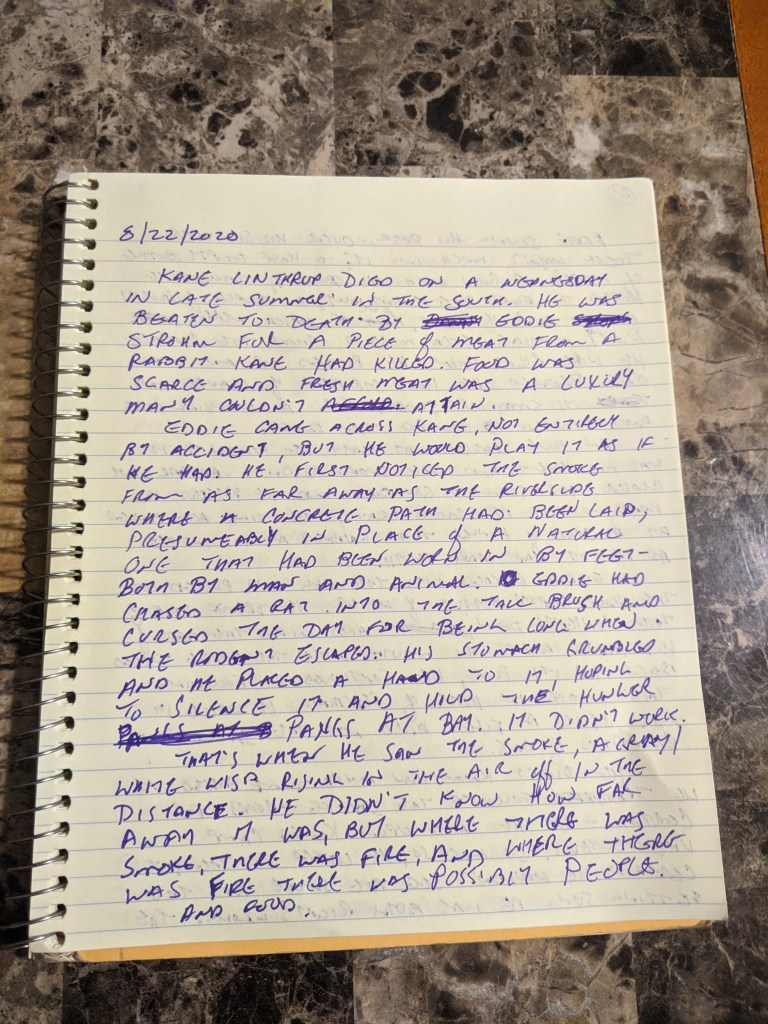
On the way home I sat with my notepad on my lap as Cate drove and I began penning a story in purple ink (don’t judge—that pen is smooth). For the first time in several months I knew where a story could go. I only wrote five pages before stopping—the bumpetty bump of the car on South Carolina roads makes it difficult to write. I will share with you the first couple of paragraphs:

Kane Linthrop died on a Wednesday in late summer in the south. He was beaten to death by Eddie Strohm for a piece of meat from a rabbit Kane had killed. Food was scarce and fresh meat was a luxury many couldn’t attain.

Eddie came across Kane, not entirely by accident, but he would play it as if he had. He first noticed the smoke from as far away as the riverside where a concrete path had been laid, presumably in place of a natural one that had been worn in by feet—both by men and animal. Eddie had chased a rat into the tall brush and cursed the day for being long when the rodent escaped. His stomach grumbled and he placed a hand to it, hoping to silence it and hold the hunger pangs at bay. It didn’t work. 

 It’s kind of rough, but it’s a start. When we got home that night I started writing on another piece—typing this one. A couple of days later, the story was done. Finally, I had written my first new story since April. It was a relief more than anything. I’ve started several other stories and have worked quite a bit on the handwritten one—yes, still writing it in purple ink. I’m not entirely sure I am over the hump, but I think I am on my way. That’s a good thing.

I’ve started developing a plan for 2021, both for pandemic and non pandemic situations. I hope to release five books next year, maybe even six, since the plan was to do five this year and four next year. I don’t know yet, but I know it feels good to have written something and to be able to update all of you. I didn’t need a break. I needed inspiration. 

Thank you for following along and not leaving me during this break. As always, until we meet again my friends, be kind to one another.

A.J. 

My Summer Vacation by Jimmy Lambert … Finally Gets Released

Coming to you, live from wherever you are on June 1st, My Summer Vacation by Jimmy Lambert, a novel by A.J. Brown. 

Starring Jimmy Lambert, Doctor William English, Robert Mahler, Paul Bissette, John Warner and Sarah Tucker. With guest appearances from Mrs. Robinson, Jack Lambert (not the football player), Denise Lambert, Rita Horton, and a host of others. 

***

On the third day of summer vacation in 1979, three boys walked along the side of a road, laughing, talking about baseball cards, swimming at Booger’s Pond and Sarah Tucker, the prettiest girl in school. How could they know a few minutes later one of them would be dead, one crippled and one about to face the worse summer of his life? 

Wrongly accused of a crime he didn’t commit, Jimmy Lambert is sent to The Mannassah Hall Institute for Boys. On his first day there, Doctor William English strikes him. It would be the first of many Jimmy would suffer at the hands of guards and inmates. Fighting back is an option, but could it have dire consequences?

As Jimmy loses hope, two unlikely people come to his aid. Will they be in time to save him from the bullies at The Mannassah Hall Institute for Boys? Or will they be too late?

CHAPTER 1

Jimmy Lambert stood in front of a classroom full of kids. There might have been a couple who were a year older, but mostly, they were his age. It was the third day of seventh grade and none of the students really wanted to be there. They were still in summer vacation mode, still coming down from whatever high, low or in between they experienced since the last day of the previous school year. Most of them had normal, even boring summers, which made the summer assignment just as normal or boring. 

Every kid knew the assignment before they left school on the last day of sixth grade: Write a paper about your summer vacation. It wasn’t like it was a big surprise they would have to stand in front of the class and read the paper out loud—they had been doing this very thing for the last two years and probably would again next year, when eighth grade rolled around.

Though he should have been nervous, Jimmy found he wasn’t. Not even close. He had no sweats and his heartrate didn’t increase when his teacher—a short, round black lady by the name of Mrs. Robinson, with more chest out front than up and down height—called his name. His hands should have been cold and there should have been butterflies in his stomach. Still, he stood from his desk slowly, putting both hands on it and pushing himself up. His warmups were too big for him and cinched in front with a drawstring. On his right leg was a brace that ran from ankle to mid-thigh. It was covered by the warmups. The shoe on his right foot was two sizes too big, while the one on the right foot was a normal sneaker, sized eight in boys. 

After a few seconds, he took half a dozen hobbled steps forward. Then he turned and faced the class, a group of twenty-seven students besides himself. They all looked at him as if he had something interesting to say. Of course, they did. He had been on the news multiple times since the last school year. Some of them probably had questions, ones they might hope he will answer with his report. He didn’t know if they would consider his summer vacation as interesting as the news reported, but he knew without a single doubt, none of them had one quite like it. 

Jimmy held his report in both hands, thankful it was bound by a blue folder, something the other kids didn’t think, or care, to do with the annual rite of passage. He looked around the classroom, saw mostly familiar faces, though a couple were clearly new to the school. His eyes fell on the pretty blonde with the green eyes and wearing a light blue skirt and top. He could see her knees and legs. Her hair was pulled back into a ponytail and her eyes were wide and staring directly at him. If that didn’t make a young boy nervous, then nothing will. 

Jimmy glanced at the binder to see he had opened it to the first page. It simply said, My Summer vacation by Jimmy Lambert. He had put thought into his paper. A lot of thought. Plenty had happened since the last school term ended and before the new one began. Most of those events he left out of his report. Some things were too graphic to write about. Still, it wasn’t a generic rehash of boredom the other kids over the previous two days had given. It had some of the things they probably wondered about in it, but without all the sordid details. Who wants to hear those, anyway?

He looked around the class one final time. None of the other kids looked bored. They all sat at their desk, their reports in front of them. He took a breath, released it, then started.

“My Summer Vacation, by Jimmy Lambert.”

He glanced up, not sure he really needed the paper in front of him to tell the story. 

Jimmy licked his lips, now feeling the butterflies in his stomach. The rapt attention of his classmates was not the same ‘meh’ attention others had received to that point. The nerves came slowly, not because he stood in front of the class about to give an oral report, but because he was about to tell his story, in part at least, to a group of people who might already have preconceived ideas about what really happened between school years. Even so, that wasn’t so scary, all things considered.

“Before I tell you about my summer vacation, I need to tell you about something that happened at the end of the last school year so everything will make sense to you.”

His jaw already felt tired, though he had only stood in front of the class for thirty seconds and said only a mouthful of words.

“Though summer vacation was only a couple of weeks away, my whole life changed one day as I ran from a bully, right through these halls.” He pointed to the closed door with a sliver of glass in the center that acted like a window. He turned back to his classmates. Some of them whispered among each other, surely speculating on who the bully could have been. Jimmy could give them three guesses with the first two being wrong and they would still probably get the right answer. Others sat in their seats, their eyes wide with anticipation in them. 

He looked down at his paper, at the words there, written in his not so neat print, the letters big and easy to read. They were words with no real oomph to them, no real impact. They were boring. He wrote it that way on purpose, hoping to just get up, be quick about it and leave out all the mess that happened shortly after school let out, not ending until just under five weeks before school was back in. But he knew that wouldn’t work. Again, the news had painted a picture for the other students. Now was his opportunity to give his side of the story.

Jimmy turned to Mrs. Robinson. She sat behind her desk, thick, overly large glasses perched on her wide nose, her short arms propped on the shelf that were her breasts. He closed the folder and set it on her desk, then turned back to the classroom of boys and girls. He glanced at the pretty blonde. She smiled, then nodded.

“I don’t need this to tell you about my summer vacation.”

Jimmy took a deep breath. He never thought he would tell this story to anyone besides close family and a friend or two, but there he was, staring at the class as they stared back at him. Now the nerves began in earnest, the butterflies fluttering in his stomach, his palms sweating.

“My name is Jimmy Lambert and I was twelve at the end of last year, just as I am today. I was old enough to hang out with my friends without Mom or Dad holding my hand or looming over me like vultures over the kill. I was also young enough to still be considered a child and still naïve to the world’s venom.” He took another breath, released it, and continued. “I didn’t know time stalked me, its steely claws always reaching, always mere inches away from snatching me up and tossing me into an all too real Hell.”

Some of the boys snickered at the mention of Hell. Though they laughed thinking Jimmy swore and the teacher would tan his hide right in front of them, Jimmy knew better. So did Mrs. Robinson. 

“Quiet down back there,” she snapped, her voice scratchy, “or I’ll give you something to make noise about.”

The snickers stopped and the boys straightened in their seats. Mrs. Robinson gave a backhanded wave to Jimmy. “Continue, Mr. Lambert.”

He nodded, looked at the class and shoved his hands into his pockets. He felt small right then and the classroom looked so much larger. It was intimidating, and the butterflies in his stomach grew a little more intense. Instead of retreating into a shell, Jimmy began his story.

“A couple of weeks before the end of school last year …”

***

Originally, My Summer Vacation by Jimmy Lambert was scheduled to release in early March. Then people started losing their jobs because of shutdowns and lockdowns. I could not, in good conscious, asks people to purchase a book, especially if they had recently lost their jobs or had their hours reduced. Instead, I spent a month giving away free stories on Type AJ Negative. I believed that was the right thing to do. 

So, why now? Why put a book out now? Like many people who write and publish books, I still need to earn a living. Yes, I have a full-time job, but selling books helps keep us afloat. Simple as that. I hope you will consider purchasing My Summer Vacation by Jimmy Lambert. If you would like a print version, you can get it directly from me and I’ll sign it.

Get your copy on June 1st!

As always, until we meet again my friends, be kind to one another.

A.J. 

An Author’s Gift

Recently, I had a conversation with a good friend of mine. He’s a tremendous person with tons of talent when it comes to both music and the written word. He is humble and engaging. I enjoy our conversations. However, he struggles with confidence when it comes to writing. Man, do I get that? Yes, yes I do.

During the course of our conversation, I made a statement that has stuck with me. It was two sentences and I’m going to give you them one at a time, then put them together.

First: Writing is a gift to yourself.

For many people, writing is an outlet, a hobby, something they do because they feel the words. Sometimes, writing is used as therapy. Writing is also a profession that many, many people attempt to succeed at. 

gift-1420830_1920Whether or not you write for yourself or for publication, writing is an art form. It is like music and painting and sculpting and woodworking and any number of other things out there. Most people don’t pick up a pen, a brush or a guitar and right away know how to use those various instruments to create something good, great or magnificent. For most, our first attempts (and even our hundredth) aren’t all that good and are far from magnificent. Simply put, it takes time to develop the necessary skills to create art.

Like with any other learned skill, it can be frustrating, and so often we give up before we get started because we get discouraged that we can’t do what others do. Let me quote Theodore Roosevelt here:

“Comparison is the thief of joy.”

If you know me at all, you have probably heard that statement. I, for the longest time, struggled with comparing myself to other writers. I struggled with comparing myself with their successes and the lack of my own. I struggled with wondering how in the world can someone who isn’t that good of a story teller sell so many books or have so many fans and I couldn’t do or have those things. I struggled with comparing myself to others instead of enjoying what I do and how I do it. It made it difficult to write because I would get so angry that I would rant and rave to my wife (who has always been so patient with me) about my failures and others’ successes. She always said, “You will get there one day,” and little by little, I have.

Back to the point. I learned how much I enjoyed creating stories when I stopped worrying about what others were doing and comparing myself to them. I didn’t say writing stories. I said creating stories. Creating is art, and I create art. But I don’t do it for you, the readers. I have to make that clear, not to you, but to me. I write stories for me. I create art for me. It is the one gift I can give myself every single day.

As of this writing, I have created over 2000 short stories, twelve novels, dozens and dozens of songs, a handful of poems and quite a few haiku.  I have created this art from my brain, my heart and through my fingertips. I have given myself these gifts over the years, and I have kept every single one of them. 

Part of this gift to myself is seeing growth in my abilities. I can go back and say, Man, I wasn’t all that good in 2004, but look at where I was in 2008, then where I was in 2010 and where I am, here and now. I can see growth in everything I write, everything I create. And it excites me and makes me want to create better works with words. That excitement is such a gift. 

Another part of this gift to myself is when I complete a story, when I see it through from beginning to end, I get to see the finished product. I get the self-satisfaction that I succeeded in creating something out of nothing. I get the joy of completion. These are gifts that others can’t give me. I can only give them to myself.

Second: Sharing your writing is a gift to the world.

We all have our favorite authors. They are like the relatives that give us the best gifts at Christmas or for birthdays. They are the aunts or uncles you go to when you need a pick-me-up. They are the people you can rely on to make a gloomy day better. You sit, you open one of their books and you begin to read. Pretty soon, you become engrossed in their words, mesmerized by their stories, and for a few minutes, an hour or two, the world is a little better because you aren’t dwelling in it. You get enjoyment from their stories. You feel because of something they wrote. For a while, you are alive in someone else’s world.

It’s an amazing gift you get to keep forever, either on your bookshelf or on a digital device (or both), but most importantly, in your memories. 

women-4465904_1920I see where people post pictures on social media with the caption, Making Memories. You see pictures of people at the beach and captioned or hashtagged with it is Making Memories (#makingmemories). You see pictures of people out to dinner and you see those words. You see pictures of people on vacation and there are those words, making memories. It’s like pictures we take out of a box from our childhood. If it’s a Polaroid (if y’all don’t know about Polaroids, Google is your friend) there is usually something written in the white space beneath the image. 1982, Tony, Buddy, Me. If it’s a photo that was developed at any fine establishment such as CVS, Walmart, Eckard’s or any other place like those, then most of the time there will be writing on the back of the image. The only difference is we made memories without saying, Making Memories and sharing all those photos with the world. #I’mreallygladwedidn’thavesocialmediawhenIwasakid. 

These pictures are all memories of the past, of when things were better or maybe worse. They’re memories. Some of those memories are the most beautiful gifts you can have. To be fair, some of those memories are like having bad hair on picture day at school. You want to forget that happened, but the picture is there to taunt you for the rest of your life.

Stories are the same. 

When an author shares their work with you, they are giving you a part of their gift to themselves. They are saying, hey, I want to share my gift with you. I want you to partake in my excitement, in my art … in a piece of me. 

Let’s look at that last part for a minute: hey, I want you to have a piece of me. Our stories are our babies. We’ve been with them from conception (the idea), to birth (the writing), to adulthood (completion). We’ve watched them develop and change, sometimes struggling to raise them (use the right words) and correct them (rewrites and edits). Then we let them go and we hope we’ve done our best. Sometimes, before we let them go out into the world, we hug them a little tighter (go over the story one more time), then we say, ‘Okay, child, it’s time for me to let you go.’

Sometimes, it’s terrifying. 

But we’re also ready for that story to go out into the world, to earn a living. They are our children, and by an author saying, hey, here’s my story, he or she is giving you the gift that is a piece of their hearts, their souls, their lives. And those authors want their stories to be accepted, to be loved, to be read and remembered in a positive light. 

My friend and I are both huge Pearl Jam fans. Back in August of 2019, my friend stood in a pub in Wilmington, Virginia, and belted out Once, By Pearl Jam. He dedicated the song to me. I still have the video on my phone. It was a gift to me, a memory I will always have (#makingmemories). It’s also a memory I cherish because it was so much a part of himself that he offered, not only to me, but to everyone there who witnessed it. 

If you’re an author, writing is a gift to yourself. It is a wonderful, beautiful thing to treasure, to look back on, like an old picture. It’s a gift you get to keep to yourself and you’re not being selfish by doing so. It is something nobody can ever take away from you. But if you choose to share your writing, then you are giving the world a piece of that gift, a piece of you and who you are. 

If you’re a reader, you can give a gift back to your favorite author(s). You can buy their books, you can write reviews and you can let the author know you appreciate the gifts they give you with the words they write.

As always, until we meet again my friends, be kind to one another.

A.J.

Donate

If you’d like to donate a couple of bucks to a working author, it would be greatly appreciated.

$2.00

Because I Can (Part 3 of 4)

“Stop it! Stop it, man! Stop hitting my little brother!”

Eight. That’s how many times Uncle Lou punched Reggie. The younger brother’s face was meat by the time he finished. One eye was completely swollen shut, his other one may as well have been, his nose was broken, his lips were fat and split and the blood … his face and clothes and the wall and the floor were covered in it.

And my stomach danced the dance of Earl and Ralph, but nothing came up. 

I looked at Dequan. He looked from me to Lou and Reggie, his head moving back and forth as if he were at a tennis match. 

“Why are you doing this, man?”

I wanted to laugh but held back. “Because we can. Isn’t that what you said when I asked you why you hurt people? Because I can?”

Ahh … the defiance surfaced on his face again, but only briefly. “I’m sorry, dog,” he said, trying to sound apologetic. “I shouldn’t have said that. Just stop, man.”

“Sorry isn’t good enough, DOG. And if you want us to stop, well, you’re just going to have to hurt someone else. You know, since you can.”

“What? Who? You made your point, man. I get it. I hurt people, so you hurt me and …”

“No, that’s not the point, man. That’s not the point, dog. That’s not the point at all. I don’t want to hurt you. I don’t do well with hurting people.” I looked at my uncle. I could see that twinkle in his eyes and Johnny was there again telling me to drown the kitten, drown him and you’re in. He wanted to hit Reggie again. Part of me felt the horrible head of revolt surface, but then it faded as fast as it arrived. I pointed at him and spoke, “That guy, though. He likes hurting people.”

With that said, he punched Reggie again, this time in the side of the head. Reggie’s head jerked to the side violently, striking the wall. Blood seeped from his ear and his head sagged to his chest.

“Stop, man! Just stop, man!”

My stomach clenched, but it wasn’t a feeling of nausea, but a legitimate pain that felt like something gnawing at my insides. I turned away from Dequan and grimaced. I wasn’t sure I would be able to go through with this. Just watching Lou use Reggie as a punching bag made me sick. But there was something else there, something that pushed the sick feeling aside and kept me on track to finish the deed. It was excitement. I could feel it in my chest, in the way it made the muscles on my face twitch into a sadistic smile, the way it made me feel cold inside. Is this how it is for people who commit crimes of murder and rape and muggings and stealing and who knew what else?  Is this what ‘because I can’ feels like? It scared me but exhilarated me as well. 

“He’s out cold,” Lou said and shook his fist. There was blood on it.

“Please, man. Whatever you want me to do … I’ll do it, man. Just stop. Please, just stop.”

“Whatever?”

“Anything, man. Anything. Just stop hurting him.”

“Your brother … you love him, Dequan?”

He nodded, but I could see he didn’t want to actually say it. Yeah, keep that tough guy persona. That’s not what I wanted right then. I needed him to do one thing, one more act of violence, just because he could. But I needed to break him a little more.

“Is that the best you can do? A nod? That’s your brother. If it were my brother, I could say I love him. You can’t say that, can’t you?”

“I can say it.”

“Okay, let’s hear it. Do you love your brother?”

Again, I could see the thug in him wanted to come out, wanted to reach out and punch me as hard as Lou punched his brother. This is a man who was raised to be tough. Big boys don’t cry and all that crap. Then his face softened just a little. “Yeah, I love my brother, man.”

“Good. Because if you love him like I think you do, then you have the opportunity to save his life.”

“What? How?” His eyes grew wide. I had him. I knew it and so did he.

That pain in my stomach subsided. Deep down it was still there, but not so bad. No nausea, and that gnawing pain was fading. 

“Uncle Lou, do you have that picture I asked you to get?”

“Yeah. Let me go get it.”

Lou went up the steps, his boots thudding heavy with each one he took. The door opened and closed and for several minutes it was just me and Dequan.

“Man, please, man. Just let us go.”

“Dequan, do you remember a couple days ago when I said you had no problems killing someone? Remember that? You said that, right?”

“I was bluffing, man. I ain’t never killed anyone.”

“You’re wrong, Dequan. You killed someone.”

“You’re lying, white boy.”

“Am I?”

I went upstairs. I was only gone long enough to go to my bedroom and reach into the top drawer of my desk where a newspaper sat, a constant reminder of just who Dequan had killed. I saw Lou near the back door having a smoke. That was okay with me. It gave me a little more time to talk to Dequan. Back into the basement I went and sat back in my chair. I unfolded the newsprint, then opened it up to a story on the third page, one about an old man who had died after spending three days in the hospital.

***

He slapped the old man. That’s what Dequan did to my grandpa. After he punched him and after Grandpa had hit his head, not once, but twice, that punk slapped my grandpa across the face. 

That’s when I threw up again. 

Officer Sam stopped the tape. I wiped my mouth and motioned for him to keep going. That’s when good old Dequan reached into Grandpa’s pant pocket and pulled out his wallet. There wasn’t much money in it, but he took what there was and threw the wallet across the street. 

Then he slapped Grandpa again. Then he punched Grandpa square in the face. I threw up again. After that I left the police department and Officer Sam. 

Let me say this about the police in my town. Other than good old Officer Sam, they suck. There was enough evidence on that video to arrest at least two of the men involved, including Dequan Jackson, the one who had completed the Knock Out Game the way it was intended: knock out the victim with one punch. But he didn’t just win at the game, he then stole the money out of my grandpa’s wallet, then hit him in the face again. They had the evidence. Any of those blows could have been the one that put Grandpa in a coma. Any of them.

Then there’s the matter of the wallet and the fingerprints that they could have lifted off it. It’s not like Dequan didn’t have a few arrests under his belt, one of which had him on probation already.

Guess what? They did nothing. Nothing.

Nothing …

***

The image on page three of the newspaper was of an old man with a smile on his face and a VFW hat on his head. There were enough wrinkles around his nose and mouth to give him a bulldog look. The collar of his button-down shirt could be seen. The picture had been taken three weeks prior to his death. I provided it to the paper when I thought that both them and the police were going to do something about the crime that claimed Grandpa’s life after three days in a coma. 

Daquan stared at it.

“Who’s that?” he asked.

“My father,” Uncle Lou said. 

I spun around to look at him. I didn’t hear him open the door or come down the steps in his heavy boots. 

“The man you killed when you decided to play that game you thugs play. What’s it called again?”

“The Knock Out Game,” I said.

“Yeah. That’s it. The Knock Out Game.”

“I ain’t never seen that man.”

I didn’t have enough time to react before Lou lashed out, smacking Dequan so hard one of his teeth came out and landed on the floor a couple feet away.

“You lying sack of crap,” Lou said. “I’ve seen the video. I saw you hit him, then take his money, then hit him again while he was out cold on the sidewalk. You did that and guess what? You’re going to do it again.”

“What? What’s he talking about?”

“You’re going to—“

“Stop,” I said. I stood in front of Lou, my hands out, palms up. “Please, stop for just a minute. If he doesn’t do what we want him to, you can do whatever you want to him. But let me do this. Okay?”

Lou nodded reluctantly. His hands went to his hips and he glared at Dequan.

“Do you have the picture?”

Another nod and he reached into his shirt pocket, then handed it over.

I looked at it for a minute. She was an older woman, her hair streaked with white. She wore a yellow housedress and a pair of white canvass shoes. A pair of glasses were perched on the bridge of her nose. She was smiling. Beside her was a young man, one that may have been seventeen or eighteen at the time it was taken.

I flipped it over and held it between two fingers and my thumb. Turning it to Dequan, I showed it to him.

“Recognize this woman?”

Donate

If you’d like to donate a couple of bucks to a working author, it would be greatly appreciated.

$2.00

Because I Can (Part 2 of 4)

I was eight. There were some older boys down the road from me. Johnny Jenkins and Dale McMurtry and Paul Whateverhislastnamewas. They were almost teenagers, and they hung out at the park, near the swings, smoking their Marlboros and swearing their swears and talking about girls and skipping school and how much they hated their parents. They were tough. Sometimes they got in fights, but I never saw any of them. I only heard them talking about it, about how Paul swiped at this Ricky kid and broke his nose, and how Dale punched that same Ricky kid and blackened his eye. But Johnny had them beat. He had knocked a tooth out of Ricky’s mouth and split his lip—with one hit.

Yeah, they were tough, and I wasn’t. I wanted to be, so I approached them one day. It was summer, and it was still early in the morning before the sun was high and the heat was unbearable. Independence Day had passed a couple weeks prior and school was still well over six weeks away. They were smoking their cigarettes and Paul had just flipped a butt away.

I guess they thought I wanted to swing on the playset, because Paul crinkled up his nose and called to me, “You wanna swing?” His dark hair was down to his shoulders and neatly combed for the most part. My dad said only girls wear their hair long, but Paul Whateverhislastnamewas didn’t look like a girl to me. He looked mean, and his stare scared me. 

I didn’t turn and run, like I probably should have. Instead, I stood stock-still and shook my head when he asked his question.

“Then what do ya want?”

“I want to join your group.”

The three of them laughed. Dale had been sitting on one of the swings, slowly rocking back and forth when I spoke. He laughed so hard he fell right out of the swing and onto his knees.

I didn’t laugh. Sure, my stomach quivered, and my chest heaved, but I tried to stay under control. 

“You want to join our group?” Paul asked. 

“Yes,” I said, my voice strong. 

True facts:

1-I was a wimp.

2-I wanted to be tougher.

3-They were the toughest, meanest kids I knew.

4-Before that day, I had no problems with wanting to swear and call people names and whatever. I could even make bad jokes about some of the kids my age.

5-After that day, well … vomit happens.

Paul and Dale exchanged looks. In that exchange I could see they thought I was crazy. They were probably right. Johnny smiled and I should have known I would regret walking up to them thinking I could be cool and tough and smoke Marlboros and talk about what girls looked like without any clothes on and beat up other kids. I should have known better. 

Johnny pushed himself off the pole he leaned against. He blew out the last puff of smoke from his cigarette before tossing it aside. It flipped through the air, end over end until landing on the ground, the hot cherry sparking off in several directions, tendrils of smoke still wafting up from the burnt end.

“You want to join our group?”

“Yes.” I think I moved a little, maybe shuffled my feet or something. I’m certain I was tense and terrified, but unwavering even as heat filled me.

Johnny nodded, his upper lip somewhat curled. There was a shine in his eyes, and I knew that was a bad thing. “If you can pass the initiation, you’re in.”

Dale and Paul shot glances at Johnny, but they were smiling, too. 

Fast-forward about two hours to a rundown house on South Street a few blocks from the park. “Be there at three,” Johnny had said. I arrived a full ten minutes early. They were already there. Paul and Dale sat on the crumbling top step to the house. Yeah, they were smoking their cigarettes and looking cool as always. I had my first doubts about everything right then. My stomach knotted, and my mouth had become dry somewhere between home and there. 

What am I doing here? I thought. Grandpa would be so mad at me if he knew what I was up to. 

Then the thoughts were gone. Simply, I didn’t know what I was about to do, so how could I truly think Grandpa would be mad at me? It was the way little kids (and yes, adults, more so) rationalize things.

“You ready?” Paul asked.

“Sure.” Yeah, right. I was about as ready as a terrified virgin in a jail cell full of men who hadn’t seen a woman in a long time.

They stood, walked across the crumbling wooden porch to the gaping doorway of the house. From where I stood I couldn’t see any further inside than where the sun shone. Up the steps I went and across rickety boards that felt like sponges beneath my feet, not bothering to pause at the doorway because I was tough, and I would show them how tough I was. 

It wasn’t as dark as I thought it would be inside. The sun penetrated through the dust-caked windows, casting a dim light through each room. I followed them to a back room where Johnny sat in a folding metal chair. A five-gallon bucket sat in front of him, along with a brown box, the lid closed on it.

“I have to admit, I didn’t think you would show.”

“I’m here,” I said, not really knowing what else to say.

“Are you ready for your initiation?”

“Yes.” 

(NO! NO! NO!)

Even in the gray of the room I saw the sparkle in Johnny’s eyes. He motioned me over. On lead legs I went to him. 

“Open the box.”

I did, trying to keep my hands from shaking. Inside was a kitten, an orange and white tabby with pointy ears and bright greenish yellow eyes. It meowed loudly, its mouth wide, tongue as pink as any I had ever seen before or even after.

“Drown it,” Johnny said.

“What?” I faltered.

“Drown the kitten and you’re in.”

I stared at Johnny for the longest time. It felt like the seconds had slowed to hours. I looked down at the bucket to see the water within. Somewhere far away I heard the kitten’s constant meowing. Johnny was smiling like the fool he was, that twinkle in his eyes, and behind it the knowing that I wouldn’t go through with it.

I picked the kitten up. It was soft, and it weighed so little, maybe not even a pound. It meowed and clawed at my hand as I shoved it into the bucket of water. Slivers of pain tore at my hand as the kitten fought for its very young life. 

Laughter. 

That’s what stopped me. I heard Paul laughing and it was maniacal and terrifying. Then he said, “He’s actually doing it. What a nut job.”

I heard it as clearly as I’ve ever heard anything.

Then I pulled the kitten out. Blood mixed with water spilled off my hand. The kitten still clawed at me, its meows frantic and terrified. I clutched it tight to my chest, taking its claws through my shirt and into my skin as I ran through the house and out the door and down the steps. All the while, they laughed and yelled for me to come back little wuss boy.

As I ran I could hear Grandpa scolding me for such a horrible thing as to try and kill an animal for any reason at all. I cried, and the kitten meowed and I ran all the way home where I lied to Grandpa about saving the kitten and … and I threw up.

That was the beginning of me never being able to say or do anything bad to anyone.

***

The video played out. The older gentleman, a VFW hat on his head, the two paper bags, one in each arm and the gentle stroll of a man who had lived life the best he could. 

I threw up several times before reaching the end of it. Sam—good, patient Sam—rewound it each time, knowing the torture I put myself through. 

***

“As you can imagine, Dequan, I’m not very good at violence. It makes me squeamish. I couldn’t kill the kitten, and it became a pet—Mr. Pouncer—but I guess I already told you that”

“So, what? What do you want from me?”  

What did I want from me? Truthfully, something I can’t have back. I shook my head and just looked at him. I knew his facial features, the scar on his left cheek, the dark brown color of his eyes, the corn rolls along his skull, the gold front tooth—the right one, not the left—the thickness of his nose and the bulge in the bridge where it had surely been broken before. I knew all these features. I had seen them so often in the past year or so to know them as if they were my own. 

“You’ll know soon enough,” I said and stood. I slid the chair all the way against the wall and started up the steps.

“Where are you going?” he yelled.

“Out for a while. Sit tight. I’ll be back.”

“I need to piss, man.”

I wanted to laugh, but if I would have my stomach would have rolled on me. Instead, I spoke calmly, “Go ahead.”

***

I made a phone call. It was quick and the answer I received for my request was better than I thought it would be.

“When?” I asked.

“Tonight,” came my uncle’s voice.

My stomach quivered with excitement and trepidation. 

“Okay,” I said. “Tonight will be great.”

I was smiling. My plan was coming together easier than I thought it would. Still, I was nervous. What if I couldn’t handle tonight? What if my nerves and stomach got the best of me? I didn’t know, but I wanted to find out. I wanted to see this through, even if I vomited up my intestines. It was important and important things are better done than not, as my grandpa used to say.

***

fist-4112964_1920Uncle Lou arrived around midnight. He parked in the back where there were no lights and the privacy fence blocked all view of the yard. It didn’t matter much. We lived out in the country, away from most folks, and those that were out here with us were a good mile or so away in any direction. The back hatch of his SUV came open, but no light came on. He rounded the vehicle, reached in and pulled something out. It was long, but not rigid, and he slung it over his shoulder.
“Close the hatch, Charles,” he said and made his way up the steps. I shut the hatch and opened the back door. We both went inside, Lou first. I closed and locked the door behind us.

I didn’t need to ask what was wrapped in the tattered green army blanket. I saw the feet sticking out the bottom and knew he had delivered a valuable piece of the puzzle. 

“You want him downstairs with the other guy?”

“Yes, if you don’t mind.”

“Lead the way,”

We made our way down into the basement, the light coming on with a quick pull of the chord. The bulb bobbed up and down and from side to side for a few seconds before settling into a slow seesaw motion.

Dequan looked up as we made our way down the steps. He looked like he had been asleep and had been startled awake. His eyes narrowed when he saw Lou.

“Set him down there,” I said and pointed to the wall opposite Dequan.

“What’s going on, man? What’s that in …”  His words trailed off when he saw the shoes with a familiar mark on them, the mark of his gang.

Lou set the package on the floor and unrolled the army blanket. What happened next thrilled and sickened me at the same time. Realization swept over Dequan when he saw his little brother’s unconscious body unwrapped from the blanket. He pulled at his restraints and tried to kick his legs at us, all the while yelling all sorts of pleasantries.

-What the —- have you done to my little brother?

-I’m going to kill you mother—-ers.

-I’m going to kill both you mother—-ers.

-Reggie, wake up, man. 

-I’m going to kick you’re a—es when I get out of here.

-You’re dead meat, mother—-ers.

I think he likes that one word a lot. But Lou doesn’t. As a matter of fact, Lou doesn’t like many swear words.

“Shut-up, punk,” Lou said and pulled Reggie toward the wall where another set of chains and shackles were. Only these were higher up. 

Dequan yelled on, throwing his threats and curses out at us. 

“Hold on a second,” Lou said and walked over to Dequan. To him he said, “You got one chance to shut-up. You got that?”

Defiance was heavy at work when he spat into Lou’s face. He started to say something, but his lip was split and the back of his head hit the wall before he could get anything out. His body sagged and his head lulled on his shoulders. My stomach flipped, and I felt supper try to come back up. I held my hand over my mouth, forcing it back the best I could, even as cold sweat peppered my face.

Lou came back to where I stood next to Reggie. He was wiping his face with the sleeve of his shirt. He said nothing as he hoisted Reggie to a standing position.

***

Let’s fast-forward again, this time about six hours. 

Uncle Lou and I had finished restraining Reggie a little after one that morning and agreed to set things into motion the next day, and what a long day it would be.

We woke—I slept very little, though Lou seemed to sleep like a baby—had a cup of coffee and some toast, grits and eggs, and made our way downstairs.

The brothers were asleep. I’ll be honest here: I wasn’t sure Dequan was still alive. Lou had smashed his head hard into the wall the night before. For all I knew, he had killed him. That would have been bad if it would have been true. The last year would have been wasted and then what? I didn’t know.

Lou walked over to Dequan and kicked his leg. Dequan woke with a startled scream that made me smile a little. No, my stomach didn’t shake or rock or roll—the last year or so I worked on trying to control it, but honestly, I hadn’t succeeded very often. But I was getting better at it.

“Wake up, scumbag,” he said and kicked Dequan’s leg again,

“I’m awake. I’m awake, man.” The defiance that had been in his voice and on his face the night before was gone, replaced with that dog’s been kicked too many times look.

Again, I smiled.

Then Lou walked over to Reggie, the younger of the two brothers who hung from his arms, his legs slightly buckled beneath him. 

“Wake up, Sunshine,” Lou said and patted the side of Reggie’s face. The younger brother stirred, his eyes fluttered, then he was awake and the blank look of confusion filled his face.

“Where … where am I?” 

“Hell,” Lou said. I flinched. My stomach woke up and the muscles twitched. 

“Reggie? Reggie? You okay, bro?”

“Be quiet, Dequan,” I said.

“Reggie? Reggie? You okay?”

Lou’s jaw flexed and he yelled “Shut-up!” 

“I just want to know—“

Lou leveled a punch to Reggie’s gut. The air rushed out of him and he tried to pull his legs up but couldn’t quite muster the strength. He struggled for air, his mouth gaping open and his eyes clinched shut, tears trickling from the corners of them.

“Why’d you do that?” Dequan yelled and pulled on his chains. He winced. I guessed his muscles were stiff from being stuck in the same position for a couple days. 

I pulled my chair from the center of the room and placed it about ten feet from Dequan and sat down. 

“Listen up, Dequan. This is very important. That man over there is very angry. This man, sitting here in this chair, is not very happy either. You see, you owe us some pain …”

My stomach gurgled when I said that. I bit back the vomit and swallowed. I continued.

“That man is going to get that pain one way or the other, either from you or your brother.”  

I nodded to Lou.

He punched Reggie in the jaw. The younger brother’s head snapped to one side. His lip split, bled and immediately began to swell.

Dequan turned his head as soon as Lou struck his brother. 

“Oh no, Dequan,” I said, “you need to watch this.”

“Why are you doing this? We ain’t never done nothing to you.”

“That’s not true,” I said and nodded to Lou. Another punch, this one to the eye. Reggie let out a small yelp of pain. My stomach lurched.

“What did we do? I ain’t never even seen you before, man. What did we do to you?”

I looked at him. His left eye was swollen mostly shut, his lip busted. Blood had crusted on his shirt. 

“What did you do?” I wanted to laugh at the absurdity of the question, but I didn’t. Instead, I spoke softly. “You hurt people because you can. That’s enough for me.”

I nodded and waved a hand at Lou. He turned to Reggie, a glimmer in his eyes—one like what I saw in Johnny’s eyes when I was a kid—and punched him and punched him and punched him …

***

“Play it again,”

“I think you’ve had enough, Mr. Hanson.”

“No! Just one more time. Please.”

“Why? Why are you doing this to yourself?”

“I have to.”

Officer Sam played the footage. Again, the older man rounded the corner, the camera’s angle catching it from almost a block away. He carried the two paper grocery bags, the VFW hat sat on his head. He wore thick glasses—coke bottle thick, my mom would call them. Nothing changed. He was still minding his own business. 

Then it happened. Six men appeared on the screen going the opposite direction. They were just ordinary men, until they reached the old guy. They were about to pass each other. That’s the way it should have been. The old guy passing the group of six. And if it would have stayed that way …

One of The Six turned his head to the side as they passed each other. Just as the One passed the old man, he turned back, his hand in a fist and swung for the old man’s face. 

The gist of the rest of the video:

-The fist connected.

-The old man’s head whipped to the side.

-That head hit the brick wall beside him.

-The grocery’s fell from the old man’s arms. It’s clear there was a jug of milk in one of the bags.

-The old man fell and hit his head on the edge of the sidewalk.

-The Six laughed.

-The One knelt and slapped the unconscious old man.

And I threw up.

To be continued on Tuesday, May 12th …

Donate

If you’d like to donate a couple of bucks to a working author, it would be greatly appreciated.

$2.00

Because I Can (Part 1 of 4)

Because I Can (Part 1)

By A.J. Brown

I watched the video several times. The first time I felt sick to my stomach—literally. The cop in the room with me paused the video when I stood, my hand over my stomach, and turned to leave. I didn’t make it very far. One hand went on the wall—it was cool to the touch. I grew hot. Sweat beaded my forehead. My stomach turned over, grumbled, and I heaved, though nothing came out. My ribs hurt afterward. 

“You okay?”

He wasn’t gruff, and he didn’t have a raspy movie-cop’s voice. No, this guy talked like a normal person with normal feelings and normal thoughts. Still, he was tough. You could see it in his eyes, the way they appeared hard, as if staring in them too long would be like staring at two polished stones the color of onyx. 

“Give me a sec, okay?”

“You don’t have to watch it again.”

I put a hand in the air. The heat of my face had receded, the sweat began to dry. I could breathe again, but my mouth tasted like a well-worn shoe. Don’t ask me how I know what that tastes like. You won’t get an answer that will satisfy the question. 

I pushed myself back to a standing position. My stomach still hurt, but the cramped nausea I had felt moments earlier was gone.

“Play it again, Sam.”

No, his name wasn’t Sam, but that’s what I called him. He didn’t seem to mind.

revenge 3He clicked the mouse back to the beginning of the black and white surveillance video. An old man rounded the corner of a brick building. He moved slowly, the way most old men do, and he carried a couple of grocery bags—paper, not plastic. He was minding his own business. My stomach grumbled, then quivered. The backflow works kicked into gear. I tried to force the vomit back down, but in the end, it won, I lost, and the floor was splattered with what was left of lunch.

“Really, we don’t have to do this.”

I looked back at the cop through tear-blurred eyes. 

“Yes, we do,” I said, got back to my feet and staggered to the seat.

We watched the video again and again and again, until I saw all I needed to.

###

“Welcome,” I said.

The basement was dimly lit, the single sixty-watt bulb dangling from the ceiling. It was the old-style rope-pull type, with a chord leading from the light’s chain to the ceiling and through several eye loops, ending at the wall by the door with a loop on the end. The sheetrock walls covered the cinderblocks behind them and were painted a flat green back in the seventies. The trim work was six inch baseboards at the bottom and, interestingly enough, at the top. There were twelve steps that led to the first floor of my grandpa’s old house. Grandpa was dead, so what was happening—or going to happen—didn’t matter to him. It wasn’t like he would ever find out. There were no windows, and yeah, the room was a bit dusty. Other than the chair I sat in, there was no other furniture or boxes or bags or anything else in the room.

Well, that’s if you don’t include the dirt bag on the floor. 

The dirt bag mentioned just now probably didn’t think he was one, but he was. I watched him long enough to know he was a dirt bag extraordinaire. 

Extraordinaire.

“Where am I?”

He struggled to sit up but couldn’t get much further than where he sat against the wall, slouched back and looking like a sagging bag of deer corn. His arms were held to the wall by thick chains; twelve-inch bolts had been screwed into the walls, through the sheetrock and right into the cinder blocks. Reinforced metal plates held the chains and Mr. Dirt Bag in place. He squinted, but probably not from the light—like I said, it was dim, a sixty-watt bulb, the old type, not one of those new corkscrew type that burn forever and a day. From my understanding, he had a great fall and bumped his crown. He had some help.

“You’re here,” I said from my seat in front of him. I did a grand wave of my hands, like one of Barker’s Girls from The Price is Right.

He tried to push himself to a better sitting position with his bound feet. They scraped across the floor as if he were shuffling around, and he slid back to his former slouched over position. I watched this with great interest. His struggle with the chains and not being able to use his hands to push off on the floor or even to steady himself brought a sort of satisfaction I wasn’t terribly used to. His face contorted, and he grunted several times before looking up at his arms.

“What’s going on? You need to let me go, white boy.”

White boy? Yeah, I guess you could say I’m white—really I’m more transparent than anything else. The sun touches my skin and I burn to several shades of lobster. 

“I don’t think you’re in any position to tell me what to do.”

“What? Do you know who I am, white boy? Do you know what I can do to you?”

“Yes, and yes, but neither of those matter right now.”

Finally, Dirt Bag looked long at his arms, at the shackles that held him in place. No, I didn’t go for handcuffs—they were just too thin, and the chains weren’t all that strong. Someone angry enough just might be able to break the small chains that bound one wrist to the other. That’s a chance I didn’t want to take. He bent his wrists and used them to pull himself against the wall, but that was as far as he could go—I made sure of that. Before I had the chains put in I researched the average wingspan for a man that stood four inches over six feet. My guess was he eighty to eighty-four inches. I added an extra two inches to that higher total. Do the math—his arms could only go so far before he could sit up no further, and there was no way he was standing, not with his feet all bundled up in ropes and duct tape.

“Let me go,” he said.

“No,” I replied.

I had one leg crossed over the other at the knee. Both hands rested on that leg, folded one on top of the other. I probably looked like a statue or a mannequin sitting there, barely moving.

He yelled at me, called me names I won’t use here—I don’t use that type of language, thank you very much. He threatened me, cursed me. He spat at me once, but most of it dribbled down his chin or landed on his saggy-bottomed pants. He pulled against the chains. 

And I watched it all.

“When you’re done, let me know.”

“You just wait until I get out of these chains.”

I stood from my chair—it wasn’t anything fancy, just something I grabbed from the kitchen before bringing Mr. Dirt Bag into my grandpa’s home—and walked over to him. I knelt about ten feet in front of him. 

“Your name is Dequan Jackson. You’re twenty-two years old and have one brother who is younger than you. His name is Darrell. You live in an apartment on James Schofield Road with any number of whores you call girlfriends. Many of those women are strung out on crack or heroin that you gave them in return for sexual favors. You think you’re a gangbanger. You might be—I haven’t figured that out yet. If you ask me, you’re just another wannabe thug, trying to make a name with drugs and fear. For the most part that seems to work.”

I eyed him for a minute, waiting for a response that never came. 

“Your mother is sixty-two, meaning she had you when she was either in her very very late thirties or forty. Your brother just had a birthday. He is nineteen. You once joked that you had no problems with killing someone.”

I paused for a moment, stared him hard in the eyes. He stared back just as hard, but there was something inside of him that was different now. I had done my homework on him and his family and his ‘posse’ and it was dawning on him that I wasn’t playing around, that his abduction had been planned out by this crazy white boy and he might just be in a world of trouble.

“It wasn’t too long ago that you proved that to your buddies—killing, it’s just a thang to you.”

“I ain’t never killed no one.”

His eyes were crazy wide, like a rabbit trapped down the hole with nowhere to go and not enough time to dig further down. 

“We’ll see about that.”

He started to speak, then clamped his mouth shut. His eyes grew wide for just a second—a second, I tell you. That’s all. Then they went back to their normal almost slits on his dark skin. I could still see a little of the whites, but beyond that, the color was washed away beneath his eyelids. Still, I saw recognition in his face, in his eyes.

“I know what you’ve done.”

“You don’t know anything about me.”

“Really? You didn’t hear anything I said a minute ago? You know, your brother, your mom, your whores? You didn’t get any of that?”

He said nothing. He got it, but he was too stubborn to say so.

“Look, Dequan, I’m going to give you one chance to walk out of here, completely unharmed. You feel me? One chance. That’s the term, right? You feel me?”

Again, he said nothing. Stubborn, for sure. 

“I’ll take that as a yes.”

I stood, paced the floor a couple times, my arms wrapped around my suddenly gurgling stomach. I was nervous. I held the cards and Mr. Dirt Bag could do nothing but sit chained to the wall. Still, I was scared and felt like my stomach was about to revolt. 

(You can stop, you know?  Just blindfold Dirt Bag and haul him away, drop him off in some back alley and say, hey you’ve been warned. Turn your life around and fly straight, or I’ll be back. Yeah, you can go all Batman on him and …)

That was a pipe dream. There was no turning back. He had seen my face. I wasn’t sure if he had seen Uncle Lou’s face, but it didn’t really matter. I was smart enough to figure most of the plan out, but not so smart enough to remember to wear a mask like the dude in Saw or like Jason or Michael or a host of other horror movie villains. And if I let him go he would remember what I looked like, and yeah, you better believe he would come after me, posse in tow. I’m not stupid—I just forgot one little, but holy cow important, detail.

I stopped pacing and knelt back down. I looked him in the eyes and all I saw was contempt. 

“Why do you do it?”

He scrunched up his face, as if he were confused. “Why do I do what?”

“Why do you hurt people?”

He was quiet for a few seconds. I don’t know if he pondered his answer or just sat staring at me, anger burning on his face, but he answered with a smile that showed off one gold tooth. 

“Cause I can.”

It was my turn to get quiet. I didn’t really expect him to answer, and I certainly didn’t expect an answer so … honest. I was stunned. He was defiant. 

“I gave you an answer, now you let me go.”

I stood, put my hands on my hips. I wanted to kick him. I wanted to punch him as hard as I could right in the temple, just like … I wanted him to see stars and feel pain.

But I couldn’t. The thought of hitting Mr. Dirt Bag, of causing him even a fraction of the pain he had caused others, made my stomach sour. I wanted to vomit but held back. Instead of letting my anger get to me, I backed away and sat back down in the chair.

“Let me go. You asked your question, I gave you an answer, now let me go.”

“I said I would give you one chance to walk out of here unharmed. I didn’t say when you would get that chance.”

His upper lip curled, and he growled deep in his throat. A second later, he was cussing me for all I was worth. This is what he said, minus all the swear words:

–What type of ******* game you playin’?–

–Let me go right now, you ****head—

–I’ll kill you, mutha******–

–When I get free, you’ll wish your punk*** was dead—

“I’d like to tell you a story,” I said calmly.

Instead, I stood, walked to the stairs and started up them.

“Hey,” Mr. Dirt Bag called, “I thought you were going to tell me a story.”

“I changed my mind.”

I left the room, turned the light off and closed the door behind me. From outside the room I locked the bolts—all six of them—and slid the three boards in to the homemade latches I had made. If Dirt Bag managed to get out of the shackles, he would have to figure out the six locks, and even then, he would not be able to open the door from that side. I unlocked two of the locks—why make it easy on him?  

My stomach hurt, and I sat down at the kitchen table, a place I had spent many mornings while growing up, listening to Grandpa talk of the war—no, he wasn’t all shell-shocked like many others were. He had no problems talking about what war was and why they fought and just what the heck was wrong with it. My hands shook as I sat, elbows on the table, head down, eyes staring at the yellow Formica-topped table. Had I really wanted to hit the guy? Had I really wanted to hurt him?

You betcha.

I wanted to do all sorts of bad things to that thug wannabe. My stomach rolled again. I didn’t eat too much that morning on purpose, knowing what I planned to do, knowing the man in the basement wasn’t going to walk out of there or even be carried out alive, and it would be all on my head. 

As I sat there, I reflected on my life. I’ve never been able to hurt someone, or something. The thought of insulting someone out of anger made my stomach hurt. The thought of insulting someone as a joke wasn’t too intolerable but was still enough to make my stomach rumble. One time, at a party when I was a teenager (a party I probably shouldn’t have been at) I threw up on Maggie Igliana’s shoes because I laughed at someone jokingly saying Mike Halford’s mom would spread for half the football team. Up went dinner and the nastiness that was half digested beans and franks. It splattered the floor and Maggie Igliana. She screamed. I bolted. Out in the front yard I threw up a second time. I was sixteen. Rumors at school had me being totally drunk and hitting on Maggie. They said I asked if she would spread for the football team. The first time I heard it I vomited in the boys’ bathroom. 

Four things:

1-That was the last party I ever attended.

2-I’ve never told a dirty joke or made a joking comment or laughed at one about someone since.

3-I’ve never been drunk, but that doesn’t matter when you’re a teenager.

4-Maggie never talked to me again, which is a shame—I really liked her.

Yet, there I sat, wanting to kill a man I didn’t even know. The thought had me standing and running to the sink, where the last remnants of breakfast ended. I swished water around in my mouth, spat it out, and wiped my lips with the back of my hand. I washed the vomit down the sink, making sure none of it was left behind.

I could let him go. That’s what I wanted to do. That’s what I really, really wanted to do.

My legs shook as I went back to the door and unlocked it. I slid the boards from their places and opened the door. Three steps down, I pulled the rope, turning the light back on. I went down the steps. 

“You ready to let me go?” Dequan asked.

“No,” I said. My stomach gurgled.

I sat down in my chair and stared at him, hoping I didn’t look as uneasy as I felt.

“I want to tell you a story.”

“Seriously, man?”

“It’s not like you’re going anywhere, so, yeah, seriously.”

He shook his head, rolled his eyes.

I could still let him go.

“I want to tell you a story about Mr. Pouncer.”

“You know someone named Mr. Pouncer?”

“No. I knew a cat named Mr. Pouncer.”

Again, he rolled his eyes. I leaned forward in my chair, elbows on my knees. I rubbed my hands together nervously and began my story.

To be continued …

Donate

If you’d like to donate a couple of bucks to a working author, it would be greatly appreciated.

$2.00