Just What’s Going On Here? 1/03/2023

One thing I want to do this year is promote my work more. I’ve done a poor job of it over the last few years. Sure, I post stories here, and occasionally, I post information about a book but those have been sporadic at best. That means information about new books, old books, reviews and goings on. That also means more posts, some of them that will simply read like this one with a title similar to this one. 

With that said, here is the first installment of Just What’s Going On Here.

1/03/2024-1: There are books coming. They are, in no particular order, 22, Human Touch, Unbroken Crayons, Motivational Sh*t You Didn’t Ask For, Her Cure, The One Left Behind, Susie Bantum’s Death and Simply Put. There’s also the 10th anniversary release of Cory’s Way

1/03/2024-2: I recently had a discussion with Lisa Vasquez about doing a collaboration similar to the one I did with another writer, M.F. Wahl, a few years ago, titled All We See is the End. You can find that little book here:

Lisa came up with a really cool storyline and I am currently researching for it. I’m excited. You should be, too. It’s going to be killer.

1/03/2024-3: I received a new review for The Forgetful Man’s Disease today. It’s pretty cool and I am proud of it. Here is the review:

This story is about an old man named Homer Grigsby who suffers from dementia and has flashbacks of his son’s death. He also sees ghosts of his old friends and refuses to leave his home in the Mill. The writing was exquisite, seamlessly weaving nostalgia, sadness, and a touch of horror. Homer Grigsby felt incredibly real, and portrayal of his struggles with dementia was both moving and authentic.

Wonderful Story!!

This was a real pick me up and will be appearing on the site with the other reviews. Also, if you want to pick up a copy of The Forgetful Man’s Disease, you can get the digital version here: 

If you would like a print copy, drop me a line at ajbrownstoryteller@gmail.com

1/03/2023-4: I finished my first story of 2024, a five thousand word piece called No Sin Goes Unpunished. The devil does his deed without making a deal with someone for their soul. It was a fun write.

Thanks for stopping by. That’s all for now. Feel free to drop me a comment below or reach out to me at the email above. I’d like to hear from y’all. 

Until we meet again my friends, be kind to one another.

A.J.

Reviews, Reviews, Reviews

If you’ve been following this page for the last 10 years (yes, it has been almost 10 years!), then you know I’m a story teller. I’ve posted a LOT of stories on here over the years. Before I continue, if you have been following this page, even for a day, thank you. I honestly wasn’t sure this page would go that long, and I’m happy it has. 

If you’re a lurker, thank you. If you’re someone who comments, thank you. Just the fact that you are here, is awesome. Now, let’s get down to business.

I’m seeking reviews for my books. Yes, I know, I’m always seeking reviews. What writer isn’t? Over the next few months, I’m going to give away 10 free ebooks of each of my books to 10 people. No, I’m not giving them away all at once. It will be one book at a time, every 2 to 4 weeks. The catch? You have to review the book, and no, not a year from now, but preferably within 6 weeks of receiving the ebook. 

Yes, I am trying to garner some reviews for some of my books that don’t have many. And, yes, I am trying to garner some reviews for my books that also have over 20.

You get a book for free. I get a review. 

If you want to review more than one book, great. Read one. Review it. Request another one. 

Also, the review can go on a personal blog or Goodreads or Amazon, or even here on this site as a comment on the page the book is on (or all of the above). 

I’m thinking of starting with The Forgetful Man’s Disease, one of my favorite stories that a lot of folks haven’t read (but more details on that in the next couple of days).

If you are interested, please comment below and leave me your email address. Again, thank you for being here and your interest in my works.

Until we meet again, my friends, be kind to one another.

A.J. 

How About A Birthday Contest or Two?

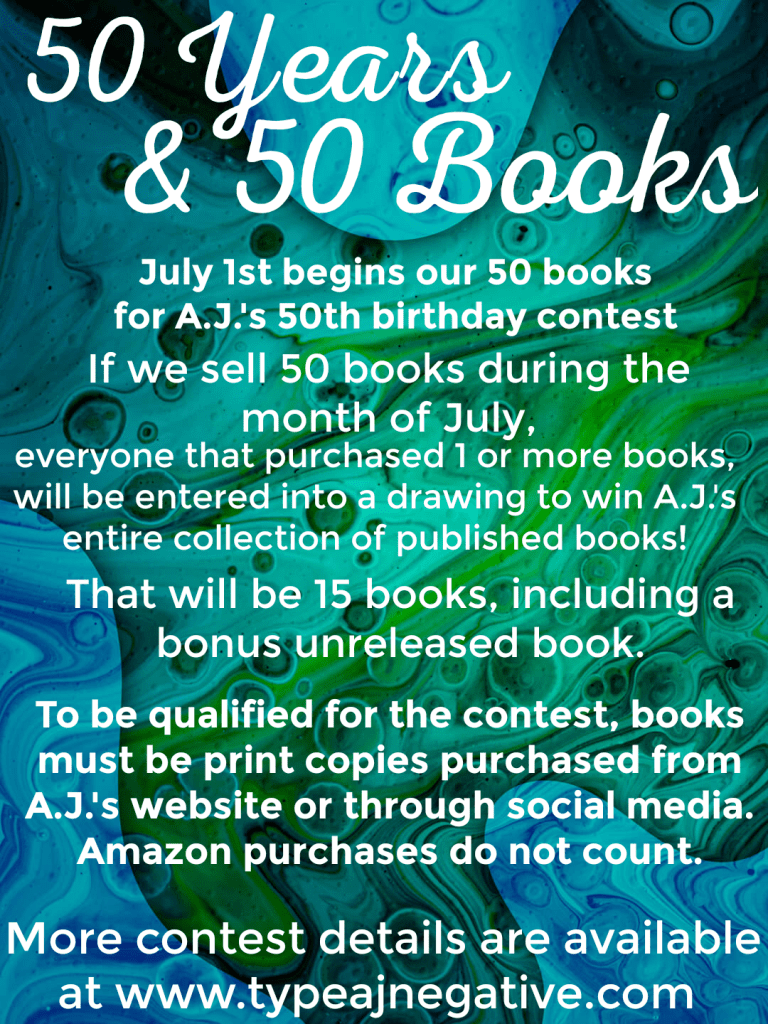
July is my birthday month. Normally, I’m not big on birthdays. To me, they are just another number. This one is different. I turn 50 on July 8th. That is a big deal birthday. I want to celebrate this one. And I will. All. Month. Long.

I want you, my readers, to come celebrate as well. To do that, we are having two contests during the month of July. They are big contests.

The first one is called 50 Years & 50 Books. Here is how it works:

If we sell 50 print books in the month of July, then we will give away a complete set of my print books to one person. That is 15 books, including a bonus book that has not been released yet, that is slated to come out in August. That is a $157.00 value. The books will be signed, but not personalized. The reason for this is if you purchase a print book, even if you only have that one, you will get another one in the complete set. If you want to give that book away, then I want you to be able to do so without having your name inscribed in it.

Now, here is the important stuff: 1) The books have to be purchased directly through myself or Cate, either on our social media pages or through my website. AMAZON PURCHASES DO NOT COUNT. Please understand that last sentence. If you purchase a print book through Amazon, thank you, but it will not count toward this contest. 2) I hate doing this, but I can’t ship a big box of books internationally. It sucks. I wish I could afford to. That means I can only ship within the United States. I apologize to my international friends and fans. I just can’t afford to do that. 3) 49 books is not 50. 28 books is not 50. The goal is 50, in honor of the age I will turn this month. If we don’t reach 50 or higher, then there is no drawing for the complete set of print books. That sounds pretty crappy, but it really isn’t. The contest is 50 Years and 50 Books. 4) All book orders will be sent out in mid-August, AFTER the contest is over. This will allow us time to package and mail out the books.

I hope this sounds good to y’all and I hope we sell enough books to be able to send out a full set to one person.

The second contest doesn’t cost any money (unless you want to spend some, then by all means, spend away). It is called. 50 Years & 50 Reviews.

If we receive 50 book reviews in the month of July, then we will give away one complete set of my digital books. That’s 15 books, including one yet to be released. 

Now, here is the important information: 1) Book reviews need to be sent to me or Cate, either on our social media pages or through PM’s or through my website, Type AJ Negative. We would also like you to post the review on your social media page (or blog if you have one). AMAZON REVIEWS DO NOT COUNT. If you place a review on Amazon, thank you, but it doesn’t go toward the contest. 2) Book reviews must be new. They cannot be reviews already left somewhere else. 3) Book reviews can be of any of my books. 4) Like with the 50 Years & 50 Books contest, the goal is 50 reviews here. Not 49. If we don’t reach the goal of 50 reviews, there is no drawing. 

You can leave reviews at the following places (as well as your personal social media pages, websites and blogs):

My author page:

https://www.facebook.com/typeajnegative/

The 50 Years Contests Page:

https://typeajnegative.com/50-years-contests/

Or by sending me or Cate a PM through our various social media pages.

I realize I did not post Cate’s information here. Those who know my wife also know her social media pages and they are set to private, so I will not be adding it here. Those who know Cate, please feel free to contact her directly.

There you have it: two great contests in honor of my birthday. I don’t do these things too often, so I hope you will participate. 

As always, until we meet again my friends, be kind to one another.

A.J.

Reflections On the Year Gone By Part 3

If you missed Part 1, you can read it HERE. 

If you missed Part 2, you can read it HERE. 

In January, a review appeared on Amazon for my book, The Forgetful Man’s Disease. The individual who posted the review was a man named Draven Ames. I knew Draven from our mutual dealings with Stitched Smile Publications. He was new to the family that is SSP. We developed a friendship and cultivated it through social media, emails and private messages. He left this review for The Forgetful Man’s Disease:

“Just finished The Forgetful Man’s Disease, a novella by AJ Brown. This isn’t the first story by him that I have read. Each time I read his work, the voice of his characters grab me. This story is about a man who is in the later stages of Alzheimer’s, reliving his past as ghosts torment him. It is a story about love and loss, about grief and sadness, but, most of all, about letting go.

There were twists and turns, sure, but the real power of the story comes in the very real characters AJ Brown brings to life, the emotional journey we go through as we watch a man struggle with confusion and the loss of his memories. At the end of the novella, AJ Brown talks about how this town is based off a SC town he lived in, and the realism is easily seen in his writing.

I’m very happy I picked up this novella and read it. Will be sharing this one with my wife.

As a side note, the love between the MC and his wife was very beautiful and touching. 5/5.”

Fast forward to the first week of April. I’m on vacation and sitting at a local restaurant and pub with Cate. My favorite local band, Prettier Than Matt, is playing. It’s a Wednesday evening. I’ve had my cell phone for maybe a month and it was still new to me. It buzzes and makes its little text message sound. Not really thinking much of it, I don’t look at the phone. I’m on a date with Cate and watching PTM. The text can wait. Then the phone buzzes and dings again. And again. And again.

“You might want to check that,” Cate said.

I picked up the phone. As I did so, it buzzed and dinged again. I clicked on the message and stopped breathing. 

“What’s wrong?” Cate asked. I turned the phone toward her, too stunned to speak. The message simply said, Draven’s gone.

Most of you who read that line just now understood that didn’t mean he got up and walked out of the room and out of the house and rode off into the sunset. You understood immediately that Draven, my friend and fellow author, had died. I knew Draven struggled with PTSD and depression, but all of my interactions leading up to his death gave me no indication he was struggling. The night before I had spent three hours chatting with him about his novel and working on ways to make it better. We had planned to chat again that weekend to look at some issues within the story he was working on. We said our goodbyes and that was the last time I interacted with him. 

Draven’s death reminded me (and in return, I now remind you) that life is fleeting. There are many people out there dealing with things. We may not know what they are or how serious they are, but they are there. And sometimes those things become overwhelming and there is no light at the end of the tunnel, or so it is perceived. The only option for some—really, many—is to take their own life, just as my friend had. I think about his death often, and wonder if there was anything I could have done to help him.

I want to leave this section with the national crisis hotline: 1-800-273-8255. This line is answered 24 hours a day, 7 days a week. If you feel like there is no hope and no way out, please call this number. You are not alone, even if it feels like you are.

***

Before Draven passed away, he mentioned The Forgetful Man’s Disease to a Twitter follower of his. The day after his passing, I noticed a post on Twitter that I was tagged in. I clicked on the notification and read the tweet. It said something to the effect of: In honor of Draven Ames, I am going to read The Forgetful Man’s Disease by @ajbrown36. 

I remember sitting outside a little restaurant in downtown Columbia called Michael’s, Cate sitting across from me and Prettier Than Matt was about to play again, when I read the tweet. Even in death, Draven had done something nice for someone. What does that tell you about his character? Yeah. He was a great person. 

I contacted the individual and we talked quite a bit over the next few days to weeks. His name is George Ranson and we struck up a solid connection from the very start. I talk to him from time to time through Twitter and I follow his goings on in the Twitterverse. He’s a truly good guy and a voracious reader. 

George let me know he was finished with The Forgetful Man’s Disease and he wrote a review for it:

“If you enjoy intelligent, well-written horror stories filled with rich, complex characters then A.J. Brown is the author for you. And The Forgetful Man’s Disease is a perfect introduction to this extremely talented writer. This novella is a short enough to be read in a couple of sittings but packs the punch of a full-length novel & will leave you thinking about what you’ve read long after you’ve finished reading it.

The story centers around Homer Grigsby, an elderly widower who’s final days are fast approaching. As Homer deals with the frustrations common with advanced age, most notably his increasingly untrustworthy memory, he is also continually confronted by things that are decidedly less common: the ghosts of long dead friends, neighbors & loved ones. The story unfolds in frequent transitions between two points in time, the nightmare-like present and a period from decades earlier during which a tragic event would have a painful and enduring effect upon Homer’s life. These shifts in time are done seamlessly and add to a sense of foreboding that builds continually from the first page to the last. The story is beautifully written with a conclusion that is as emotional as it is stunning.

The brilliance in A.J.’s writing is in the way he effortlessly blends the inhuman aspects of horror that readers of the genre crave (the spirits of the dead in this case) and the simple human emotion that readers of ANY genre crave.

In a nutshell…If you’re a fan of horror or simply a fan of beautifully told stories you will LOVE The Forgetful Man’s Disease.”

HORROR WITH HEART BLACK LOGO FINALThat’s a cool review, but it was what he said in a conversation that described my writing in a way I never could. George called it horror with heart. Horror. With. Heart. I thought about that a lot, discussed it with Cate and then asked George if I could use his words as my new hashtag for social media. With his blessing #horrorwithheart was born.

But what exactly is horror with heart? I will answer it like this: 

In today’s world, horror is all about shock and blood and guts. No one is trying to tug on the readers’ (or viewers’) heartstrings. The goal to Horror With Heart is to touch you emotionally, to make you feel something besides disgust. I want you to hurt when my characters hurt. I want you to be in love when my characters are in love. I want to shatter you when I shatter my characters. It’s all about feelings instead of shock and gore.

My thanks goes to Draven for sharing one of my books with someone in his social media circle. It also goes to George for the encouragement and the kind words and, of course, the hashtag. 

***

I might do something drastic in 2019. No, not might, but will. My relationship with the behemoth, Amazon, is on shaky ground. She is not a nice companion and she certainly isn’t a good business partner. She reminds me of Ebenezer Scrooge before he gets visited by all the ghosts of Christmases gone wrong. 

Over the last year I’ve seen nearly thirty reviews, most of which were verified purchases, removed from my books. When I realized this was happening, I went to Amazon and copied all of the reviews remaining and posted them on my website. I also contacted them and didn’t receive a satisfactory reason as to why the reviews were pulled. 

I’ve also had quite a few issues since Amazon decided that print books needed to go through KDP instead of Createspace. One of those issues is how long it takes to get books from Amazon and that they take the print cost of the books out of the author’s royalties. 

amazonThere are other issues with Amazon that I won’t go into here. At the end of the day, I’m tired of dealing with them and their lousy customer service. If I can work it out—and I’ve been researching this—I will sell all of my self-published books directly from my website. I wanted to pull all the books from Amazon. I didn’t want them to have any of my books, but as it was pointed out to me by another author, many readers equate Amazon with a writer’s credibility. Essentially, if your books are on Amazon, readers take you more seriously.

With that in mind, I posed this question on my Facebook page and in a Facebook group: Do you purchase books on Amazon? If so, how often?

Every person who responded purchases books off of Amazon (mostly digital). Every. Single. Person. And most of those folks purchase their books from Amazon only. 

Sigh. Instead of pulling all of my books from Amazon, I am going to leave them on the site, but I am also going to put them on my website (yes, both digital and print). I honestly didn’t want to stay with Amazon. It’s like being in a bad relationship and sticking around because you have nothing better in store. But she is a necessary evil. 

For the record, I’m not taking on Amazon. They are a juggernaut who can do whatever they want. I’m just tired of them changing the rules every year or so, but still making a crap load of money off of the authors. I’ve always been one to do things my way, so I guess this will be another step in that direction with my writing. If what I’m planning to do works, I will spread the news everywhere I can. Stay tuned and let’s see what happens.

***

I’m also making a change to Type AJ Negative. In March or early April, I will convert my blog into a full blown website. I will stick with WordPress because I enjoy the user friendly controls and I’ve never had a bad experience with their customer service.

Don’t worry. The blog will remain, but it will get a massive upgrade and I will add a lot of things to it that are not on there now, like BUY buttons, videos, pictures, schedule of events, new short stories, all of the book reviews, maybe even a facelift in its appearance as well. Like converting the book files to digital and reformatting for print files, setting up the website will take time, but I’m determined to give you all a better landing page and make it easier to find my work. I also want to get back to more of the humorous posts I used to put on here. I hope you will like it and come back on a regular basis.

***

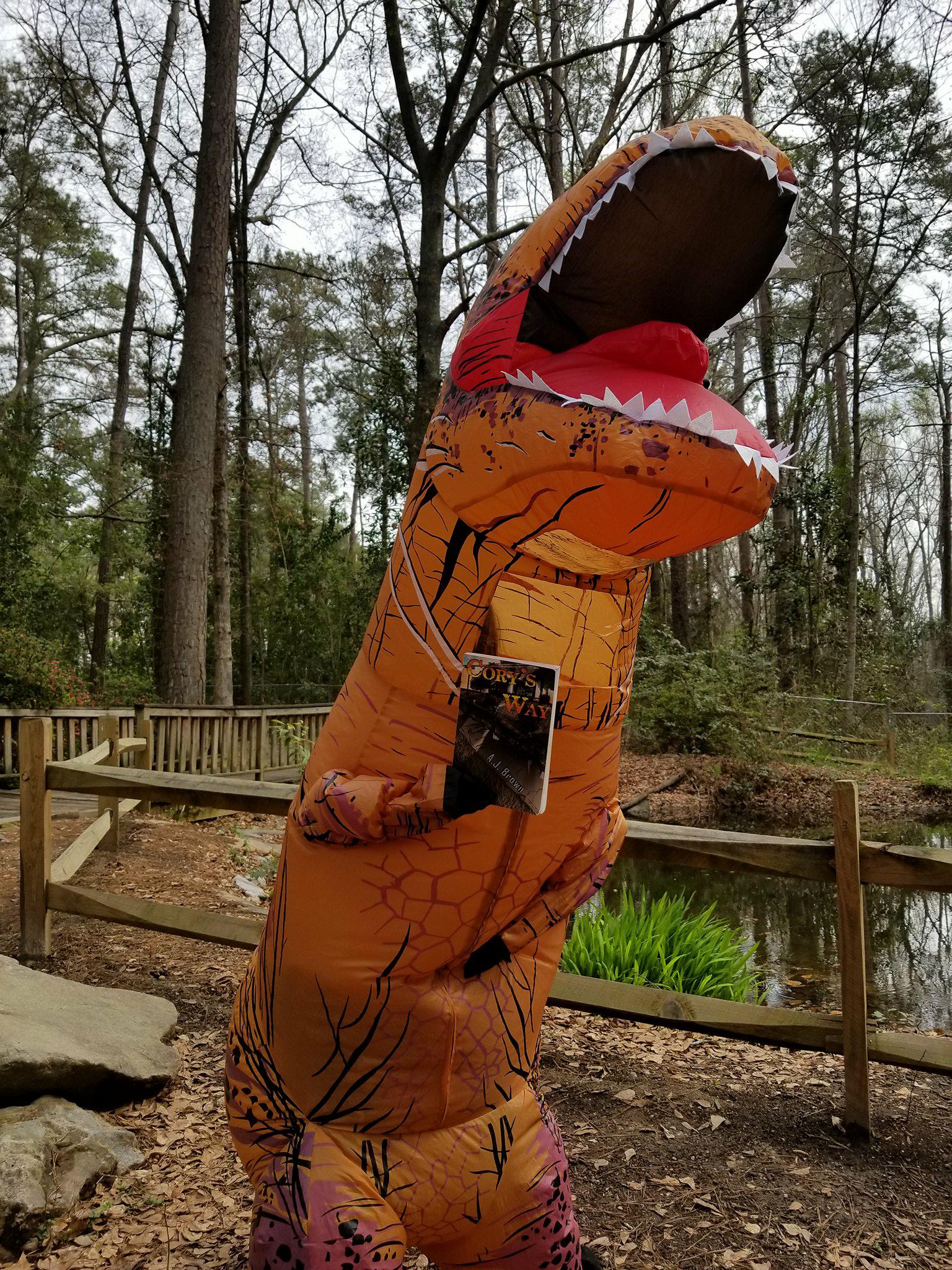
I met a dinosaur at the park at the beginning of the year. I got her to take a picture with one of my books.

Dinosaur

***

I leave 2018 behind with this thought.

You can be passive and watch life pass you by. Or you can be aggressive and go after life and live it. 

Yesterday I was ten and learning how to play baseball for the first time with my dad throwing Nolan Ryan fastballs to me. Twenty hours ago I was seventeen and walking across the stage during graduation from high school. fifteen hours ago I was twenty-seven and getting married. twelve hours ago I was in the delivery room with Cate as she gave birth to The Girl. Ten hours ago, I was in another delivery room as Cate gave birth to The Boy. Five hours ago I turned forty. Three hours from now, I’ll be fifty …

Do you see what I am getting at. Time waits for no one. You have to live your life or you will wonder what happened to it when you get older. Then you will wish you had done more. Don’t wish. Go live. 

Until we meet again, my friends, be kind to one another.

A.J.

The Obligation of Words (and the Symbolism of Typewriters)

So often I feel like writing is a waste of time for me. I do it every day, sometimes very late at night when I can’t sleep or early in the morning when everyone is still in bed. Most days when I sit to write, it feels like an obligation, like something I am required to do—like homework when I was in school. To who am I obligated? To the readers? To the fictional voices in my head who love my work? To the characters, themselves, who wish to have their stories told? To myself?

Maybe it is none of those things. Maybe I am obligated to the words, or to nothing at all. Still, writing often feels like an obligation for me. And I don’t know why.
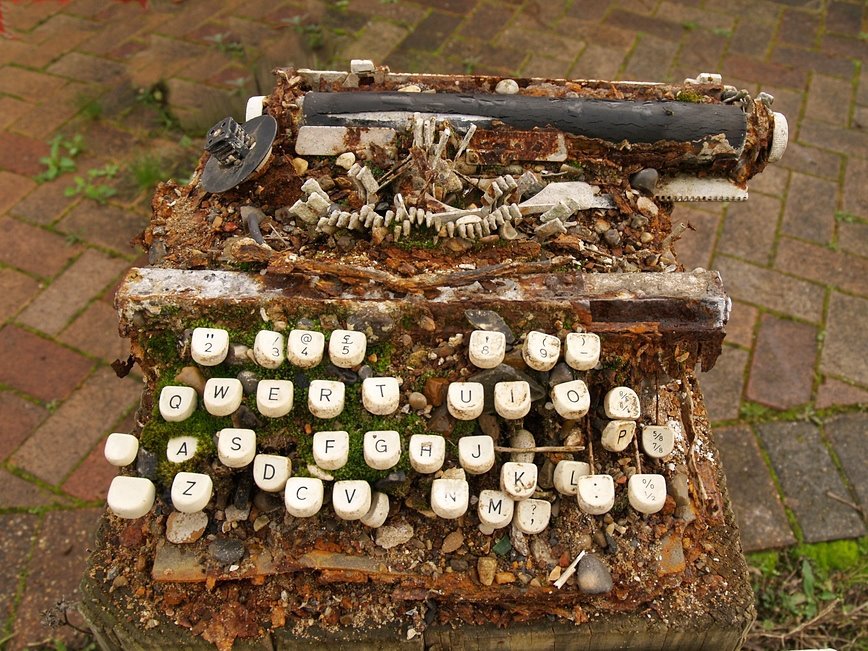
392550_412747505422764_855367895_nWith that obligation comes the feeling that I am an ancient typewriter, one that is missing all the vowel keys, and with every word I type, I have to go in and hand write in all the missing A’s, E’s, I’s, O’s, and U’s (and sometimes Y’s—let’s not forget the Y’s). The feeling is the keys are sticking and each time the type bar goes up, it does so slower than it should and it strikes the platen weakly, leaving only a faint gray letter on the paper.

It is during those times that writing can be a struggle. The words don’t come out right. The sentences sound off or awkward or just plain weird. That is when the same word gets used over and over and when an hour can pass with only 32 words having been written—do the math, that is one word for almost every two minutes. Though it is a struggle, I continue to write on. After all, bad writing is better than no writing (because, you know, at least I’m writing).

Yes, that is the obligation speaking. Any writing is better than no writing, even if the words I pen are mere shadows of stories I’ve written in the past.

Still, I don’t know what the obligation is or where it came from or why I feel so strongly about it.

Here is a truth as I know it: If I’m not writing, I feel like I am wasting my time. It is a damned if I do, damned if I don’t situation. Again, that obligation to put words to paper or on the screen comes heavily into play. It’s a constant battle of what I should be doing other than writing, and what I should be writing. Here is an example to illustrate things a little better:

I have several books written, but they need to be edited. Editing is not writing. It is part of the process of putting a book out, but it is not the actual act of writing. It needs to be done, but when I am editing, the voices in my head are yelling at me, YOU SHOULD BE WRITING! Unfortunately for me, when the voices start bickering, I can’t cover my ears and walk away. It’s impossible to get away from yourself and what is in your head.

But then when I am writing, some of the other voices (and in many cases, the same ones who bickered at me for not writing) yell, YOU SHOULD BE EDITING THIS STORY! IT’S NOT GOING TO EDIT ITSELF!

AHHHHHHHH!!!!

You see, I can’t win at this, but there is this obligation, this overwhelming feeling that I need to write. And maybe that is the problem. The need to write is so strong, it is almost an obsession. Or maybe it is an obsession.

I’m ripe with things to say. 

The words rot and fall away.

—Blink 182

Stay Together for the Kids

rusty-typewriterThose are powerful lyrics to a powerful song. Those lyrics, quite often, are how I feel when I wake in the morning or before I go to bed. I have all these words spinning around up in my head. They are alive and hungry and waiting for me to send them out through my fingertips. If I don’t write them down they will die and decay and be lost to me forever. It’s like losing thousands of friends a day. Most of them might not be all that close and might just be acquaintances, but some of them … some of them are like extensions of my family, parts of me that I love and cherish and … dammit, I don’t want to lose them all!

At this point it is easy to say, ‘hey, you’re losing it, bro.’ Maybe so. It’s also easy to say, ‘you are your obligation.’ Again, maybe so. Probably so.

I honestly think the obligation is tied to fear. Fear is a horrible feeling. Fear of losing a loved one, a job or getting hurt by someone or killed or whatever. Maybe your fear is of picking up kitty cats. Hey, it could be a real thing. Don’t judge! The fear is something so simple, so easy to see and dismiss, but so real: what if I take a break from writing—a week, two tops—and when I return to it, I won’t be able to write?

Sounds crazy, I know, but I think that is the problem I have when it comes to writing. I have tried to take breaks from time to time. The longest such break in the last couple of years has been four days. At the end of that four days, I had the hardest time sitting down and putting two words together, much less two hundred or two thousand. My fingers itched to put anything on the screen. When that didn’t work, I pulled out a notepad and pen and dated the top of the page (as I always do), but nothing came out. Nothing came out.

I forced myself to write on a story I knew I would never finish, but I still wrote some words—all of about three hundred of them. They sucked. We’re talking being stuck in a sewage drain up to your chest and you just dropped your phone and you need to retrieve it in order to save yourself suckage. It took another three days before I felt really comfortable with the words I wrote. That was after just four days of not writing.

I thought my head would explode from the frustration. Obligation fueled by fear.

But there is another fear that goes with it. It is something I was concerned with when I stopped putting The Brown Bags out in print form: if readers don’t see my words, they lose interest in me. If I don’t market, readers lose interest in me. If I am not constantly out there, readers lose interest in me. It’s just reality. Out of sight, out of mind. Obligation is still there.

Then there is this happy little contradiction: sometimes my mind screams in all of its many voices, WHAT ARE YOU WRITING FOR WHEN NO ONE IS READING YOUR WORDS? 

Okay, I may be able to count on both hands and maybe one of someone else’s hands, how many fans I really have out there, but there are still folks reading my words. It is hard to know who the fans are or if folks are reading your work. I can honestly say that these (non-writer) folks follow my work regularly: Joan Macleod and Mary Cooper and Frank Knox and Greg Crump. I didn’t count my wife in there, but with her and possibly my brother-in-law, Stephen, that puts my straight up, legit fan base at six people. (If you are a straight up, legit fan and I am not aware of this, drop me a note in the comments, just don’t throw a brick at my head. The brick will break and I will not get the hint.)

But what if I never had work published? Would I still feel this way? Would I still feel the obligation to write. I think so, but maybe it would be directed somewhere else. When I was a kid I had a need to constantly play or practice at basketball. As I got older, I began to draw and I had the need to constantly put a pencil to paper. But that was different. I didn’t feel I absolutely had to do those things. I didn’t feel that if I didn’t shoot five hundred free throws in a day I would forget how to do it, or if I didn’t draw a picture every day I would forget how to. I didn’t feel obligated to do it. And when I thought about quitting those things, they didn’t scare me.

With the exception of the last paragraph, I feel a lot of writers—probably far more than will admit—have the same issues. They have that obligation.  They have that need to write, that fear of not only not being able to write, but of failure, driving them to do so every day. They have a desire to be read, to know they are being read, and to know that  what they are writing is reaching people. They stress over writing time and having enough work out there. They stress over editing and marketing and putting themselves out there. Many of them also feel it is a waste of time, and quite a few of those folks quit all together.

Writers rarely reach superstar celebrity status like rock stars or movie stars do. Sure, we have Stephen King and James Patterson and J.K. Rowling, but the majority of writers (and I’m talking a fictional percentage such as 98%) don’t ever reach half of that climb to the top of Mt. Success.

Wouldn’t it be awesome if writers were treated like rock stars when it comes to our fan base? We could release a single (short story) and then another later on, and by George, if you like them, go get the entire collection at your favorite brick and mortar store or online. You could tell your friends how awesome the writer is that you are reading. I find this interesting: we listen to songs over and over, trying to learn all the lyrics (including those pesky background lyrics that are so hard to decipher sometimes) and we try to learn how to sing them and even play them, again, over and over. But when it comes to a story, we read it once and put it down. ‘I know how the story is going to end now.’ Yes, this is true, but don’t we know how the song is going to end, too?

I apologize for going slightly off the beaten path here. The point to that last part is writers don’t often reach very high heights. That can be frustrating, as well.

Musicwriter June 5 2014 031Still, there is obligation. As real or in our heads as it may be, writers, authors, storytellers, struggle with this obligation. Whether it is to the readers or themselves or some other weird issue, it is there. It is immense pressure, especially when the writers don’t know anyone is reading their words, when they feel like a rundown typewriter in a field, the letters of each type bar fading, fading, faded.

I know only a handful of people will read this, and I’m okay with that. But for you handful, this is what you can do: turn your favorite authors into rock stars. Talk about them the way you would your favorite television show or actor/actress or band. Buy their books, but don’t stop there. Actually read them. Still, don’t stop there. Leave a book review on Amazon or on a blog or Goodreads (or all of them). Look them up, contact them and say, ‘hey, you did good.’ Find them on social media and follow them (but not in that stalkerish kind of way). Tell your friends about them with the same enthusiasm you have about Grey’s Anatomy, The Walking Dead, or Game of Thrones. And, no, that is not an obligation you have.

Now, to close this longer than usual post. For me, the obligation comes, not only from fear, but from chasing a dream. I’ve been chasing the rabbit down the hole of words for a lot longer than I realized until recently (I started writing in 1993). That’s a long time to see only a tiny bit of that dream become reality. Still, I’m obligated, and that rabbit hole seems to be getting smaller while the obligation seems to be getting larger.

Do you want to know why the typewriter is so beat up now? The typewriter is really symbolic. It is our hearts and our souls and our struggles. It is our doubts and confidence, our dreams and our reality, and they aren’t meant to go through rabbit holes.

Until we meet again, my friends, be kind to one another.

A.J.

ASOM Gets a Cool Review

Normally, I don’t place reviews as posts on Type AJ Negative, but this one totally made my day. This is from DSJM Reviews and appears on Goodreads. I was totally blown away when I read it. It is humbling to have someone say this about my work.

Inside our minds there is darkness that sometimes forces a reality to those who think it might exist, bringing you into the world of being mad- full force with illusion; therefore, causing the state of mind to become unstable. Meaning numbness, deception, paranoia, just a cocktail of madness that is somewhere in between chaos and having a dream. The boundaries of going mad is a well thought process, quite genius if I may add. Scientists and doctors will say that madness or becoming psychotic happens in many different ways though I am only going to list a couple: abuse during child life, triggers (meaning something touched that right nerve mixed with emotional problems) cross-bred with other abusive like natures which creates the perfect recipe for chaos. It enriches the lucidity of dreams in an atmospheric way, manipulating them into your worst nightmares. Some may say it is only a nightmare but what if those dreams or nightmares become your reality in the depths of your brain, statically charging the mayhem within?

A.J Brown brings us not just one incredible short story but three amazing, bizarre, and mind altering stories- perfect in my thoughts. Every once in awhile you hear voices in your head, as you turn the pages with frigid, clammy hands and spine chilling nerves causing you to react irrationally. While you go on with word by word, they soak into you as it trickles through your processors in your mind. Slowly succumbing to the insanity within it officially makes your mind alternate between paranoia and its normal stance. In my opinion, Brown- who is the master mind behind this madness- is powerful in his words and builds the ultimate character strength with a vivid and lucid imagination of slowly making you feel like you are becoming psychotic and paranoid, that the insanity is slowly overtaking your reality.

A.J. Brown is an excellent story teller, his ability to think like this is honestly just quite maddening. I rejoice to have the chance to read this fantastic and amazing soul tearing tales that almost make you want to shake your head at the realism and connection you feel for each character. A Stitch of Madness reminds me of Stephen King, the articulate detail bringing forth to your mind that makes you question is this reality or not, that alone brings you into A.J. Brown’s personal nightmares. Anyone who would spend a little time and read this will forever become a fan of A.J. Brown. I look forward to reading more from Brown, perhaps seeing more- and longer- novels in the future. Thank you for creating a few more nightmares in my mind for sleep at night.

And now for the shameless plug: if you haven’t read A Stitch of Madness and you would like to, please go to Amazon and check it out. If you have read ASOM, I thank you, and also ask would you mind doing a review? I totally appreciate it.

Until we meet again my friends, be kind to one another.

A.J.
Dog Pile on the Rabbit


There’s an old cartoon starring Bugs Bunny called, ‘A Hare Grows in Manhattan.’  If you’ve never seen a Bugs Bunny cartoon, then you are probably significantly younger than me or were very sheltered as a child.  I am going to lean toward younger than me.  Either way, you need to look him up.

In this particular cartoon, Bugs tells a story of his younger days and how he got cornered by a bunch of dogs.  Early in the cartoon the dogs decide they want to bully Bugs.  They play a game called ‘Dog Pile on the Rabbit.’  The activity is just as it sounds: the dogs pile on the rabbit in an attempt to hurt him.

Can you see that?  Can you see Bugs in his nice little blue blazer (he had a hat, as well) being pounded on by one, two, three, four, five, six, seven dogs, all of them wearing heavy sweaters and derbies? All of them on top of him, trying to crush him under their weight?

Do you have that image?  It’s kind of mean, isn’t it?  It’s the typical bully mentality: see someone you believe is weaker than you and push them around.  If that’s not bad enough, have all your buddies push them around, as well.

Dog.  Pile.  On.  The.  Rabbit.

This morning I was perusing Facebook just before heading to work.  I came across a post in a group I was a member of.  I use the word WAS on purpose here.  This group was a book review group.  As a writer, these are the types of groups I like.  At some point last night someone took exception to another person asking them to review the individual’s book.  From what I gather, based on the person’s post, the person downloaded the samples of two books and…

…went off on the requesting individual.  When I say ‘went off’ I’m talking ballistic here.  The individual asked for an honest review of his self-published book.  Apparently, the reviewer decided to give an honest review, but also post it to Facebook because…because…honestly, I don’t know why.  Maybe the reviewer was a little pissed off because of the quality of the writing.  Fine.  If you’re mad about that, then tell the requestor, don’t tell the rest of the world.

I’m not going to mention the reviewer’s name, but here are a few little tidbits from the post in the group on Facebook.  Are you ready for this?  Here goes:

You reek of amateurism.  (That’s not too bad, right?  There’s a chance the reviewer is right.)

You’re a deluded narcissist… (Not very nice.  Name calling.)

Either way, you will never get read by anyone who matters.  (EVERY reader MATTERS.  Every single one of them.)

You’re an embarrassment who deserves to fail.  (WTH?  Really?  Deserves to fail?)

Okay, I have to stop here.  A lot of the comments made in this post bothered me, but this one lingered on my mind long after I read this.  No one deserves to fail.  No one.  I don’t care how bad the book (oh, wait, I mean, the sample of the book) was, but to say someone deserves to fail is totally wrong.  The person did something many others didn’t do: he tried.

Let me throw out a thought:  What if this person, the requestor who wrote the book that reeks of amateurism, is a special needs person?  What if this is the best he could do, based on being a special needs person?  What if this is someone who always wanted to try to write, but never did because he thought people would laugh at him.  Or worse yet, bash him?  What if this is a person who lacked the confidence to try anything like this?  And what if this person worried and struggled to even ask anyone to read it?  We don’t know these things, but what if?  Just throwing it out there.

How dare you think you’re good enough?  What dues have you paid?  What makes you think for one minute you deserve to be called a writer…?  (Ummm…Stephanie Meyers anyone?  My point?  She’s not the greatest writer, but millions have bought her books and millions have watched her movies.  Why?  Because she connected with the readers.  No, she’s not that great at it, but she succeeded where most of us want to, and the fact that she didn’t give up is what made her a writer, at least for a while.  Was she good enough?  What dues did she pay?  Does it matter to the millions who love Twilight?  I doubt it.)

There was a lot more, but most of it was general mouth running, though I still think it was aimed at the individual.

Here’s the problem with this whole post: this is NOT how you review someone’s book.  If you think someone wasted your time, fine.  If you think someone can’t write, fine.  If you think that the book should be burned in a ceremony in a temple, fine.  But—BUT!—you don’t attack the individual.  The moment you attack the individual you have lost all credibility.  You have become a bully.

There are tactful ways to leave negative reviews, be it privately or publicly.  This…this is not the way to do it.  Zero encouragement.  Zero positivity.  Don’t say that sometimes you can’t say something good about something or someone.  That’s a lie.  If you can’t, then you don’t want to.

This was mean-spirited.  This was hurtful, and I feel bad for the person it was directed at.  It’s public shaming, even if the reviewer didn’t post the requestor’s name or title of the book.  I’m certain that individual saw it.  I wonder how crushed he may have felt after reading it.

But wait.  Remember the first few paragraphs about Bugs Bunny?  Did you see the title of this piece?  That’s right.  Dog Pile on the Rabbit.

The public humiliation was one thing, but the comments that followed were worse.  People piled it on, echoing the reviewer’s thoughts and words (even though they didn’t know who the writer was or read his book).  That individual who wrote a book or two was the rabbit and the reviewer was Butch, the leader of the dog gang, and all those that got in line and jumped on top were the other dogs piling it on.  Just piling it on.

Now, before you think I’m a sensitive, whiny individual, I’m not.  I’ve never read anything by the reviewer (who may or may not be a writer, as well.  I don’t know).  But, I do know he’s not Stephen King.  He’s not James Patterson.  He’s not Dean Koontz.  He’s not Clive Barker.  He’s not J.K. Rowling.  He’s not Dan Simmons.  He’s not even Stephanie Meyer.

I also know that he was wrong.  Period.  He was wrong.  I don’t care who you are, your efforts should never be bashed by anyone.  Yes, the person asked for an honest review, and yes, this is about as honest as one can get in expressing how bad the reviewer thought the book was.  But this was the wrong way to do it.

Maybe I wouldn’t have taken exception to it, if it hadn’t been made public for anyone in that group to read.  I wouldn’t have known about it, so I’m certain I wouldn’t be writing this now.  Maybe, if he had just kept it between himself and the writer…No.  Who am I kidding?  It’s still wrong.  There is this thing called tact.  I have, on more than a lot of occasions, been told I lack it.  However, I’ve never bashed anyone like this reviewer did to this individual.

But really, this isn’t just about the ranting review.  It’s about the public pile on.  Why do we, as people, do this?  Why don’t we stop and think, ‘hey, that could be me?’  Why don’t we, instead of bashing and jumping on the bandwagon, try and put ourselves in others’ shoes.  Maybe then we wouldn’t be so quick to pile on, to jump right into the fray, to judge.

I do have one question about this.  Would the reviewer, if standing face to face with the writer, still say the things he said?  Would he be a little more cautious?  Would he suddenly change his tune because, guess what, the person is right there in front of him?  I don’t know, but I can take a guess.

Let me tell you a little story.  Back when I first started writing, an editor sent me an e-mail asking me about a story I had written that had appeared on a website.  I sent him the story, excited that someone wanted my work.  Not long after, I received an e-mail back from him.  In that e-mail he ranted and blasted me, personally, and my writing—much like the reviewer did to the requestor.  I was told I should never write anything ever again.

That was very early in my writing ‘career.’  It could have been damaging.  At first, I was hurt and angry and I wanted to just wring the editor’s neck.  If he had been standing in front of me when he said those things, well, I just may have done that.  Instead, I chose to prove him wrong.  But most people aren’t going to do that.  Most people who get smacked like that give up.  That’s never a good thing.

So, people, before you pile on the rabbit, put yourself in the other person’s shoes.  Not just in the writing world, but in life.  Just remember, we don’t know what someone else is going through, or even anything about them.  This may be the best a person can do, based on circumstances.  You just never know.

Until we meet again, my friends, be kind to one another.


Where Did That Come From?

As a writer, I like when someone comments about one of my stories. I also like when I make someone wonder about me.

One day last week, a young lady that works for the same firm I do was getting on the elevator with her friend. I got on behind them. Normally (like there is really anything normal about anything I do anymore) I would joke around with them and tell some tale about elevator etiquette. Before I could do so, the young lady–we’ll call her V–said to me:

“Can I ask you a question?”

In my experience when a female ask that question, I am either a) in trouble or b) about to be in trouble.

“Sure. I may not have an answer, but I’ll try.”

She scrunched up her nose and her upper lip curled up on one side. It was a really good Rocky impersonation. “Where did that dark side come from?”

I knew what she was talking about, but I tried to play dumb, which for me isn’t that hard and it’s really not an act.

“What are you talking about?”

She shook her head. “Come on. The book.”

“Ohhhhhhh… yeah, I’ve always been like that.”

“Really?”

“Oh yeah. I’ve always liked the darker things.”

And that’s the thing: I work with people every day. Most of them have no clue I’m a writer. For the most part, I keep the two separated, simply because I write horror and a lot of people view horror writers as twisted, demented people who should be locked up in cages in someone’s basement. Oh wait. That’s not right, but they do think we’re twisted and demented–how else could we come up with the subjects we write about?

The answer to that last question is… ummm… real life gives us most of our subject matter, but that’s for another day.

The point is: most of the people I work with know me as a nice, helpful person (for the most part. Sometimes the niceness goes right out the window and I revert to my normal persona). So, when they read something I’ve written, it opens their eyes… or maybe it scares them a little. A few even view me differently now.

I’m okay with that.

V said, “I was reading and saying, oh… oh my…”

What V was referring to is my short story collection, Along the Splintered Path, three stories about splintered lives. She mentioned the second story in the book, ‘Round These Bones. She said it was disturbing.

There you go. I succeeded at my job. The story was intended to be disturbing and if I managed to make one person feel that way, then it was a job well done.

As writers, that’s what we want. We want to hear from people. We want to know that something we wrote did what it was supposed to do. We want to know that the readers enjoy the stories and we want to know when it made them cry or if it made them angry or sick to their stomach or even made them smile.

I’m happy with V’s feelings on the book. It did what it was meant to do.

If you would like to check out Along the Splintered Path, just go here.

I would love to hear your thoughts on it. Pick it up. Leave a review. Writers really do want to hear from the readers. It helps us figure out what we are doing right and it helps us to know what needs to be fixed.

If you pick up the book, maybe you’ll look like this person (her name is Gina and yes, this was used with permission) while you’re reading it.

Photobucket

I thank you, now, for reading, not only Along the Splintered Path, but also Type AJ Negative.

Read on and your thoughts are always welcome.

Until we meet again, my friends…

First, Do No Harm

Recently I was in a staff meeting at work. Those things are never really meetings—mostly we sit and listen to a speaker. You know how meetings can be when there are speakers. Sometimes you like them, sometimes you don’t. This last meeting was no different. I listened, not only because I was at work, but because every event in my life is a setting for a story, even if I’m not really into the subject.

Close to the end of the speaker’s speech, he said something that caught my attention. It’s the only thing I wrote down.

What did he say?

Simple: First, do no harm.

The rest of the meeting went by and I barely heard another word, because I was thinking about that statement. I think he went on to say something about not harming the workforce or causing harm to the way we do our jobs. I’m not sure. It doesn’t matter, really.

First, do no harm.

I started thinking about how that could be applied to the writing world. It could go a long way in our business.

Have you ever had someone say something about your writing about you in a review? Have you ever had someone say something negative about you in a review? Have you ever had an editor or publisher tell you to stop writing, it’s not your thing? Have you been rejected?

Hmmm…

You ever workshop a story with a group of folks and have them just tear your piece to shreds? I have a rule when it comes to workshopping: If I can’t say something positive to go with the negative, then I don’t comment at all. Some of you are saying, ‘oh, but how can someone learn if you don’t tell them what’s wrong with a manuscript?’ I didn’t say that. I said if I can’t say something positive to go with the negative, I don’t comment at all. That means I want to make sure and give the writer something good to hang their hat on, while also giving them constructive criticism in the process.

You see, all negatives and no positives can be discouraging for anyone, but in writing it can be brutal. Writers tend to think that if people don’t like their work, then as an extension, they don’t like them. It’s not true, but that is the way a lot of new writers think. Negatives can also be the difference between someone continuing the pursuit of a writing career or giving up. Ask any of the writers I’ve worked with over the last couple of years: I can be tough and sometimes an ass (gasps, am I aloud to say this on here). However, I like to give folks something to build on, give them a positive to feel good about. That way I’m not a complete ass. Just half of one.

It’s a building block. Negatives and positives get results. All negatives and all positives don’t–especially the all positives.

I’ve told this story before, but:

A few years ago, I had an editor tell me that I should quit writing. It wasn’t my thing. I was no good at it.

Do you see anything positive in those statements? Me neither.

Were those comments necessary? I don’t think so. I had just started writing and, for a short while, my ego was bruised. You see, the editor said nothing about the story, but about me—I took it as a personal attack. He didn’t say ‘hey kid, keep trying’ or ‘this could be better, maybe you could try this.’ No, he said I should quit writing. I was no good at it.

I was no good at it…

Wow. If I didn’t have a strong personality and good self esteem, that could have been detrimental. It could have led me to giving up. That editor did some harm.

After that short pity-party was over, I got angry and I said I was going to prove him wrong. He pissed me off. What a prick. How could he say those things? How could he crush someone’s dreams without so much as an ounce of compassion? He was my Simon Cowell.

What about book reviews? I see so many people complain about getting bad book reviews or one star reviews. When asked, most of them say that the reviewer didn’t understand or reviewed something they wouldn’t normally read. And?

Listen, as long as the reviews aren’t malicious, aren’t clearly from someone who didn’t read the book and aren’t personal attacks, there is no issue. We have to remember that each reader is different and each reader likes and dislikes different things. It doesn’t necessarily make it a bad review. It just wasn’t their thing. Granted, if someone likes romance and they read horror, there is a good chance they aren’t going to like it, so reviewing that story/work might not be fair for the writer. Unfortunately, that comes with the territory when you put yourself out there. However, when the reviewers attack the writers or assume something about the writers, that’s wrong it could be hurtful.

Remember, first, do no harm.

I read one review on Amazon the other day that said: The author of this book obviously has some very disturbing issues.

Really? Why? Just because someone writes something disturbing doesn’t mean there is something wrong with them.

Another review:

This book was good but not great. I hated the ending I had no idea what happened or what/who was after them. I didn’t like it very much.

It’s a good book, but you didn’t like it very much? Then wouldn’t that make it a bad book, in your opinion? The book received a one star and I have no issues with that, but with the way the review was done, it makes me question if the reader actually read the story.

A friend of mine told me that someone questioned his parenting abilities because he writes horror.

Really? Can we not separate the person from the fiction?

This is going to come off bad, but: People who are too narrow minded to separate the story from the writer cause more harm than good when they post reviews blasting, not the work, but the author.

I think it’s great when a person says to me, ‘where did this dark side of you come from?’ The truth is simple: it’s always been there, but I separate who I am as a writer from who I am as a person. Unless someone knows me well enough to be a friend, then they don’t know I’m a writer and they certainly don’t know that I write horror. I guess that’s why it comes as a shock to a lot of folks.

However, writers, don’t argue with the reviewers. It can make things much worse for you and can lead to a lot of other reviewers doing more harm than you can recover from. A couple of years ago a woman who had received a pretty good review didn’t like something the reviewer had said and instead of thanking him for the review, she blasted the person on his review site.

The reviewer politely explained his thoughts to her and she became irate–and yes, that is the right word–and cussed the reviewer out—no, that’s not an exaggeration. There were F-bombs galore in her rebuttal. Welllllll, the next thing you know this goes viral and what had originally been a book that had about seven reviews, all of which were decent and none of them below four stars, became a book that had about two hundred reviews and most of those reviews attacked the writer, as a person, because of how she responded to the reviewer.

In my opinion, the moment she cussed at the reviewer, she committed literary suicide. She may not have said, ‘hey y’all, come on and rip my story and me a new one,’ but she may as well have by her reactions. Does that make it right for all the people who clearly didn’t read the book to bash her? Not in my opinion.

Harm was done, by both the writer and the reviewers in that instance. Thankfully, those cases are few and far between.

Editors. This is the group of people that us writers try to impress the most. Sure, we want our work to get to the readers, but if editors don’t like our work, then there’s a good chance it’s not happening, at least not in the traditional publishing sense of things.

I’ve done my share of taking subs for publications and, writers, let me tell you, it’s tough. Sometimes you get so many good stories you have no choice but to let a few of them go. However, I rarely ever sent out a form rejection. I hate them. The only times I ever sent a form rejection was when I had nothing really positive to say about the story, but I always added the sentiment to keep working and don’t give up.

Most editors don’t do that. They are pushed for time. They have lives, after all. They are often forced to send form rejections. It’s part of the business. Most editors are truly gracious and appreciative that writers take the time to submit to them. Yet, there are a handful of them that took notes from the aforementioned Simon Cowell. If you don’t know who Simon Cowell is, watch the next video.

There are those editors out there who do this to writers. I say this: If that’s how they are, then so be it, but by doing this, by acting like Cowell, damage is done. Sure, maybe someone can’t write, maybe someone can’t tell a story, but that’s no reason to not encourage someone or offer them a little bit of advice on how to better themselves. And no, telling someone to quit because you’ll never be any good is not the advice I’m talking about.

I have a saying (yeah, I know, I have a bunch of those) that goes something like: There is a minimum standard of how you treat people. This includes the homeless and people you don’t like. You treat people no worse than how you wish to be treated. That can be applied to writing as well. There is a minimum standard of how we should treat our fellow writers. If you don’t want someone to be rude about your work, think before you bash someone else’s.

What we have to remember is that someone took the time to write a story, hopefully edited and cleaned it up and then sent it off. Someone is waiting on pins and needles for a response and hoping it’s favorable. A rejection is bad enough on its own so no need to add insult to injury.

Be honest, but be fair in your reviews.

And, writers, be gracious and thankful if someone buys your book, reads it and takes the time to offer a review. I just recently found out that we can leave comments to the reviewers over at Amazon. Currently, I’m going through them and thanking those who took the time to read and review my work. It means a lot to me and I appreciate it.

First, do no harm. Words to live by.

Until we meet again, my friends…

Matthew Tait’s Slander Hall and Other Notes

Fifteen years ago the affluent gated-community of Slander Hall was the setting of the largest mass suicide in U.S history, dozens of men and women committing the ultimate sacrifice and embracing the covenant of their leader to shed their bodies for a life in outer space. Now a modern ghost town, it boasts only the decaying and derelict phantoms of a withered populace. Cedar Jarrell, sole survivor of the holocaust that claimed so many, returns to the dark heart of Slander Hall on a final pilgrimage where not all who take the journey will survive…

What people are saying about Slander Hall

Dropping directly into the meat of the novella, Matthew Tait wastes no time bringing his readers completely up to speed within a few paragraphs… ‘Slander Hall’ has a cinematic feel to it; eagerly grasping the reader by the hand, it’s like watching an intense movie unfold.

Crafted like a cross between a classic ghost story and twist on Silent Hill, this haunting and well-written tale takes you to the edges of the madness in your own mind… Well-written and pacy, the story will haunt you for many days (or even weeks) after you read it.

… a great turn of phrase, a literary frolic and a grotesque elegance. Yes, despite the more artistic delivery in places, many splatter writers should sit up and take notice…

… stirs in some thoughtful social commentary on the subjects of suicide and doomsday cults, and serves up a tasty and satisfying dish….

About Matthew Tait

Matthew Tait was born in Australia in 1977. Like many writers he has held far too many jobs, including co-managing a video store. And although it seems a prerequisite for any writer, he’s played rhythm guitar in a few bands as well.

From 2005 until its closure in 2011, Matthew was an assistant editor for the award-winning Australian news and literary criticism zine, HORRORSCOPE. He currently writes for HELLNOTES.

The first story in his collection Ghosts In a Desert World was awarded a recommendation from the Australian Horror Writers Association.

Among his influences are Clive Barker, and the late, great Richard Laymon.

Tait’s new novel, Slander Hall, was published in January of 2012 by Dark Continents Publishing.

Excerpt From Slander Hall

Cedar felt cold. He had not expected developments this early in the game.

Sephera asked: ‘Are you people seeing this?’

Now fully within the glare of his torch, a humanoid figure walked implacably toward them. Then it stopped. It scrutinized the group through eyes that didn’t appear to be human, twin ovals that were slanted and black. It stood on skinny posterior legs that arched slightly, enough to give it a semblance of humanity. A bulbous head stood atop a naked torso and midriff with flesh the color of yellow cheese.

Time canted for the briefest of moments, as if the five of them were mere models encased in a paperweight scene and being shaken. The space between this creature and his little group could be no more than fifty meters, yet Cedar could feel from that meager distance a bubble of air as thick and palpable as fluid. Whatever this thing was, it had presence… a malignancy that started in its eyes and radiated through the tainted air.

He tried to speak, but found no speech forthcoming.

‘We should back away,’ Sephera whispered, saving him the trouble. ‘Something’s not right. Everybody move toward the right. That small lane that angles between the fence.’

Gordana let out a little whimper. ‘Something’s definitely not right. That thing isn’t even human.’

‘What is it?’ Philip said.

As if the creature had heard the question and felt the need to respond, it suddenly sprang into a lurching gait, fixing them with its huge eyes. Closing the already short distance, Cedar could see they were haunted – almost predatory. When it moved, its body made a writhing motion utterly out of proportion to its anatomy, and it was this more than anything that finally got them moving. With Cedar taking the lead, they began to back away by slow degrees toward the skinny lane. Philip was no longer transfixed; turning his back on the creature, he broke into a full-tilt run.

Want more?

Sure you do. You can pick up Slander Hall at Amazon: HERE

If you’d like to follow Matthew Tait, I’ve done the stalking for you:

Twitter: @MatthewStait
Blog: Different Masks
Facebook: Matthew Tate

Other Works

Ghosts In a Desert World

Photobucket