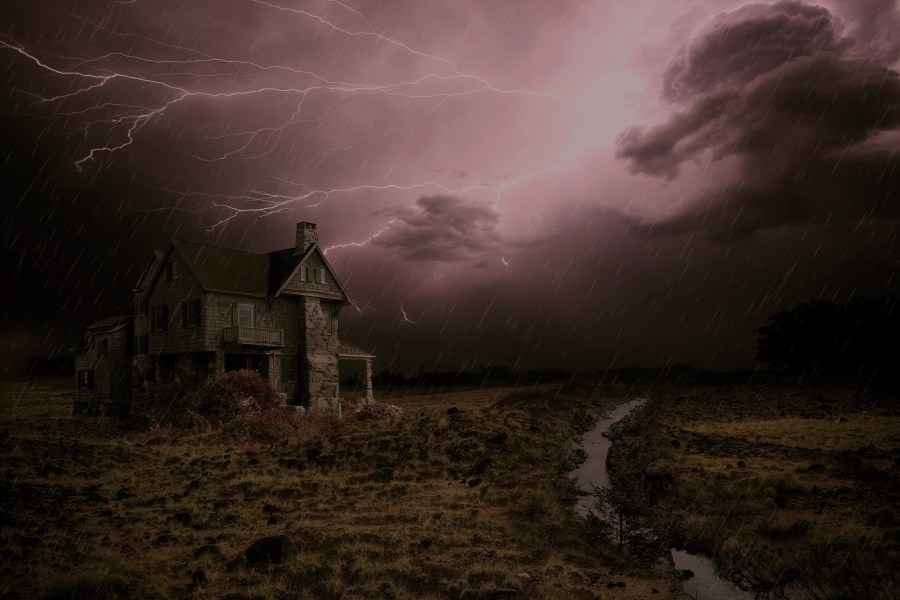
On A Small House
A.J. Brown
The storm rages outside.
Lightning flashes,
Thunder rolls,
Rain pelts down on the small house.
Trees bend with the wind.
With candles in each room
Their flames flickering high
Casting shadows of dancing people along the walls,
The child lies in bed.
He stares at the window
With blanket tucked beneath his chin.
He holds the stuffed doggie tight to his chest
And the lightning flashes,
The thunder rolls,
Rain pelts down on the small house.
Shadows flicker in the room,
The tree outlined by the streaks in the sky,
He shivers as a cold finger tickles his spine.
A fan on the dresser
Blows the curtains about
They sway away from the window and lay back into place.
He clutches the doggie and whispers,
“It will go away.”
The lightning flashes,
And the thunder rolls,
The rain pelts down on the small house.
His eyes catch blinding streaks in the night sky
Through the light blue curtains.
Tree branches stretch like fingers
Reaching for him,
Grasping for him.
And the doggie is held tighter.
His eyes grow wide as the curtain lifts upward.
And the lightning flashes,
The thunder rolls,
Rain pelts down on the small house.
He stares at the window
Two eyes stare back.
The child stifles a scream,
Or it catches in his throat.
He pulls the blanket over his nose
Hiding all but his eyes.
The fan flips off as the power dies
And the curtain lays flat against the window.
The lightning flashes,
The thunder rolls,
Rain pelts down on the small house.
A head appears behind the curtain,
On the other side of the window.
A shadow, that’s all,
Is what he tells himself.
Then comes the scratching.
Scritch, scritch,
Scratch, scratch,
The boy’s heart skips a beat,
Then another.
And he watches the window
Waiting for
The lighting to crash
And the thunder to roll,
As the rain pelts down on the small house.
A sound, like glass tinkling on the floor
Fills the room.
The curtain billows inward
In front of the broken window.
Cool air enters the room
And the rain becomes loud.
He hears the steady
Clink, clink, clink
Of raindrops on a piece of broken glass.
The lightning flashes,
The thunder rolls,
Rain pelts down on the small house.
A hand reaches in
Boney and pale,
Fingers like knifes with sharp pointy tips.
He pulls his legs to his chest
And he screams.
“Go away!”
The hand retracts
As the lightning flashes
The thunder rolls,
And rain pelts down on the small house.
Daddy comes into the room.
His savior arrives.
He picks the little boy up
Holds him in his arms,
“All is okay, little one.”
The boy looks at the window
As the light flashes across the sky
The head slinks into the darkness
And the lightning quells,
The thunder quiets,
And the rain slowly ceases
The boy lies back in bed,
Grabs the doggie and holds it tight.
Daddy leaves and the boy smiles
“I told you he would go away.”
And somewhere in the distance
The lightning flashes
The thunder rolls
And rain pelts down on a small house.
__________
Poems are a fun way to make you think of your word usage. Each poem has its own meter, whether it rhymes or not. Your choice of words is crucial to a smooth, lyrical poem. So often when I wrote poetry, I had the most difficult time actually making it smooth, making it sing. So, when I succeed, I am usually ecstatic.
This poem is about every child’s fear, both of storms and of the dark. I wanted to capture the raw emotion of a young boy on a dark and stormy night after his imagination has gotten the best of him. Was there a shadow lurking outside his window? Was there a hand reaching through broken glass to get him? Was there even a broken window, or was it all the boy’s imagination. I’ll never tell because, at the end of the day, the ending will always be left to interpretation.
I hope this poem didn’t bore you and that you enjoyed it. If you did, will you, please, like this post, comment on it and share it to your social media. I greatly appreciate it.
A.J.

Donate
If you’d like to donate a couple of bucks to a working author, it would be greatly appreciated.
$2.00


 Before I get into my blog, let me give you a brief history on Bill Walton. Stick with me for a paragraph here. Bill Walton played basketball for the UCLA Bruins in college, where he was on two national championship teams and was part of one of the greatest dynasties in all of sports. He then went on to play professionally for the Portland Trailblazers, San Diego Clippers and Boston Celtics. He was part of two NBA championship teams. He is currently a commentator of NBA games. Walton, in my opinion, sees the world differently than most people and his seemingly joyous outlook can sometimes be hilarious when he goes on one of his humorous rants.
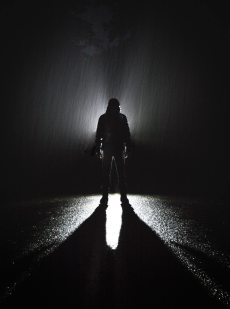
 First, the shadow as a noun. We’ve all seen objects casting long, gray or dark shadows in its wake, especially in the early morning as the sun rises or in the early evening as the sun sets. Trees, buildings, mountains … people casts shadows as the sun’s rays hits them, blocking those rays from reaching the ground. A lot of reference to shadows in fiction are negative. He hid in the shadows. What loomed in the shadows? It lurked in the shadows. All statements that imply dread or something sinister. A shadow in and of itself is not scary at all. It’s what could be in those shadows that terrifies people.
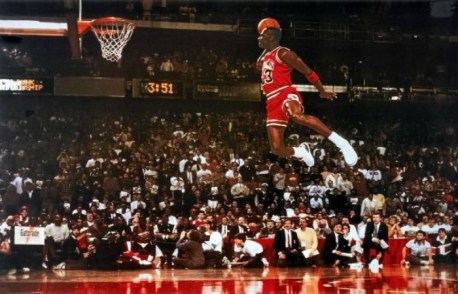 Michael Jordan did things in the eighties and nineties on a basketball court that no one else ever had. From that point on, every great player that came into the NBA was compared to him. I don’t know how many times I have heard, Is he the next Michal Jordan? Kobe Bryant came along and did things that Jordan didn’t do. Lebron James followed. Teams built their rosters around the notion of how do we get by Jordan’s Chicago Bulls or Bryant’s Los Angeles Lakers or any team James has played for. The standard of excellence keeps getting pushed higher and higher because there was a shadow of greatness left behind by someone who came before them. In order to cast a shadow, you have to do something. In order to be the greatest, you have to do something greater than the person before you.
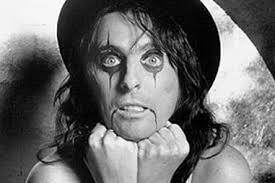 Artists, such as Black Sabbath, Alice Cooper and Kiss created music and songs that were different from the norm of their day. They either disturbed the listeners, disgusted them, or excited them. Either way, people noticed, people listened, people heard, people saw and people felt their impact. They casts shadows, no matter how large or small they may have been.
 Before reading today’s post, I want to tell you about our little project. In the coming months one character from each story in my collection, Voices, will be interviewed by Lisa Lee with
  His head jerks up. His eyes are wide. His bottom lip quivers. Lisa suddenly feels sorry for him, but she knows she can’t turn back now.
 Type AJ Negative